
Sequent Microsystems’ SM-I-006 Eight MOSFETS 8-Layer Stackable HAT provides eight MOSFET output channels per board. Stack up to eight boards on one Raspberry Pi for as many as 64 outputs. Sequent’s current product page specifies four channels rated up to 4 A at 240 VDC and four rated up to 12 A at 24 VDC; all eight support 1 kHz PWM. Those are manufacturer-published maximum ratings, not a guarantee that every load or installation is suitable.
What the Sequent SM-I-006 does
The SM-I-006 is a stackable output HAT that connects to a Raspberry Pi over I2C. Each card has eight open-drain MOSFET outputs, which switch loads powered by an external DC supply; the HAT is not the load’s power source. Sequent lists compatibility with Raspberry Pi models Zero through 5 and an RS485/MODBUS port. Its onboard processor handles PWM, and the product page describes a hardware watchdog and galvanic isolation between the high-voltage and high-current channel groups.

Sequent also lists command-line tools, a Python library, Node-RED nodes, CODESYS, OpenPLC, Home Assistant, and Arduino integration. These are manufacturer-listed integration options, rather than independent compatibility test results. See Sequent’s SM-I-006 product page for the product details and documentation.
Channel ratings and stack capacity
According to the current manufacturer listing for the SM-I-006, each card divides its eight outputs into two groups:
#1 Best Overall

- On board processor permits proportional load control using PWM at 1kHz
- RS485 port connected to the local processor permits operation as MODBUS RTU slave, replacing the Raspberry Pi with any PLC
- Heavy duty, 5mm pluggable connectors can control loads up to 12A
- High Current channels 24V/12A are galvanically separated from the High Voltage (2A/240V) channels
- TVS diode protection on high current outputs, diode protection on high voltage
| Channels per card | Manufacturer-listed maximum | PWM |
|---|---|---|
| 1–4 | 4 A per channel at 240 VDC | 1 kHz |
| 5–8 | 12 A per channel at 24 VDC | 1 kHz |
The “up to 64” figure is a stacked system total: eight outputs on each of up to eight cards, used with one Raspberry Pi. It is not the number of outputs on a single HAT. Sequent’s page also lists selectable stack IDs using a six-position DIP switch.
Do not read the channel ratings as permission to connect any load that falls below the stated voltage and current. The appropriate wiring, load characteristics, operating conditions, and installation still matter. Check the documentation for the exact board revision and the load’s requirements before designing a circuit.
Rank #2
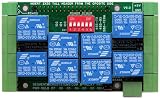
- Enable Raspberry Pi to control AC and DC loads for IoT, Home, Industrial and Building Automation. Stackable to eight layers, the card can be expanded to 64 relays.
- Each relay can switch up to 120VAC/24VDC and currents up to 8A. N.O. and N.C contacts are brought out to heavy duty pluggable connectors. Status LEDs for each relay indicate when the coil is activated.
- RS485 transceiver allows the Raspberry Pi to communicate with other sensors and actuators using MODBUS or other industrial protocol.
- Software support includes Command Line, Python and Node-RED native nodes.
- Using only the I2C port for communication, the card leaves all GPIO pins free for other functions. It works with all Raspberry Pi's from Zero to 4 (Raspberry Pi not included).
Check the board revision before using specifications
Sequent’s older “User’s guide 3.0” describes an earlier 8-MOSFET stackable expansion card and says up to eight cards can be used. Its feature list gives four high-current outputs at 10 A/24 VDC and four high-voltage outputs at 2 A/240 VDC. Elsewhere, the same guide describes 10 A/48 VDC and 300 VDC/4 A. Those conflicting figures make the guide unsuitable as a single coherent specification sheet for the current SM-I-006.
Use the documentation that matches the specific board in hand rather than combining figures from different pages or revisions. The current SM-I-006 listing gives the 4 A/240 VDC and 12 A/24 VDC ratings above. The older guide is available at Sequent’s User’s guide 3.0 mirror.
Rank #3

- Supports Thermocouples type J, K, T, N, E, B, R and S; Works with any Raspberry Pi from ZERO to 5
- 24 bit delta-sigma A/D converters; Ultra-low drift (0.005µV/ºC) low offset (50µV) amplifiers
- On-board hardware watchdog; Reverse polarity power supply protection; Cold junction compensation
- Maximum accuracy (through calibration): 0.1%; Maximum acquisition speed 40 cps
- RS485/MODBUS transceiver with in and out ports; Programmable threshold LEDs on all inputs
Do not confuse it with Sequent’s I/O Back Panel card
Sequent sells a separate “8 MOSFETs and 8 Digital Inputs” card for its Raspberry Pi I/O Back Panel. That is a different Hardware On Panel (HOP) product, not the SM-I-006 stackable HAT. Its ratings should not be substituted for the HAT’s specifications. See the I/O Back Panel product page for that separate card.
Quick Recap
Rank #4

- Sixteen RELAYS with Status LEDs and NO contacts
- Eight layer stackable to 128 relays
- Pluggable Connectors 26-16 AWG wires, 2A/24 contacts
- RS485, push-button, LED status
- Node-RED, Command Line, Python drivers
What to verify before choosing or wiring one
- Confirm the model and revision. Match the product and its documentation before applying voltage or current limits.
- Match the load to the channel group. The current listing specifies different voltage and current limits for channels 1–4 and 5–8.
- Plan for external load power. The open-drain outputs switch an externally supplied load; account for the supply and wiring in your design.
- Check system integration needs. Consider the Raspberry Pi model, I2C connection, stack-ID configuration, RS485/MODBUS requirements, and the control software you intend to use.
Product prices and availability are accurate as of the date/time indicated and are subject to change. Any price and availability information displayed on Amazon at the time of purchase will apply.

