
Quick wins for a faster PC:
Scan for outdated or missing drivers - takes under a minuteDriver Scan →Repair Windows errors before they cause bigger problemsFix Now →Mikode is a small, historical assembly-language compiler and emulator that makes low-level computer ideas visible through examples such as drawing characters, playing Snake, blinking an LED, and reading a button input. It may suit a curious child learning alongside an adult, but it is a work in progress rather than a polished children’s course: its instructions are simplified, its setup is Linux-oriented, and its Raspberry Pi directions date to older boards.
What Mikode is
Mikode is software, not a physical kit or a high-level programming language. Its repository describes it as an assembly-language compiler and emulator for teaching computer logic. Instead of requiring learners to begin with conventional AVR mnemonics such as LDA and INC, it offers more readable instructions such as LoadImm and Increment, then compiles them into binary based on the Atmel AVR microcontroller instruction set. The emulator provides a 64K address space and monitor ROM for displaying characters. Mikode on GitHub


This is a bridge to machine-level concepts, not a complete introduction to every aspect of assembly or a lesson plan calibrated to a particular age. The repository calls Mikode a work in progress. The project materials describe examples and functionality; they do not report measured learning outcomes or prove that the examples have been independently tested.
What a learner can do with it
Start with instructions and screen output
The repository includes examples for drawing characters. That gives an adult and learner a way to connect instructions and memory with something visible on screen before moving to hardware.
Explore Snake
The project includes a more complex Snake example in snake.asm. It can provide a concrete setting for noticing how a program responds and changes over time, though the project materials do not establish how much prior knowledge a child needs to understand or modify it.
Connect code to physical input and output
The Hackster project shows code for blinking an LED and reading a Raspberry Pi GPIO input. The repository separately documents GPIO support on Raspberry Pi A+, B+, 2B, and 3B, and maps GPIO functions to emulated registers. It says GPIO access requires root privileges. This makes the project’s examples a possible route from abstract instructions to a light and button, but not a guarantee of compatibility with a current Raspberry Pi.
Rank #2
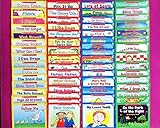
- Childrens Learn to Read Books Lot 60 - First Grade Set + Reading Strategies NEW
- 60 stapled booklets total. 15 titles each in levels A, B, C, and D
- Each 8-page reader is black and white as designed by a reading specialist to attract attention to the print
- Measures 4 1/2" by 5 1/2"
- This series of books is a Teachers' Choice award winning item as voted by Learning Magazine!
Is Mikode suitable for a child?
It may be approachable as a guided activity when an adult can help with Linux setup, command-line use, and the basic ideas behind registers and binary. The friendlier instruction names lower one barrier, while the emulator and examples give learners concrete things to inspect. But there is no published age recommendation or evidence in the project materials about children’s learning outcomes. Bob Burns’s 2017 Hackster page says he was interested in eventually teaching his then-five-year-old daughter and considered kindergarten too early for binary math; that is his personal reflection, not an age guideline or evidence that a fuller tutorial was later published. Hackster project page
A practical way to judge fit is to try the software together and treat the examples as experiments rather than a step-by-step curriculum. A child interested in how computers work may enjoy tracing a simple instruction; a learner expecting a visual drag-and-drop coding environment may find the command-line setup and low-level concepts frustrating.
Recommended Free Tools
How to install and run the examples
The project’s README gives build instructions for Linux. These are maintainer-provided directions, not a fresh compatibility test. It says Mikode was tested on Ubuntu and Raspbian, should run on Debian-based Linux distributions, and runs on PocketChip. The latest GitHub release shown is v1.2.2, dated December 22, 2017. The Hackster page is dated December 9, 2017; these dates establish the age of the published materials, not whether the project is maintained today.
- Install the dependency. Install
libncurses-devif it is not already present. - Build from the repository. Run
autoreconf -i, then./configure, thenmake all check. If the checks complete, install withsudo make install. - Or build the release archive. The repository offers a v1.2.2 source archive; download and extract it, then build it using the project’s instructions.
- Compile a sample. In the directory containing the example, run
mikode example1.asm. - Run the compiled sample. Use
mikode -r example1. The documented Snake source file issnake.asm.
The documented command syntax is mikode [-rg] [-s] [--run] [--gpio] [--sleep=TIME] file. During interactive execution, the documented function keys include controls for showing registers, stopping or restarting, stepping, and quitting. Consult the repository README for the exact key assignments and any setup details before using them.
Rank #4

- 40 Set Phonics Flip Books: Master reading through 11 progressive levels (Set 1A–3B). Sinoome Phonics Flip Books guide children from foundational CVC words to complex word families, bridging the gap from emergent reader to independent decoder
- Systematic Word Family Curriculum: Move beyond rote memorization. Each word family book (e.g., -at, -op, -uck, -ill) uses a "change the onset" method to help kids decode shared patterns instantly. This logical structure builds phonemic awareness and accelerates reading fluency effectively
- Interactive & Multisensory Learning: Designed for tactile engagement, these books turn phonics practice into interactive play. Kids flip through rhyming patterns to create new words, reinforcing letter-sound connections and spelling skills. Perfect for early literacy development
- Learn to Read Books for Kids 3-5: Aligned with Pre-K and Kindergarten reading standards, this 40-book phonics flip book set is perfect for emergent readers. It offers a hands-on, structured approach to early reading intervention, making it an essential tool for homeschooling or nursery small-group instruction
- Visual Progress Tracking: Monitor early literacy development with 6 double-sided (A/B) word review pages. These companion sheets allow parents and teachers to easily track spelling progress, verify mastered word families, and target areas that need extra phonics reinforcement
What the optional Raspberry Pi activity needs
The Hackster parts list specifies one Raspberry Pi 1 Model B+, a generic breadboard, one LED, two 330-ohm resistors, and one 12 mm pushbutton. The activity uses the LED for output and the button for input. If sourcing parts, the relevant category is a Raspberry Pi breadboard LED GPIO kit, but the project does not establish that a contemporary kit or board will work with its historical code and wiring assumptions.
- Check the board model against the older project instructions before wiring anything.
- Follow a suitable circuit diagram and observe safe GPIO wiring practices; do not assume a modern board’s pin layout or software behavior matches the example.
- Expect GPIO access to require root privileges according to the repository documentation.
Compatibility with current Raspberry Pi boards was not established in the project materials. If you do not have a supported board, the emulator examples still offer a software-only way to explore the project.
Best Value
What the project’s age means
Mikode’s public materials are from 2017, and the latest GitHub release listed is v1.2.2 from December 22 of that year. That makes it a historical project whose current maintenance status is not established by those materials. Its documented Linux environments and Raspberry Pi models should be treated as the maintainer’s stated compatibility, not a promise for present-day systems. Anyone considering it should check the repository for current build notes and assess whether the older instructions fit their environment.
Quick Recap
Product prices and availability are accurate as of the date/time indicated and are subject to change. Any price and availability information displayed on Amazon at the time of purchase will apply.

