
The Tool Desk
Outbyte PC Repair FREEClear out junk files and repair common Windows errorsFree Scan →Outbyte Driver Updater FREEFix the driver behind crashes, sound loss and screen glitchesFind Drivers →The first self-contained digital camera was a Kodak prototype built by engineer Steven Sasson in 1975. It captured an image with a CCD sensor, converted it into digital data and saved it to cassette tape—but it was a lab experiment, not a consumer product. “First” here means a working, self-contained digital camera, not the first idea for electronic imaging or the first electronic still camera of any kind.
Who invented the first digital camera?
Kodak engineer Steven Sasson built the prototype after his supervisor, Gareth Lloyd, asked him in 1974 to investigate whether a newly available charge-coupled device (CCD) could serve as a camera’s image sensor. Sasson completed the camera in December 1975. The National Inventors Hall of Fame and IEEE describe it as the first self-contained digital camera.
That category matters: electronic imaging concepts and experiments existed before Sasson’s camera, while later devices such as Sony’s Mavica used a different approach. The 1975 prototype is notable because it brought image capture, digitization and recording together in a portable, self-contained camera system, with a separate unit needed for playback. National Inventors Hall of Fame; IEEE Spectrum.
What did the first digital camera look like, and how did it work?
It was a bulky assembly of parts rather than a modern consumer camera. The National Inventors Hall of Fame lists a Super 8 movie-camera lens, 16 nickel-cadmium batteries, a CCD imaging area array, an analog-to-digital converter and several dozen electronic circuits spread across six circuit boards. Sasson described the sensor as 100 by 100 pixels in a 2012 interview—10,000 pixels, or 0.01 megapixel.
PC Slower Than It Used to Be?
A free scan shows the junk files, broken settings and background clutter dragging Windows down - then fixes them in one click.Free scan · Windows 10 & 11Outdated Drivers Are Slowing You Down
One free scan finds every outdated or missing driver and matches the right update for your exact hardware.Free scan · exact hardware match#1 Best Overall

- 16MP Sensor: Captures detailed photos with a CMOS sensor for everyday shooting
- Optical Zoom: 4x optical zoom with a 27mm wide angle lens for flexible framing indoors or outdoors
- Full HD Video: Records 1080p video for travel clips, family moments, or simple vlogging
- Memory Support: Works with Class 10 SD, SDHC, or SDXC cards up to 512GB
- LCD Screen and Battery: 2.7in LCD screen with 2 AA alkaline batteries for convenient on-the-go use
The camera captured light through its lens and CCD, converted the sensor’s analog signal into digital data, then recorded the data on digital cassette tape. A separate playback unit converted the stored information into a standard NTSC signal that could be displayed on a television. The system was digital in how it stored image data, even though viewing it required that external playback equipment. National Inventors Hall of Fame; IEEE Spectrum; MegaPixel interview with Steven Sasson, 2012.
The first photograph
The first image, taken in December 1975, showed Kodak lab technician Joy Marshall. Recording the image to tape took 23 seconds. The first playback had serious tonal defects; Sasson later recalled, “There was a problem with the display so that the image was distorted when we first viewed it.” The 23-second figure is reported by IEEE; the interview quotation is from Sasson’s 2012 interview. IEEE Spectrum; MegaPixel interview with Steven Sasson, 2012.
Rank #2

- 16MP Sensor: Captures detailed photos with a CMOS sensor for everyday shooting
- Optical Zoom: 4x optical zoom with a 27mm wide angle lens for flexible framing indoors or outdoors
- Full HD Video: Records 1080p video for travel clips, family moments, or simple vlogging
- Memory Support: Works with Class 10 SD, SDHC, or SDXC cards up to 512GB
- LCD Screen and Battery: 2.7in LCD screen with 2 AA alkaline batteries for convenient on-the-go use
Why didn’t Kodak sell it?
The 1975 camera remained a prototype. Sasson and Lloyd received U.S. Patent No. 4,131,919 in 1978, but the invention did not proceed directly to a commercial camera. A 2022 NYU Stern-hosted case study quotes Sasson’s 1976 report imagining a future consumer camera as “a small device capable of taking color pictures under very low light conditions.” The same case study reports that Douglass Harvey, head of Kodak’s Apparatus Division, responded to a request to continue development with, “Yes, and I hope you will fail.” That anecdote is reported by the case study, rather than presented as a direct transcript.
Kodak’s digital-camera development did not end with the 1975 prototype. The National Inventors Hall of Fame says Sasson and Robert Hills developed the first self-contained digital DSLR in 1989 and that Kodak initially declined to sell it. These milestones show a longer path from invention to commercialization, rather than an immediate transition from prototype to product. IEEE history of Kodak and digital cameras; National Inventors Hall of Fame; NYU Stern case study, 2022.
Rank #3
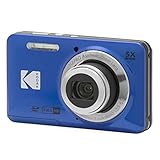
- 16MP Sensor: Captures detailed photos with a CMOS sensor for everyday shooting
- Optical Zoom: 5x optical zoom with a 28mm wide angle lens for flexible framing indoors or outdoors
- Full HD Video: Records 1080p video for travel clips, family moments, or simple vlogging
- Memory Support: Works with Class 10 SD, SDHC, or SDXC cards up to 512GB
- LCD Screen and Battery: 2.7in LCD screen and a rechargeable lithium-ion battery for on-the-go use
How did the 1975 camera differ from later milestones?
Several early cameras are called “first” depending on whether the claim concerns a self-contained digital prototype, an electronic still camera, or a consumer product. Their recording methods and purposes were not the same.
| Milestone | What it was | Recording and viewing | Status |
|---|---|---|---|
| Kodak prototype, 1975 | Steven Sasson’s self-contained digital camera prototype | Digital image data recorded to cassette; separate playback unit converted it to NTSC for television | Working prototype; never became a commercial camera |
| Sony Mavica prototype, 1981 | Electronic still camera, a different category from Sasson’s all-digital cassette system | Used a Sony CCD and recorded signals on a two-inch floppy disk | Prototype; Sony says a filmless consumer Mavica was released in 1988 |
| Apple QuickTake 100, 1994 | One of the early digital cameras aimed at consumers | IEEE’s history identifies it as a digital camera; the cited history does not state a storage medium here | IEEE calls it the first digital camera under US $1,000 |
Sony dates its Mavica prototype to 1981 and its filmless consumer Mavica release to 1988. Its corporate history describes the device as an electronic still camera; it should not be treated as the same kind of all-digital, cassette-recording prototype Sasson built. IEEE’s “first under US $1,000” description of the QuickTake 100 is an attributed characterization, not a universal resolution of every possible priority claim. Sony corporate history; IEEE digital-camera history.
Rank #4
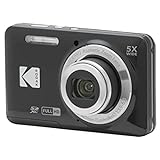
- 16MP Sensor: Captures detailed photos with a CMOS sensor for everyday shooting
- Optical Zoom: 5x optical zoom with a 28mm wide angle lens for flexible framing indoors or outdoors
- Full HD Video: Records 1080p video for travel clips, family moments, or simple vlogging
- Memory Support: Works with Class 10 SD, SDHC, or SDXC cards up to 512GB
- LCD Screen and Battery: 2.7in LCD screen and a rechargeable lithium-ion battery for on-the-go use
Where is Sasson’s camera now?
IEEE reports that the original prototype is held by the Smithsonian’s National Museum of American History. Its significance is not its resolution or convenience by today’s standards, but its demonstration that a camera could capture, digitize and store a photograph electronically as one functioning system. IEEE Spectrum.
Quick Recap
Best Value

- Sixteen Megapixel Sensor: Captures detailed photos with a sixteen MP CMOS sensor for everyday shooting
- Optical Zoom: Four times optical zoom with a twenty seven mm wide angle lens for flexible framing indoors or outdoors
- Full HD Video: Records one thousand eighty p full HD video for travel clips, family moments, or simple vlogging
- Memory Support: Works with class ten SD, SDHC, or SDXC cards up to five hundred twelve GB
- LCD Screen and Battery: Two point seven inch LCD screen with two AA alkaline batteries for convenient on the go use
Product prices and availability are accurate as of the date/time indicated and are subject to change. Any price and availability information displayed on Amazon at the time of purchase will apply.
Free tools Windows power users keep installed
One-click scans. No signup required.

