
8 Pins For Linux is an experimental computer by Dmitry Grinberg that runs Debian through emulation—not a tiny processor running Linux natively. Its circular board uses three integrated circuits in 8-pin packages, with an STM32G031 microcontroller emulating a MIPS system. It is a maker project built to explore how little hardware can run a usable Linux environment, not a practical desktop replacement.
What “8 Pins For Linux” means
The name refers to the package size of the board’s three integrated circuits: each chip has eight pins. It does not mean the entire computer has only eight connections. The compact circular board combines a microcontroller, memory, USB-to-serial circuitry, and SD-card storage.
Grinberg framed the design challenge as: “What is the minimum to be considered a ‘modern computer’?” His project targets include at least 8 MB of RAM, at least 1 MIPS of CPU performance, SD storage, and USB. These are goals for this particular experiment, not minimum requirements for Linux generally. See Grinberg’s project page for the design and build details.
How the board runs Debian
The STM32G031 microcontroller is the host. It runs a MIPS emulator, and that emulated system boots Debian. In other words, the Linux environment runs on the emulated MIPS computer rather than directly on the STM32G031. The project also uses a PL2303GL USB-to-serial bridge for its console, an 8 MB SOIC-8 PSRAM chip, and an SD card for storage. Grinberg names APS6408 and VTI7064 as possible PSRAM parts.
What’s actually slowing this PC down?
Pick the symptom - the matching free tool is one click away.
#1 Best Overall

- 🔥【Dual Mode & High Performance】 The ESP32-S3 development board features integrated dual-core xtensa 32-bit LX7 microprocessor, clock speed up to 240 MHz, with 16MB Flash and 8 MB PSRAM. Perfect for Arduino IoT projects requiring stable wireless communication with ultra-low power consumption.
- 🔧【Easy Programming & Debugging】 Equipped with dual USB Type-C ports, this ESP32-S3 board supports both USB and UART modes for effortless programming, firmware flashing, and debugging.
- 🌐【Versatile Wireless Connectivity】 Built-in Wi-Fi (2.4GHz) and Bluetooth 5.0 (LE) dual-mode ensure seamless connectivity with a wide range of smart devices, making it ideal for IoT, smart homes projects.
- 🚀【Flexible Download Options】 Supports dual download methods — USB direct download or USB-to-serial download — offering flexibility and convenience for different development needs.Ideal for beginners and developers working with ESP32-S3.
- 🔋【Advanced Power-Saving Modes】 Designed for energy-efficient applications, with 3.3V SPI voltage, the ESP32-S3 board supports multiple low-power modes, allowing you to extend battery life based on different usage scenarios.
Fitting those functions into such a small design requires sharing connections. The RAM, SD card, and serial functions use overlapping pins; the project’s circuit and firmware distinguish signals through bus behavior and filtering. Hackaday describes a filter that separates high-frequency SPI traffic from lower-frequency serial traffic. This is a project-specific design technique, not a general-purpose way to connect arbitrary SD and serial devices. Hackaday’s April 5, 2025 overview summarizes the board’s architecture.
What it can do—and how slowly
Grinberg reports that, with the STM32G031 clocked at 148 MHz, the emulated processor performs approximately like a 1.65 MHz MIPS R3000 with its floating-point unit disabled. At a 120 MHz microcontroller clock, he describes the effective CPU speed as about 1.5 MHz. These are the creator’s reported comparisons, not results from an independent benchmark.
Rank #2

- START CODING WITH THE ELEGOO UNO R3: Connect the included USB cable, upload your first sketch, and build sensor, motor, display, and automation projects, making it a practical controller for maker desks, classrooms, coding clubs, and robotics labs
- ATMEGA328P CORE FOR EVERYDAY PROJECTS: A 16 MHz clock, 32 KB flash, 14 digital I/O pins with 6 PWM outputs and 6 analog inputs provide a versatile foundation for LEDs, buttons, relays, servos, displays and sensors
- RELIABLE USB PROGRAMMING AND CLEAR WIRING: The ATmega16U2 USB interface supports sketch uploads and serial communication, while clearly labeled headers help simplify connections to jumper wires, shields and modules
- POWER AND EXPAND YOUR WAY: Run the board from USB or a recommended 7-12 V external supply, then add compatible shields and modules for data logging, automation, robotics, test fixtures and custom electronics projects
- BOARD AND USB CABLE INCLUDED: Comes with 1 ELEGOO UNO R3 development board and 1 USB-A to USB-B data cable; breadboard, sensors, shields and power adapter are not included, and younger learners should work with an experienced adult
He says the system boots Debian in about a minute and can run vi, make, objdump, and gcc. That establishes the project’s basic software capability, not a comfortable everyday workflow: Grinberg warns that commands are slow and compilation can take minutes. He also describes the system as a full Debian installation that can install .deb packages from /boot.
What building the project involves
This is a build-from-parts project, not a confirmed off-the-shelf computer. Grinberg’s instructions cover soldering the SD socket, passive components, microcontroller, USB-to-serial chip, and PSRAM; flashing a bootloader; writing the supplied disk image to an SD card; loading firmware; and connecting to a serial terminal.
Do these 3 things before closing this tab:
1Fix the driver behind crashes, sound loss and screen glitches2Repair Windows errors before they cause bigger problems3Scan for outdated or missing drivers - takes under a minuteRank #3

- [COMPLETE 6-PACK SET AND EXACT SPECIFICATIONS]: Each pack includes 6 single-board computers with pre-soldered pin headers. Total package contains 6 ESP32-S3 N16R8 boards. Specifications include dual-core Xtensa 32-bit LX7 microprocessor up to 240 MHz, 16MB embedded Flash memory, 8MB PSRAM with Octal SPI support, 34 GPIOs, and 3.3V operating voltage.
- Features two independent USB Type-C ports: one dedicated native USB for direct flashing and CDC communication, and a second port operating through a USB-to-UART bridge for straightforward serial debugging.
- [OPTIMIZED PIN MAPPING AND RELIABILITY]: Overcomes common setup limitations by clearly defining the onboard RGB LED mapping to GPIO48 instead of GPIO47. The generous 16MB Flash and 8MB PSRAM provide substantial headroom for compiling complex libraries, running heavy displays over SPI, and managing intensive wireless data transmission without memory overflow.
- [STEP-BY-STEP FIRMWARE DEPLOYMENT INSTRUCTIONS]: 1. Connect the board to your computer via the native USB-C port. 2. To enter programming mode, press and hold the BOOT button, click the RST button once, then release the BOOT button. 3. Select your preferred C/C++ or MicroPython development environment. 4. Compile and flash your code. 5. Define your status LED to GPIO48 for visual feedback.
- [APPLICABLE SCENARIOS AND TARGET AUDIENCE]: Engineered for electronics hobbyists, firmware developers, and engineering students. Ideal for prototyping custom IoT devices, building home automation nodes, constructing real-time HVAC pressure differential monitors, gathering aquarium temperature telemetry, and deploying sensor mesh networks.
- Assemble the board. Solder the socket, passive parts, STM32G031, USB-to-serial bridge, and PSRAM as described in the project instructions.
- Prepare storage. Write the supplied disk image to an SD card with a capacity of at least 1 GB.
- Load the software. Flash the bootloader and then load the project firmware, following Grinberg’s instructions.
- Connect the console. Attach the board over USB-C and open a serial terminal at 115,200 bps, 8N1.
Grinberg says he assembled his board with a RadioShack 45 W soldering iron and designed the project to be approachable for someone with limited soldering experience. That describes his experience, not a guarantee that every builder will find the small components or assembly straightforward. His project page says he hopes a kit will become available and is seeking a company to sell one; it does not confirm that a kit is currently on sale.
Independent reader supportYour contribution helps us test, update, and keep practical guides available for everyone.Who this project is for
- Good fit: makers interested in embedded systems, processor emulation, severe hardware constraints, or the engineering tradeoffs behind getting Linux to boot on a tiny board.
- Not a good fit: anyone looking for a fast, general-purpose Linux computer, a plug-and-play device, or a ready-made kit whose availability is confirmed.
The interesting achievement is not that three small chips rival a normal computer. It is that carefully shared pins, modest memory, custom firmware, and emulation make a small Debian-capable system possible at all.
Quick Recap
Best Value

- INCLUDES 1 ESP32 BOARD AND 1 EXPANSION BOARD – Combination pack contains one ESP32 development board with USB Type-C and one matching 38-pin breakout expansion board for convenient prototyping and IoT development.
- POWERFUL DUAL-CORE MICROCONTROLLER – Features the ESP-WROOM-32 module with built-in WiFi and Bluetooth connectivity, suitable for embedded systems, smart devices, and automation projects.
- USB TYPE-C WITH CP2102 CHIP – Integrated USB Type-C connector and CP2102 USB-to-Serial chip for fast and reliable power supply and data communication.
- SOLDER-FREE EXPANSION BOARD – The 38-pin breakout board supports quick and easy prototyping with no soldering required. Easy to plug in the ESP32 and access GPIO pins.
- COMPATIBLE WITH ARDUINO IDE AND MICROPYTHON – Fully supported by the Arduino IDE and MicroPython, making it ideal for beginners, hobbyists, and professional developers working on IoT projects.
Rank #4
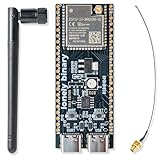
- 【GOLD EDITION — IMMERSION GOLD PCB】The Lonely Binary Gold Edition features a black PCB with lead-free immersion gold (ENIG) plating and clear silkscreen — the signature finish of the Lonely Binary Gold Edition line. RoHS-compliant.
- 【16MB FLASH + 8MB PSRAM】Large memory capacity for OTA updates, large programs, and AI/ML tasks — more headroom than 4MB boards for data-intensive IoT and automation projects.
- 【EXTERNAL IPEX ANTENNA】External IPEX antenna can be positioned for extended WiFi and Bluetooth signal coverage — for remote applications like weather stations, robots, or enclosed builds.
- 【DUAL USB TYPE-C PORTS】Separate power and data ports for macOS, Windows, and Linux. Power via USB-C (5V) or VIN pin (5–12V); do not exceed 5V on the USB-C ports.
- 【FLEXIBLE PROTOTYPING PINS】2x40-pin GPIO headers compatible with breadboards and sensors. Supports external ToF sensors via I2C for distance sensing.
Product prices and availability are accurate as of the date/time indicated and are subject to change. Any price and availability information displayed on Amazon at the time of purchase will apply.

