
There is no universal confidence percentage that safely separates automated decisions from cases needing human review. Set the threshold for the specific pipeline decision by weighing error consequences, validating what the score means, estimating review capacity, and monitoring performance after launch.
What a confidence threshold controls
A threshold is a routing rule: outputs on one side proceed automatically, while outputs on the other are sent to a person, delayed, or otherwise handled differently. Before choosing a cutoff, define exactly what the score represents and what action the pipeline takes for each route. A model’s nominal confidence score is not necessarily a calibrated probability of being correct.
The National Institute of Standards and Technology (NIST) advises that human judgment should determine both the trustworthiness metrics used and their precise thresholds. Its voluntary AI Risk Management Framework calls for evaluating risks, impacts, costs, and benefits in the intended context rather than relying on a default percentage. See NIST AI RMF 1.0, Section 3.
Set the decision criteria before tuning a cutoff
Specify the decision and its errors
Write down which records, predictions, or generated outputs are being routed; what the automated action is; and what counts as an error. Distinguish false accepts from false rejects, and include the costs of delay and unnecessary review. The consequences may differ sharply: an error that is easy to reverse may be tolerable in one workflow, while a rare but harmful error may rule out automatic handling in another.
Quick wins for a faster PC:
Repair Windows errors before they cause bigger problemsFix Now →Fix the driver behind crashes, sound loss and screen glitchesFind Drivers →Clear out junk files and repair common Windows errorsFree Scan →#1 Best Overall
Identify affected groups and operating conditions
Choose validation conditions that resemble how the pipeline will actually be used. Identify relevant data segments and expected shifts in inputs, and examine whether error types or consequences differ across them. An acceptable average can conceal a serious failure for a particular segment or outcome.
NIST recommends realistic test sets, documented evaluation methods, and consideration of performance across data segments. Its guidance also emphasizes contextual assessment of risks and impacts; it does not prescribe one universal set of metrics or cutoffs. See NIST’s trustworthiness guidance.
Rank #2

- 【Diagnose Check Engine Light in Seconds – No Mechanic Needed】The FOXWELL NT301 OBD2 scanner instantly reads & clears engine fault codes (DTCs) with one click. Simply plug into the 16-pin DLC port, turn ignition on, and get accurate results within seconds—No prior car knowledge required. Save hundreds on dealership fees by knowing exactly what’s wrong before you visit a shop. The #1 choice car scanner for DIYers and car owners who want to take control of their vehicle’s health
- 【Clear & Reset CEL with Confidence】Unlike cheap code readers that just erase codes temporarily, NT301 works like all professional vehicle code readers: It clears the check engine light only after you’ve fixed the underlying issue. If the problem isn’t fully repaired, the fault code will reappear. So you’ll never get a false pass. Use the foxwell scanner to verify your repair work and drive with peace of mind
- 【Sm-og Check Helper – Know Your Pass/Fail Status Before the Test】With dedicated one-click I/M readiness hotkeys and a simple Red-Yellow-Green LED indicator, you’ll instantly know if your vehicle is ready for annual testing. Built-in speaker provides clear audio feedback. No guesswork—just confidence before you head to the test center. One less thing to worry about when inspection day comes
- 【Advanced OBDII Modes – O- 2 Sensor & EVAP Testing】NT301 go beyond basic code reading with enhanced OBD2 modes. Run an EVAP system check to assess fuel tank condition, and use the O- 2 sensor test to optimize air-fuel ratio, boosting fuel economy, cutting em- issions, and saving you money at the pump. The code reader for cars and trucks is like having a mini em-issions lab in your glove box
- 【Live Data Graphing – Spot Engine Issues in Real Time】View and log live sensor data in easy-to-read graphs with this OBD2 scanner diagnostic tool. Monitor ox- ygen sensors, fuel trims, coolant temperature, RPM, and more to spot suspicious values instantly. This obd scanner gives you professional-grade insight without the pro price tag—a feature you won’t find on basic $20 car code readers
Check whether the score is useful
Evaluate confidence on representative, labeled outcomes from the intended operating conditions. If people interpret a score as a probability, check calibration: among cases assigned similar confidence, how often are the outcomes actually correct? Calibration is different from the policy decision about how much risk is acceptable. A well-calibrated score does not, on its own, tell a team which error rate is tolerable.
Calibration measures such as Expected Calibration Error (ECE) and risk-coverage analysis are discussed in a 2026 review of abstention by healthcare large language models. They can be useful analytical tools where appropriate, but that review does not establish a universal method for all pipeline tasks. Select measures that fit the score, task, and evaluation data; test whether the score actually distinguishes cases with different error risks. See the review in npj Digital Medicine.
Rank #3
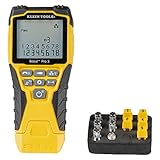
- VERSATILE CABLE TESTING: Cable tester tests voice (RJ11/12), data (RJ45), and video (coax F-connector) terminated cables, providing clear results for comprehensive testing on unenergized Ethernet cables (not designed to test PoE)
- EXTENDED CABLE LENGTH MEASUREMENT: Measure cable length up to 2000 feet (610 m), allowing for precise cable length determination
- COMPREHENSIVE FAULT DETECTION: Test for Open, Short, Miswire, or Split-Pair faults, ensuring thorough fault detection and identification
- BACKLIT LCD DISPLAY: Backlit LCD screen displays cable length, wiremap, cable ID, and test results, ensuring easy readability in various lighting conditions
- EFFICIENT CABLE TRACING: Trace cables, wire pairs, and individual conductor wires using the multiple style tone generator (requires analog probe Cat. No. VDV500-123, sold separately), simplifying cable tracing tasks
Compare candidate thresholds on the same validation set
For each plausible cutoff, estimate the operational and quality consequences together. In a selective-routing setup, a risk-coverage curve can show how the error risk among automatically handled cases changes as automatic coverage changes. Use this lens only when the score and routing design make it meaningful; the cited healthcare review presents it for LLM abstention, not as a requirement for every data pipeline.
- Automatic coverage: the share of outputs that proceed without human review.
- Selective risk: the error rate or other relevant risk among those automatically handled.
- Review workload: expected queue volume, reviewer capacity, likely delays, and escalation needs.
- Error profile: error types, severity, and outcomes for relevant data segments—not only aggregate accuracy.
- Score quality and stability: calibration where probability interpretation is intended, and performance under expected conditions or shifts.
Compare these measures on the same representative data so candidate policies are evaluated consistently. Do not average away a high-consequence failure mode merely because overall accuracy or coverage looks favorable. Risk-coverage analysis and area under the risk-coverage curve (AURC) are options discussed in the healthcare abstention review, not universal scorecards.
Rank #4

- VERSATILE CABLE TESTING: Cable tester for data (RJ45) terminated cables and patch cords, ensuring comprehensive testing capabilities
- LARGE BACKLIT LCD: Backlit LCD display enables easy reading of pin-to-pin wiremap results, even in low-lit areas
- COMPREHENSIVE FAULT DETECTION: Test for Open, Short, Miswire, Split-Pair faults, Cross-over, and Shield, providing thorough fault detection
- INTUITIVE USER INTERFACE: User-friendly interface with three buttons and simple, easy-to-identify test responses, ensuring a smooth testing experience
- MULTIPLE TONE GENERATOR STYLES: Tone on a single wire, wire pair, or all 8 conductor wires using the multiple style tone generator (solid/warble); requires probe Cat. No. VDV500-123 (sold separately)
Choose a policy with the people accountable for outcomes
Bring together the technical team, pipeline operators, and domain stakeholders who understand the consequences of errors. Agree on tolerable risks, acceptable review load, escalation conditions, and the evidence required to permit automatic handling. Record why the selected operating point fits the intended use and how its tradeoffs were accepted. NIST explicitly places human judgment in the selection of precise trustworthiness thresholds.
If no candidate cutoff satisfies the risk and capacity requirements, the answer need not be a different percentage. The team may need to route more cases to people, limit the automation’s scope, improve the model or data, or pause automation until the evidence is stronger.
Do these 3 things before closing this tab:
1Repair Windows errors before they cause bigger problems2Scan for outdated or missing drivers - takes under a minute3Clear out junk files and repair common Windows errorsBest Value

- Cable tester with single button testing of RJ11, RJ12 and RJ45 terminated voice and data cables
- Tests CAT3, CAT5e and CAT6/6A cables
- Fast LED responses indicate cable status (Pass, Miswire, Open-Fault, Short-Fault, and Shield)
- Test remote stores securely in tester body
- Compact tester easily fits in your pocket
Make the human-review queue actionable
A review queue is part of the control, not just a destination for low-confidence outputs. Define who is responsible, what evidence and context reviewers see, how cases are prioritized, and how reviewers record decisions. Specify who can override or appeal an automated outcome and how urgent or harmful incidents are escalated.
Reviewers need both capacity and authority to intervene. NIST’s AI RMF Playbook describes incident flagging and human adjudication as part of incident response and appeal-and-override processes, and calls for clear roles and documentation. See the NIST AI RMF Playbook’s Govern guidance.
Monitor the threshold after deployment
Performance and incoming data can change. Track the measures that justified the routing policy against a documented baseline: score distributions, calibration where applicable, error rates, automatic coverage, review volume, overrides, and relevant segments. Establish a review cadence and triggers for investigation, recalibration, threshold changes, or stopping automation.
Decide in advance how much drift from baseline is acceptable and who can authorize a response. NIST describes continuous monitoring throughout the AI system lifecycle and recommends regular review and documentation of risk tolerance. The NIST Playbook provides governance guidance; the framework itself is voluntary and NIST says AI RMF 1.0 is under revision. Applicable sector laws, safety obligations, or validation standards may add requirements that depend on the specific use case.
Free tools Windows power users keep installed
One-click scans. No signup required.
Quick Recap
Product prices and availability are accurate as of the date/time indicated and are subject to change. Any price and availability information displayed on Amazon at the time of purchase will apply.

