
Recommended Free Tools
Choose an automatic watch by how comfortably it fits your wrist and routine, then compare its power reserve, stated accuracy, water-resistance rating and maker’s care guidance. An automatic watch winds its mainspring through wrist motion, so it runs without a battery, but it can stop when left unworn and requires more winding and service attention than quartz. Performance and care requirements vary by model.
What an automatic watch needs from you
A rotor inside the watch turns with wrist movement and winds the mainspring. The stored energy keeps the watch running when it is not moving, but only until its power reserve runs out. Reserve is specific to the movement, so check the exact model’s specification rather than assuming every automatic lasts the same amount of time off the wrist. Longines explains the mechanism and reserve at its automatic-watch guide.
If you rotate among watches or leave one off your wrist for a while, expect to reset the time and possibly the date when it stops. Some watches can be wound manually using the crown; follow the model’s instructions. Seiko recommends wearing its watches daily for more than 8 hours to help avoid deviations associated with insufficient winding, but that is manufacturer guidance, not a universal requirement for every automatic calibre. See Seiko’s accuracy FAQ.
Start with fit and everyday usability
Try the watch on if possible. Assess whether the case sits comfortably, whether its thickness catches on sleeves, and whether the bracelet or strap feels secure through the day. There is no universal case diameter or thickness that suits every wrist; comfort depends on the wearer and the watch’s shape.
#1 Best Overall

- Stainless steel case 40mm diameter x 14.1mm thick; Exhibition case back; Black dial; Luminous hands.Band Length: 205mm
- NH35A Japanese Automatic movement, 24 jewel; Assembled in Malaysia; Watch weight 155 grams
- Includes gift box, instructions and 3 year limited manufacturer warranty; Invicta Customer Service can be reached at 1-800-327-7682 for questions (re: Additional links, band replacement, band adjustment, warranty questions, etc.)
- Legibility: Check whether you can read the dial quickly in the lighting and situations you encounter.
- Strap or bracelet: Consider comfort, adjustability and whether the material suits your routine.
- Style: Choose a design that works with the clothes and settings in which you expect to wear it.
These are practical fit and use considerations, not a substitute for checking the individual watch’s dimensions and construction.
Compare the specifications that affect ownership
| What to check | Why it matters |
|---|---|
| Power reserve | Indicates how long the watch is specified to run when fully wound and off the wrist. It depends on the model’s movement. |
| Accuracy specification | Shows the maker’s stated tolerance or whether the watch has chronometer certification. A tolerance is not a guarantee of the performance of an individual watch. |
| Water resistance | Check the actual rating and the activities the maker permits; a generic water-resistant label does not establish that swimming is suitable. |
| Service guidance | Use the maker’s recommendation for the exact model or calibre. Service advice differs by manufacturer. |
Compare official model pages and manuals, not just retailer summaries. If an exact power reserve, tolerance or permitted activity is not stated in the model’s official documentation, do not infer it from another watch in the same brand’s range.
Rank #2

- Stainless Steel case with Black Resin Band
- Black Dial with date window at 3 O'clock
- Luminous markers and hour hands; sweep second hand
- Anti-reverse bezel
- Water-resistant to 200 M (660 feet)
Understand mechanical accuracy in context
Automatic watches do not have one universal accuracy standard. Longines gives general examples of up to about ±10 seconds per day for a standard automatic, around ±5 seconds per day as typical mechanical performance, and -4/+6 seconds per day for chronometer-tested watches. These are manufacturer examples, not promises for every model or a report of a particular watch’s measured results. Longines also notes that position, temperature, magnetism, shock and winding state can affect performance. Its guidance is at Longines’ automatic-watch page and accuracy FAQ.
When a maker states a tolerance, treat it as a specification rather than a prediction that your watch will gain or lose exactly that amount each day. A chronometer designation is relevant when comparing stated accuracy criteria, but it does not remove the need to check the model’s own specification and care instructions.
Windows Errors? Fix Them Before They Spread
Repair common Windows errors and clear accumulated junk for a smoother, more stable PC - no reinstall needed.Free scan · no reinstallOutdated Drivers Are Slowing You Down
One free scan finds every outdated or missing driver and matches the right update for your exact hardware.Free scan · exact hardware matchRank #3
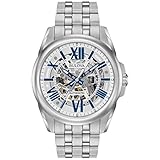
- Bulova's Men's Classic Automatic Collection features meticulously crafted beautiful timepieces with self-winding movements that are powered by the motion of your wrist.
- 3 Hand, Automatic, Full Skeleton
- Silver-Tone Stainless Steel
- Mineral Crystal
- 100M Water Resistant and 3 Year Limited Warranty
Choose water resistance for your actual routine
Read the specific watch’s water-resistance rating and instructions before exposing it to water. Seiko warns that water resistance is not permanent: aged gaskets or shock can affect it. Its care advice says not to pull or turn the crown while the watch is wet, and warns that direct faucet pressure can cause moisture to enter. The maker also advises avoiding baths and saunas, where steam, soap or hot-spring components may accelerate deterioration. See Seiko’s care FAQ.
- After seawater exposure, Seiko advises rinsing with fresh water and drying with a soft cloth, while observing the watch’s rating and instructions.
- Wipe off moisture, sweat and dirt with a soft, dry cloth.
- Do not treat a rating as permission for every water activity; follow the watch’s own manual.
Plan for maintenance before buying
Service intervals vary, so use the recommendation for the exact model or calibre. Seiko recommends service at an authorized service center about every three years, with climate and care affecting the recommendation (Seiko service guidance). Longines gives approximately every five years as general advice for maintaining accuracy (Longines maintenance FAQ). These are separate manufacturer recommendations, not a single interval that applies to all automatic watches.
Rank #4

- From Bulova's Men's Marine Star Collection, live and play in maritime watches that feature bold accents, iconic patterns and innovative materials inspired by the sea.
- 3 Hand, Automatic, Sub Second Hand, Hack Feature
- Two-Tone Stainless Steel
- Mineral Crystal
- 200M Water Resistant and 3 Year Limited Warranty
Before committing, check that you understand the winding procedure, have access to the maker’s service guidance, and are comfortable with the maintenance expected over time. If low-maintenance accuracy is your overriding priority, an automatic may not suit you as well as a quartz watch.
Quick Recap
A practical selection checklist
- Try the fit: Confirm the case and strap or bracelet feel comfortable on your wrist and work with your sleeves and routine.
- Check the movement details: Find the model’s stated power reserve and winding instructions.
- Set an accuracy expectation: Read the maker’s tolerance and note whether chronometer certification is specified; do not confuse either with an independent measurement of your individual watch.
- Match water resistance to use: Verify the specific rating and permitted activities in the manual.
- Review upkeep: Check the maker’s service interval and care instructions, and decide whether the extra attention compared with quartz is acceptable.
Product prices and availability are accurate as of the date/time indicated and are subject to change. Any price and availability information displayed on Amazon at the time of purchase will apply.
What’s actually slowing this PC down?
Pick the symptom - the matching free tool is one click away.

