
NASA’s Nancy Grace Roman Space Telescope and ESA’s Euclid both aim to clarify how the universe’s large-scale structure and expansion have changed over time. Euclid is built to map a much broader area of sky for cosmology; Roman will survey a smaller area more deeply and precisely, while also studying exoplanets and other infrared astrophysics. Their overlapping surveys are intended to complement one another, not compete as interchangeable telescopes.
What will the Roman Space Telescope study?
NASA defines Roman’s central science domains as dark energy, exoplanets, and astrophysics. Its principal survey instrument, the Wide Field Instrument, observes in infrared light and will measure light from a billion galaxies. NASA says the instrument’s field of view is at least 100 times larger than Hubble’s, allowing Roman to collect wide-area data efficiently while probing its chosen survey regions in depth. NASA’s Roman mission overview
Cosmic expansion and structure
Roman will investigate dark energy and the history of cosmic expansion using several methods, including weak gravitational lensing, galaxy clustering, and Type Ia supernovae. Weak lensing looks for subtle distortions in galaxy shapes caused by intervening mass; clustering traces how galaxies are distributed across space. Supernova observations provide another way to track distance and expansion history.
Exoplanets and wider astrophysics
Roman’s Milky Way microlensing survey is expected to find more than 1,000 exoplanets. Microlensing detects planets through the way their gravity briefly magnifies light from a background star. Roman will also support broader infrared astrophysics. Its separate Coronagraph Instrument is a technology demonstration for high-contrast imaging and spectroscopy of individual nearby exoplanets; it is not the telescope’s main survey instrument. NASA says Roman’s three core surveys account for 75% of its five-year primary mission. NASA’s 2025 description of Roman’s mission
Recommended Free Tools
#1 Best Overall

- HOBBY MODEL KIT – Unassembled model packed in an envelope with easy to follow instructions. Ideal for ages 14 and up.
- NO GLUE OR SOLDER NEEDED – Parts can be easily clipped from the metal sheets. Tweezers are the recommended tool for bending and twisting the connection tabs.
- JAMES WEBB SPACE TELESCOPE - 2.75 Sheet Model with a moderate difficulty level. Assembled Size: 4.13 L x 2.75 W x 2.75 H inches. 1:221 Scale. 62 Pieces
- FROM STEEL SHEETS TO 3D – Pop out the pieces and connect using tabs and holes. Includes illustrated instructions.
- HIGHLY DETAILED ETCHED MODEL – Display your 3D model once completed - collect and build them all.
What is Euclid looking for?
ESA designed Euclid to explore the composition and evolution of the “dark Universe.” Its primary mission is cosmology: mapping large-scale structure across space and time to investigate cosmic expansion and the roles of dark matter, dark energy, and gravity. Euclid observes at visible and near-infrared wavelengths, measuring galaxy shapes and clustering across a broad survey. ESA’s Euclid mission overview
Euclid launched on July 1, 2023. ESA says its routine survey began on February 14, 2024. ESA’s Euclid mission-status page
Rank #2

- HOBBY MODEL KIT – Unassembled model packed in an envelope with easy to follow instructions. Ideal for ages 14 and up.
- NO GLUE OR SOLDER NEEDED – Parts can be easily clipped from the metal sheets. Tweezers are the recommended tool for bending and twisting the connection tabs.
- HUBBLE TELESCOPE – 1 Sheet Model with a moderate difficulty level. Assembled Size: 3.00 x 2.00 x 2.50 inches.
- FROM STEEL SHEETS TO 3D – Pop out the pieces and connect using tabs and holes. Includes illustrated instructions.
- HIGHLY DETAILED ETCHED MODEL – Display your 3D model once completed - collect and build them all.
How are Roman and Euclid different?
| Comparison | Euclid | Roman |
|---|---|---|
| Primary scope | Cosmology-focused: mapping the dark Universe and large-scale structure. | Cosmology, exoplanets, and broader infrared astrophysics. |
| Planned cosmology survey area | Approximately 15,000 square degrees, about one third of the sky (NASA, 2023). | Approximately 2,000 square degrees for its largest core survey, about one twentieth of the sky (NASA, 2023). |
| Survey strategy | Broad-area coverage to map galaxies and structure over a large portion of the sky. | A smaller survey area designed to reach greater depth and precision. |
| Methods noted in NASA’s comparison | Weak gravitational lensing and galaxy clustering. | Weak gravitational lensing, galaxy clustering, and Type Ia supernovae. |
| Wavelengths and instruments | Visible and infrared instruments. | Infrared Wide Field Instrument for surveys; a separate visible-light coronagraph technology demonstration for nearby exoplanets. |
The areas above are planned survey-design figures published by NASA in 2023, not measured results or a universal ranking of which observatory is better. Euclid trades depth in a smaller patch for reach across a wider sky; Roman’s smaller core survey is intended to provide more sensitive, precise measurements in its fields. NASA’s Roman–Euclid comparison
Are Roman and Euclid studying dark energy in the same way?
They overlap in important techniques, especially weak gravitational lensing and galaxy clustering, but their different survey footprints and depth give the measurements complementary strengths. NASA says Roman’s more sensitive and precise observations can help correct or calibrate measurements across Euclid’s broader survey area. The missions’ survey regions are expected to overlap, so their data can be compared rather than treated as independent views of entirely separate skies.
Rank #3

- 【DISTINCTIVE LIGHTS】Experience the stunning visual effect of the JMBricklayer space telescope building set. Gently rotate the lens as the futuristic blue lights instantly illuminate the entire space set. The lights enhance the visual appeal of the space toy, bring the glamour of space technology to life.
- 【EXPLORING SPACE】Ingeniously designed to simulate opening and closing, the operator compartment and base hatch allow you to explore the fun of space as you assemble this space set. This design enhances the interactivity of the space toy and adds more realism to the telescope model.
- 【SPARK YOUR IMAGINATION】Equipped with a variety of cool space accessories such as probe, commemorative plaque and more. Let you experience more fun during assembling. If you're curious about space, this space telescope building set will surely bring you an extraordinary experience.
- 【COOOL AND STUNNING DECORS】Consisting of 995 block parts, this space telescope set contains three layers of structure: the starfinder platform base, the structural axis and the telescope body. Each layer is meticulously designed and constructed to provide a solid base for the space set, giving it a unique look and flair.
- 【WONDERFUL GIFTS】Looking for the ideal present for a space-loving boy? This space telescope building set is the answer! With its innovative design and captivating features, it will delight any young space lovers. Perfect for birthdays or holidays, it's a fantastic gift for adults or kids aged 14+.
That coordination matters because neither mission is a dark-energy “answer machine.” They are designed to improve evidence about expansion and structure; the nature of dark energy remains an open question. NASA’s Roman project scientist for its Euclid contribution, Mike Seiffert, put the sequencing this way: “Euclid’s first look at the broad region of sky it will survey will inform the science, analysis, and survey approach for Roman’s deeper dive.” NASA’s account of the missions’ planned coordination
Independent reader supportYour contribution helps us test, update, and keep practical guides available for everyone.Current mission status
NASA’s Roman mission page lists the spacecraft as launched on August 30, 2026. The cited NASA overview does not establish a commissioning-complete date or the start of routine Roman surveying, so launch should not be taken to mean Roman has already begun its regular science survey. Euclid, by contrast, has been conducting its routine survey since February 14, 2024. NASA’s Roman mission page · ESA’s Euclid mission-status page
Quick Recap
Best Value
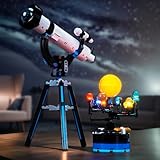
- 【NO MODEL BUILDING SET】ONLY THE LIGHT KIT FOR SALE, MODEL NOT INCLUDED. This LIGHTING KIT is specially compatible with LEGO 31378 Space Exploration Telescope . MODELS SET Need to be Purchased Separately or Already Owned by Yourselves.
- 【QUALITY GUARANTEE】Lighting set compatible with LEGO 31378 Space Exploration Telescope made of high-quality copper lines and ABS plastic, quality check, can be perfectly hidden & Compatible with LEGO blocks. If have questions withe product, please Let us know anytime.
- 【MULTIPLE PLAY】 Light kit Compatible with LEGO 31378 Space Exploration Telescope can be powered by USB (Voltage less than 5V). The lights will be brighter when powered by USB. Please test each light part before assembling.
- 【LIGHT UP YOUR BLOCKS】Light up corners of the model with gleam, intense lights, you can see the vivid details inside and outside, lights compatible with LEGO 31378 Space Exploration Telescope make blocks glow in the dark. A special arrangement for Fans & Family collections.
- 【STEP-BY-STEP INSTALLATION】Provide detailed video/PDF installation instructions(Online) and step-by-step numbered light bags. Just disassemble a few bricks to install the light fixtures! Parts small and not fragile, DON'T pull wires too hard.
Rank #4
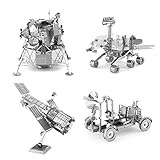
- HOBBY MODEL KITS – Unassembled model packed in an envelope with easy to follow instructions. Ideal for ages 14 and up
- HUBBLE TELESCOPE – 1 Sheet Model with an easy difficulty level. Assembled Size: 3"x2"x2.5"
- APOLLO LUNAR ROVER – 2 Sheet Model with a moderate difficulty level. Assembled Size: 3.54" x 1.77" x 2.28"
- APOLLO LUNAR MODULE - 2 Sheet Model with a moderate difficulty level. Assembled Size: 2.34" x 2.34" x 2.15"
- MARS ROVER – 2 Sheet Model with a moderate difficulty level. Assembled Size: 3.67" x 3.35" x 2.34"
Product prices and availability are accurate as of the date/time indicated and are subject to change. Any price and availability information displayed on Amazon at the time of purchase will apply.

