
To photograph the Moon with visible surface detail, expose for the bright lunar disc rather than the dark sky: start around f/11, ISO 100–200, and a shutter speed near the reciprocal of ISO, then inspect and adjust. Focus on the Moon itself and stabilize the camera. For a Moon-and-landscape photo, decide whether the Moon or foreground matters more; one exposure may not hold detail in both.
Choose the kind of Moon photo you want
Your goal determines the lens, exposure, and what counts as a successful image. A close-up prioritizes lunar detail. A contextual photo uses the Moon alongside a recognizable foreground, such as a building, tree, or mountain.
| Goal | What to prioritize | Trade-off |
|---|---|---|
| Lunar detail | A larger disc in the frame, precise focus, and an exposure that retains craters and maria | A longer lens magnifies camera movement and atmospheric shimmer |
| Moon with landscape | A foreground landmark and a composition that gives the scene a sense of place | The bright Moon and dark foreground may not both retain detail in one exposure |
NASA senior photographer Bill Ingalls recommends connecting the Moon to “some land-based object” to give an image a sense of place. A telephoto lens or telescope makes the lunar disc larger; a wider view includes more of the landscape. There is no single ideal focal length independent of the scene and camera.
Starting camera settings for lunar detail
The Moon is sunlit, so it is much brighter than the night sky surrounding it. If the camera meters the dark sky, it may overexpose the Moon into a featureless white disc. Use manual exposure if available, or spot-meter on the Moon or apply negative exposure compensation. Check the resulting image for surface detail rather than trusting the meter alone.
#1 Best Overall
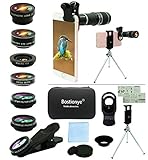
- ★11-in-1 most complete mobile camera lens kit★:Bostionye phone camera lens kit is perfect for exploring more advanced mobile photography and Videography.Includes 8 lenses:20 times telephoto lens,0.63X wide angle Lens, 15X Macro lens, 198°Fisheye lens, 2X telephoto lens,Kaleidoscopes, 4-line star filter, CPL Filter.Auxiliary equipment:universal clip, tripod, eyecup and Bostionye storage bag。 (Note: macro lens and wide angle lens are screwed together).
- ★With unique features★: 20x telephoto lens (fixed focus)-magnifies distant subjects and clearly presents long-distance vision. 198 ° fisheye lens-create interesting and unique circular mysterious effect pictures. 15x macro lens-Alignment lens for shooting flowers, insects and other small objects (optimal shooting distance: 1 to 3 inches).0.63X ultra wide-angle lens-capture a large field of view to get an amazing angle of view (The wide-angle lens should be used with a macro lens).
- ★Create surprise★:The unique functions of each small lenses can be seen in detail in the auxiliary picture display.tripod for easy shooting,An eyecup also allows you to use the telephoto lens as a monocular or a telescope.It is a good companion in the tourism industry and a favorite of animal observers.NOTE: It’s recommended to take off the phone case when using the lens since it may cause unstability while shooting.
- ★The kit is suitable for use on my phone?★:The lens kit works on 99% popular cell phones on the market. If the distance from the center of the camera(the phone has only one camera) or the main camera(two or more cameras) to any edge of your phone is less than 2.2cm, then the kit will work on your phone.How to know which is the main camera: block the camera one by one with the camera app on, the one you see a blockage there is the main camera.
- ★Best Gift Choice & 100% Satisfaction★:A phone lens kit that will provide you an extraordinary experience to capture wonderful moments in your life. The kit is fully equipped and packed in a storage box (can be carried by hand), this lens kit would be a very nice gift choice.Your satisfaction is the most important thing for us. Don’t be hesitate. Thrill your family and friends with Bostionye phone lens right now!
Use Looney 11 as a starting point
NASA describes the Looney 11 rule as a practical starting point: set the aperture to f/11 and choose a shutter speed roughly equal to the reciprocal of the ISO. For example, at ISO 100, try 1/100 second; at ISO 200, try 1/200 second. Keep ISO low when practical to limit noise, but use a faster shutter if movement or vibration is softening detail. This is a starting rule, not a guaranteed exposure: the Moon’s phase, altitude, and atmospheric conditions affect the result.
NASA’s examples show why settings should be treated as adjustable: one lunar-detail image used f/14, 1/30 second, ISO 200, while a daytime Moon image used f/11, 1/200 second, ISO 400. FUJIFILM’s example starting settings for a full-Moon surface image are ISO 100, f/8, and 1/250–1/500 second. These are examples from specific guidance, not a universal settings table.
Rank #2

- ★ This is a 420-800mm telephoto lens add extra 2X teleconverter lens become 1600mm focal. It's a Manual lens only work on manual focus mode without auto focus. Create Sharp High Quality Images, Comes with Lens Pouch and Protective Caps.
- ★ Compatibility with Canon EF/EF-S Mount---- Our telephoto lens is designed to fit a variety of Canon models including Canon EOS Rebel T8i/T7i/T7/T6s/T6i/T6/T5i/T5/T4i/T3i/T3/T2i/T1i/XSi/XS/SL3/SL2/SL1(100D) & Digital Rebel/XTi/XT/T100(4000D) & EOS 90D/80D/77D/70D/60D/50D/40D/30D/20D/10D/7D Mark II/7D/6D Mark II/6D/5DS R/5DS/5D Mark IV/5D Mark III/5D Mark II/5D & EOS-1D X Mark III/1D X Mark II/1D X/1Ds Mark III/1Ds Mark II/1Ds/1D Mark IV/1D Mark III/1D Mark II/Mark II N/1D.
- ★ Long Distance Capabilities-- - 420-800mm manual focus telephoto lens excels at capturing detailed images of distant subjects, effectively bringing remote objects closer. It is ideal for photographing the moon, wildlife, birds, buildings, airplanes, landscapes, and more. The aperture range is F8.3-16, and it automatically adjusts with the focal length.
- ★ [Solid Construction] Built with a full metal body and multi-coated low-dispersion glass elements, this lens can capture long distance subject with your Canon EOS SLR cameras. For those who photograph wildlife or the moon as a hobby, this lens would be a great choice;
- ★[Note] This is a manual lens, without elecontronice contacts, NO auto focus, so you need to use our lens in Mode M. On manual lenses, the camera may display F00 because it doesn't have direct access to the aperture value
Make a short exposure series
- Set the camera to manual exposure, if available, and begin near f/11, ISO 100–200, with the matching Looney 11 shutter speed.
- Focus on the lunar disc, then take a test frame.
- Inspect playback at magnification and check the histogram. If the Moon lacks visible surface texture or has clipped highlights, shorten the shutter time or reduce exposure compensation.
- Take a few more frames with shutter speed or exposure varied. Compare detail and sharpness; favor the fastest shutter that gives adequate exposure and a crisp result.
Air clarity, thin cloud, Moon altitude, and phase can all change the exposure. FUJIFILM recommends testing and bracketing rather than relying on a single fixed setting.
How to focus and keep the Moon sharp
With a camera and lens
Manual focus or the lens’s infinity setting can be a useful starting point, but do not assume the infinity mark is exact. Use magnified live view to focus on the Moon, take a test frame, and inspect the lunar edge and surface detail at playback magnification. Nikon recommends infinity focus and a shutter speed of at least 1/15 second or faster, and suggests f/11 or f/16 when ISO permits; use these as guidance, then verify the image with your own setup.
Rank #3

- [Easy-to-Use Warm Tips] - Fully manual lens has no electronic contacts for focusing. Switch the camera to full manual (M) mode immediately after installation, otherwise the "no lens" error may be triggered; If the error still occurs, you need to enable the "Release shutter without lens" option in the camera menu.
- [Manual Focus Experience] - Tailored for photographers who pursue the ultimate, the 420-800mm F8.3 lens adopts a fully manual focus design, requiring photographers to carefully adjust parameters such as shutter speed, ISO and aperture before shooting.
- [Telephoto Zoom Lens] - Features include precision manual focus with a large focus ring design and an internal focus mechanism, UMC technology to minimize aberrations and flare. The aperture automatically adjusts based on focal length (f/8.3 at 420mm, f/16 at 800mm), and it is compatible with 62mm filters and EF/EF-S mounts.
- [Compatibility with Canon EF/EF-S Mount] - Lightdow 420-800mm f8.3 telephoto lens is perfectly compatible with for Canon EOS Rebel T8i/T7i/T7/T6s/T6i/T6/T5i/T5/T4i/T3i/T3/T2i/T1i/XSi/XS/SL3/SL2/SL1(100D) & Digital Rebel/XTi/XT/T100(4000D) & EOS 90D/80D/77D/70D/60D/50D/40D/30D/20D/10D/7D Mark II/7D/6D Mark II/6D/5DS R/5DS/5D Mark IV/5D Mark III/5D Mark II/5D & EOS-1D X Mark III/1D X Mark II/1D X/1Ds Mark III/1Ds Mark II/1Ds/1D Mark IV/1D Mark III/1D Mark II/Mark II N/1D.
- [Capture Capabilities] - 420-800mm manual focus telephoto lens excels at capturing detailed images of distant subjects, effectively bringing remote objects closer. It is ideal for photographing the moon, wildlife, birds, buildings, airplanes, landscapes, and more. The aperture range is F8.3-16, and it automatically adjusts with the focal length. Consequently, the camera cannot set the aperture value of the manual lens, resulting in the display of F00/F-- on the camera.
Long focal lengths and telescope magnification make small movements and atmospheric turbulence more apparent. Use a firm tripod or stable support, and choose a faster shutter when exposure allows. With a telescope setup, NASA advises live view or mirror lock to reduce vibration from the camera mirror. A timer or remote release can also prevent movement when you press the shutter.
With a phone
- Turn off flash and prop the phone on a steady surface or use a tripod mount.
- Tap the Moon on screen to focus, then lower exposure or screen control until the disc looks gray enough to show features.
- Use the phone’s timer to avoid jostling it when taking the picture.
- Compare results at different zoom levels. Digital zoom may only crop the image; optical zoom uses the lens to magnify the subject, so more on-screen zoom does not automatically mean more detail.
A phone can work well for a Moon included in a wider scene. A dedicated camera offers more exposure and lens control, while a telephoto lens or telescope is more useful when the Moon itself needs to fill more of the frame.
Rank #4
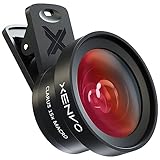
- ✔ COMPATIBLE WITH ALL SMARTPHONES, TABLETS, and LAPTOPS including ALL iPhone models, Samsung Galaxy and Note, Google Pixel, Huawei and more. CONTENTS INCLUDE: TruView 0.45x Wide Angle Lens, Clarus 15x Macro Lens, TruGrip Lens Clip, GlowClip Mini Rechargeable LED Light + Charging Cable, Quick-Release Lanyard, DuraCase, EasyClip, and Cleaning Cloth.
- ✔ TRUVIEW 0.45x WIDE ANGLE LENS - CAPTURE 45% MORE PICTURE WITH EVERY SNAP: Shoot stunning photos of people, pets, travel scenery, landscapes, architecture, selfies and more. NO DARK CORNERS (vignetting) like cheaper lenses. Crafted from aircraft-grade aluminum and premium optical glass for durability and clarity. Multi-element, coated glass lenses minimize ghosting, reflections, lens flare, and other artifacts. Xenvo cell phone lens attachment is ideal for hobbyists and photography pros alike.
- ✔ CLARUS 15x MACRO LENS - MARVEL YOUR SENSES. MAGNIFY NEARBY SUBJECTS FOR BREATHTAKING, SUPER CLOSE-UP PHOTOS: Capture all the intricacies and details with precision-focus for razor crisp macro photos every time. (For best results, position macro lens approximately 1/2 inch from subject. Not designed for zooming in on distant subjects.) THE TRUGRIP LENS CLIP offers SUPERIOR GRIPPING POWER to fasten your lenses to your cell phone when you're in action mode, framing your next perfect shot.
- ✔ GLOWCLIP RECHARGEABLE LED FILL LIGHT - The GlowClip LED light clips ANYWHERE on your phone to instantly illuminate your subject and surroundings with warm continuous light. The warm and natural LED light is superior to your smartphone's built in flash—which can be blinding and unnatural—especially in darker settings and venues. FEATURES 3 BRIGHTNESS SETTINGS: Low, Medium and High. Say goodbye to frustrating photo "retakes" and hello to brilliant photos the first time.
- ✔ QUICK-RELEASE LANYARD AND TRAVEL CASE - TRANSPORT AND PROTECT YOUR LENS KIT: Perfect for taking your Xenvo lenses with you on the fly. The travel case stores and protects all lens kit components snugly and safely while the quick-release lanyard is the perfect way to carry your lenses on your next outing. Just drape the lanyard and lens around your neck. The quick-release lanyard head makes it a cinch to access your Xenvo lenses in a flash so you never miss another photo moment.
Expose a Moon-and-landscape scene
The Moon can be far brighter than a dark foreground, exceeding what one exposure can record with detail in both. Decide which part of the frame is the priority before shooting:
- Expose for the Moon: preserve lunar texture and let the foreground become a silhouette.
- Expose for the foreground: retain landscape detail and accept that the lunar disc may become very bright.
- Shoot at twilight: the sky and foreground may be brighter, reducing the exposure gap.
- Combine separate exposures: expose one frame for the Moon and another for the foreground, then blend them if the intended image calls for detail in both. Nikon notes that a composite can be appropriate.
FUJIFILM likewise advises choosing the main subject because the camera may not capture the bright Moon and dark surroundings as a single detailed exposure. For a natural-looking frame, include a clear foreground subject and make the trade-off deliberate rather than trying to force equal detail everywhere.
Free tools Windows power users keep installed
One-click scans. No signup required.
Best Value

- ★ JINTU 420-800mm MF Super HD Telephoto lens, Solid Construction with full metal body, Small size 10.6 x 3.5 x 3.5 inch, lightweight 700g=1.8LB, easy to carry to anywhere.
- ★ Ultra high definition image quality from Japan, Multi coated low-dispersion glass. Free canon adapter supply. If your camera is Nikon, Pentax, Sony e mount cameras or other brand which can buy it from our store.
- ★ Compatible with Canon EOS Rebel T1i, T2i, T3, T3i, T4i, T5, T5i, T6, T7, T6i, T6s, T7i, SL1, SL2, 60D, 70D, 77D, 80D, 50D, 40D, 30D, 5D, 1D, 5D III, 5D IV, 5Ds, 6D, 7D, 7D Mark II etc SLR Digital Cameras.
- ★ Perfect for boyfriend or husband birthday gifts or photographyer. Best choice for small or distant subjects, ranging from birds and wildlife, through sports, to moon etc.
- ★ NOTE: This is a manual lens, NO auto focus, your camera will show "lens not attach", but not defect. pls switch to MF MODE in order to use this lens.
Equipment: what helps and what is optional
Start with the camera or phone you already have. NASA notes that the useful setup depends on the equipment, conditions, and image you want.
Quick Recap
- Telephoto lens: useful for enlarging the Moon in the frame. Nikon identifies zoom and super-telephoto lenses as options; confirm that a lens fits your camera mount.
- Tripod or stable support: helps reduce movement. A phone can also be propped on a steady surface. A built-in timer, remote release, or wireless camera control can trigger the shot without touching the camera.
- Telescope adapters: for afocal phone photography, position the phone at the eyepiece and use a compatible phone adapter for stability. Prime-focus DSLR photography requires both a camera-specific T-ring and a telescope-specific T-adapter; check compatibility for each.
Product prices and availability are accurate as of the date/time indicated and are subject to change. Any price and availability information displayed on Amazon at the time of purchase will apply.

