
Crashes, No Sound, or Screen Glitches?
Random freezes, missing sound and display glitches usually trace back to one bad driver. Find and replace yours safely.Free scan · under a minuteWindows Errors? Fix Them Before They Spread
Repair common Windows errors and clear accumulated junk for a smoother, more stable PC - no reinstall needed.Free scan · no reinstallAirlines prepare pilots for cockpit emergencies through aircraft-specific procedures, recurring practice, simulator exercises where required or available, and crew resource management (CRM). The aim is not simply to memorize checklists: crews practise recognizing a problem, sharing information, dividing tasks, and deciding what to do as conditions change. Exact requirements vary by jurisdiction and operating category.
What emergency training includes
Airline preparation combines technical knowledge and practical teamwork. Pilots study the aircraft and the operator’s procedures, practise normal and abnormal operations, and train for emergency situations. Regulators set requirements for particular operating contexts; they do not impose one identical syllabus or schedule on every airline worldwide.


Aircraft systems and procedures
Crews learn the aircraft’s systems, checklists, briefings, and operating procedures. The details are specific to the aircraft and airline. Knowing a checklist is only part of the task: pilots also need to recognize when it applies and use it while managing the rest of the flight.
Recurrent practice and simulation
Because serious emergencies are uncommon in everyday operations, recurrent training gives crews opportunities to practise abnormal and emergency procedures. Under EASA’s Easy Access Rules for Air Operations, Revision 24 (March 2026), recurrent training includes these procedures, with an FSTD (flight simulation training device) used when available and accessible. The provision is specific to that European framework; device use and training requirements should not be assumed to be identical elsewhere.
In the United States, the FAA describes enhanced training for Part 121 air carriers, including stall and upset prevention and recovery. The FAA says compliance with implementation and flight-simulation-device standards became mandatory by March 12, 2019. Its Air Carrier Training page was last updated January 29, 2021. This is a U.S. example, not a global training calendar.
Why crew resource management matters
In an emergency, the flying pilot may be handling the aircraft while the other pilot monitors, works through procedures, communicates, or helps assess options. CRM training develops the communication, coordination, workload management, monitoring, and decision-making skills that support those tasks. EASA defines CRM as “the effective utilisation of all available resources (e.g. crew members, aircraft systems, supporting facilities and persons) to achieve safe and efficient operation” in GM1 ORO.FC.115 of its Easy Access Rules for Air Operations.
EASA guidance calls for CRM principles to be integrated into checklists, briefings, and abnormal and emergency procedures. It addresses monitoring by the non-flying pilot, timely intervention, shared understanding of automation, workload, and coordination between flight and cabin crew. Combined training may also cover coordination with cabin and technical crew; that is distinct from pilots’ aircraft-specific simulator training.
Within EASA’s framework, recurrent CRM training is annual, with all specified elements covered over a period not exceeding three years. This is a schedule for that framework, not a universal cadence. In a 2013 speech explaining the U.S. pilot-training rule, then-FAA Administrator Michael Huerta said the rule would let airlines view a pilot’s training performance over time, and that “The pilot who is not flying has an active job to do.” Those were policy remarks, not evidence that all airlines use the same performance-tracking process.
How training and checking can address gaps
Training and checking can reveal areas where a pilot needs more practice. FAA Advisory Circular 121-39, issued December 30, 2014 and listed as active, gives Part 121 carriers guidance on developing remedial training and tracking. It describes one means of compliance, not the only acceptable approach. Neither the FAA material nor EASA rules support assuming that every airline uses one identical method to assess or remediate performance.
Independent reader supportYour contribution helps us test, update, and keep practical guides available for everyone.What training can—and cannot—reproduce
Simulations let crews practise scenarios without putting an operating flight at risk, but real emergencies can combine events and demands in ways that are difficult to reproduce in scripted exercises. The point is not that simulator training fails: it provides structured practice, while crews must also apply judgment and teamwork when a situation does not unfold as expected.
A historical review by Barbara K. Burian, Immanuel Barshi, and Key Dismukes examined 107 ASRS reports about emergency or abnormal situations. Twenty-five of the 107 reports described events judged to have been handled quite well; 19 of those 25 involved relatively “textbook” situations. Among 85 non-textbook reports, 93 percent involved a problem with the response or with the materials and resources used. These are findings from a selected historical reporting sample; the article’s exact issue year is not verified. They are not current industry-wide success or failure rates, and they do not establish that training caused the outcomes.
The review’s practical implication is that familiar, relatively straightforward events may differ from compound or unexpected ones, which can add workload and coordination demands. No current system-wide statistic measuring how often airline pilots encounter or successfully handle cockpit emergencies is established by the cited material.
Quick Recap
Best Value
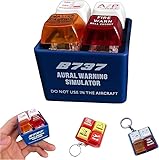
- Authentic Cockpit Safety Button Replication: This pilot crew alert keychain mimics real aircraft cockpit emergency buttons with 4 authentic warning sound effects: wind shear, terrain alert, pull-up command, and sink rate alarm. Every detail—from the button texture to the LED indicator—replicates commercial aviation standards, making it a premium collectible for aviation enthusiasts
- Functional and Interesting Interaction: The egpws warning sound simulator is equipped with a flashlight. Pressing the button can simulate an emergency alarm, and you can also enjoy the cool lighting effect, turning the daily key groping into an interesting interactive experience
- Assist Safety Training: The aviation cockpit keychain can be used as an auxiliary tool for safety training. By simulating the operation in an emergency, it helps users familiarize themselves with the operation process of the cockpit emergency procedure, which has certain practical value
- Stress-Relieving Tactile Experience: Beyond aviation use, the keychain serves as a sensory stress reliever. The satisfying click of the button, combined with the rhythmic alarm patterns, provides therapeutic feedback for anxiety relief. The LED light can also be used as a calming ambient glow, making it a versatile tool for office desks, travel, or daily commutes
- Conversation-Starting Gift for Aviation Fans: Whether it is a pilot graduation ceremony, birthday or other occasions, this small, personalized, and topic-provoking pilot and crew alert keychain is a must-have for aircraft enthusiasts, which can make them smile
Product prices and availability are accurate as of the date/time indicated and are subject to change. Any price and availability information displayed on Amazon at the time of purchase will apply.

