
The Tool Desk
Outbyte PC Repair FREEClear out junk files and repair common Windows errorsFree Scan →Outbyte Driver Updater FREEFix the driver behind crashes, sound loss and screen glitchesFind Drivers →Oak Ridge National Laboratory’s Summit was a supercomputer built around 4,608 IBM Power System AC922 nodes. Each node paired two IBM POWER9 CPUs with six NVIDIA Tesla V100 GPUs, for 9,216 CPUs and 27,648 GPUs across the system. Designed for roughly 200 petaflops of theoretical peak performance, Summit supported open scientific research from its 2018 debut until it was decommissioned on November 15, 2024.
What was inside Summit?
Summit’s defining choice was to put several powerful GPUs beside general-purpose CPUs in every node. That made it an accelerator-heavy system: CPUs coordinated work and handled tasks suited to them, while GPUs performed many of the parallel calculations used in simulation and machine learning.
| Component | Per node | Across 4,608 nodes |
|---|---|---|
| IBM POWER9 CPUs | 2 | 9,216 |
| NVIDIA Tesla V100 GPUs | 6 | 27,648 |
| DDR4 memory | 512 GB | More than 2.3 PB, based on the per-node specification |
| GPU HBM2 memory | 96 GB | About 0.44 PB, based on the per-node specification |
| Non-volatile memory | 1,600 GB | About 7.4 PB, based on the per-node specification |
| Peak performance | About 42 TFLOPS in the official node table | About 200 PFLOPS theoretical peak in ORNL’s system description |
The memory figures describe different parts of the system, not one interchangeable pool. DDR4 was system memory, HBM2 was high-bandwidth memory attached to the GPUs, and the official node specification separately listed non-volatile memory. ORNL described the system as having more than 10 PB of aggregate memory. Summit also used a 250 PB IBM GPFS/Spectrum Scale file system, a separate shared-storage tier rather than memory inside each node.
How did Summit’s CPUs, GPUs and network work together?
Inside a node: POWER9, V100 and NVLink
Within each AC922 node, NVIDIA NVLink provided high-bandwidth communication between POWER9 CPUs and V100 GPUs. This mattered because adding processors alone does not make a workload faster if data cannot reach them quickly enough. Summit’s architecture aimed to reduce that bottleneck by giving the accelerators a fast route to data and to the CPUs coordinating a computation.
#1 Best Overall

- 【Powerful Load-bearing】12U Network Rack Open Frame is constructed from durable cold rolled steel; Rack shelf supports enhance stability, wall-mounted capacity of 130lbs, the ground-mounted up to 260lbs
- 【Considerate Designs】Open-frame layout, including a top panel adding space, anti-slip shelf stops fixing devices and compatible racks for stack and expansion to meet requirements of home server rack
- 【Complete Accessories】A 12U open frame server rack, two ventilated shelves, four shelf stops, four velcro straps and a set of equipment mounting screws
- 【Versatile Application】Ideal for space-efficient multi-device setups in warehouses, retail, classrooms, offices and more; Excellent choices as AV Rack/IT Rack
- 【Effortless Setup】 Network Rack includes hardware, a comprehensive manual, mounting hole drilling template and an online assembly video to simplify setup
The design could support both traditional simulations and machine-learning work, but it did not make every program automatically faster. Scientists had to adapt software to use the GPUs and manage data movement efficiently.
Between nodes: InfiniBand
Summit connected nodes using dual-rail Mellanox EDR 100G InfiniBand in a non-blocking fat-tree. In practical terms, multiple network links and the fat-tree design helped thousands of nodes exchange data as large jobs were distributed across the machine. EE Times’ June 9, 2018 feature described Summit as the first public high-performance cluster at this scale to support PCI Express 4.0 and reported cross-sectional network bandwidth approaching one petabit per second.
That network was crucial for workloads that repeatedly exchanged results among nodes. A GPU-rich node could calculate quickly, but a large simulation could still be limited if its pieces could not communicate at scale.
Rank #2

- ADJUSTABLE DEPTH: 4-Post 42U open frame server rack with 4 vertical rails and adjustable mounting depth 22" to 40" (56,0cm to 101,7cm); Compatible with various servers / switches / data / AV and other IT equipment; EIA/ECA-310-E Compliant
- EASY ASSEMBLY: Mobile network rack with easy-to-follow assembly instructions and online video; Compact flat-pack shipping to avoid damage and facilitate installation; Total product height of 80.3in (204 cm) with casters, 78in (198cm) without casters
- COLD ROLLED STEEL: Durable 4 Post 19in open frame rack designed for ventilation with 42U mounting height and 1320lb (600kg) weight capacity (stationary); 3 install options included: casters, levelling feet, or base-plate to secure rack to the floor
- HARDWARE INCLUDED: Rolling computer/data rack includes cage nuts and screws to mount equipment, easy to read Units (U) and depth adjustment markings, cable management hooks for organization, and required assembly tools
- THE IT PRO'S CHOICE: Designed and built for IT Professionals, this 42U rack is backed for 2-years, including free lifetime 24/5 multi-lingual technical assistance
How powerful was Summit, and how much power did it use?
ORNL’s 2018-era system description gave Summit a theoretical peak of 200 petaflops—about 200 quadrillion floating-point operations per second under idealized conditions. That peak is a design specification, not a promise that every application would sustain that speed. ORNL’s official specification table listed approximately 42 teraflops per node; multiplied across 4,608 nodes, that is roughly 193.5 petaflops, consistent with the rounded system-level figure.
Quick wins for a faster PC:
Clear out junk files and repair common Windows errorsFree Scan →Fix the driver behind crashes, sound loss and screen glitchesFind Drivers →The official specification table listed peak power at about 13 MW. A separate historical planning passage on ORNL’s system page cited about 15 MW, so the figures refer to different contexts rather than one exact, universal reading. Both convey the scale of the electricity required to operate a machine of this size.
What did scientists use Summit for?
Summit was dedicated to open science, with work spanning energy, climate, materials, biology, health and artificial intelligence. Its mix of CPUs, GPUs, memory and high-speed networking suited projects that combined large datasets with complex computation.
Rank #3
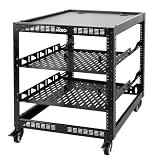
- 【Powerful load-bearing】12U Network Rack Open Frame is constructed from durable Cold Rolled Steel; Rack Shelf Back Support enhances stability; load-bearing capacity of 260lbs
- 【Sliding&Considerate】Open-frame layout, including four wheels easy to move, a top panel adding space, anti-slip shelf stops fixing devices and compatible racks for stack and expansion to meet requirements of home server rack
- 【Complete Accessories】A 12U open frame server rack, two ventilated shelves, four shelf stops, four casters, four velcro straps and a set of equipment mounting screws
- 【Versatile Application】Ideal for space-efficient multi-device setups in warehouses, retail, classrooms, offices and more; Excellent choices as AV Rack/IT Rack
- 【Effortless Setup】Server rack with wheels includes hardware, a comprehensive manual, mounting hole drilling template and an online assembly video to simplify setup
Biology and health
ORNL documented a biology project that combined neutron-scattering experiments, cryo-electron microscopy images and Summit computation to study intrinsically disordered proteins. Other ORNL reporting described molecular-dynamics work investigating DNA-repair mechanisms.
Simulation and AI
Summit was also used for large-scale simulations, including work relevant to energy and climate science, and for AI-supported processing of scientific data. In a 2024 ORNL decommissioning feature, infrastructure operations group leader Paul Abston said: “Summit was designed to run huge simulations on supernovae and fusion reactors.” The V100 GPUs were useful not only for simulations but also for machine-learning methods applied to scientific problems.
Recommended Free Tools
Demand continued late in the system’s life. Under the SummitPLUS extension, 108 projects received more than 19 million compute hours from January through October 2024. OLCF director of science Bronson Messer described the extension this way: “Summit has been a remarkably successful supercomputer, and there was no reason to limit that success to just five years.”
Rank #4

- Adjustable Depth: 23-40'' adjustable depth is used for servers and network equipment, ensuring enough space for AV equipment, components, and cabling, while allowing you to access ports and equipment from multiple sides.
- Strong Load Capacity: Ground-Mounted Load Capacity: 500 lbs, Wall-Mounted Load Capacity: 150 lbs. The av rack is made of carbon steel for better weldability performance and can help save space while meeting your need to place multiple devices.
- User-friendly Design: Ergonomic design makes the open frame av rack easier to use. The additional top panel is able to place other items with more available space. Roller design moves anywhere and anytime, is convenient, and is more energy-saving.
- Complete Accessories: We provide the accessories you need, including 2 x Pallets, 145 x M5*10 Cross Head Screws, 4 x Casters, 4 x M10*50 Expansion Screws,10 x M6*12 Cage Nuts, 1 x Grounding Wire, 1 x User Manual.
- Wide Application: The server rack wall mount maximizes the use of available space, suitable for retail venues, classrooms, offices, and other places where space is limited.
Is Summit still running?
No. Summit debuted in June 2018 and was decommissioned on November 15, 2024. ORNL’s lifecycle notice set that date as the last day for batch jobs, and the archived user guide now warns that the system is no longer online. Summit is therefore a retired system, not a machine on which researchers can currently run jobs.
Frontier had taken over as the Oak Ridge Leadership Computing Facility’s flagship before Summit’s retirement. During its service, Summit remained among the world’s fastest systems and delivered more than 200 million node-hours, according to OLCF’s 2024 lifecycle notice.
Quick Recap
Product prices and availability are accurate as of the date/time indicated and are subject to change. Any price and availability information displayed on Amazon at the time of purchase will apply.
Do these 3 things before closing this tab:
1Fix the driver behind crashes, sound loss and screen glitches2Repair Windows errors before they cause bigger problems3Scan for outdated or missing drivers - takes under a minute
