
iTechGuides is reader-supported. When you buy through links on our site, we may earn an affiliate commission. As an Amazon Associate I earn from qualifying purchases. Learn more
Yokogawa’s PBDH0400 family pairs DC-to-400 MHz bandwidth with high-voltage differential measurement for power-electronics testing. The 702921 is rated for 1,000 V and offers 50:1/500:1 attenuation; the 702922 is rated for 2,000 V and offers 100:1/1,000:1. Both are intended for fast switching-waveform work, including measurements on SiC and GaN power devices, and connect through a dedicated interface to specified Yokogawa DLM oscilloscopes.
What the PBDH0400 probes are designed to measure
Yokogawa announced the PBDH0400 family on November 8, 2024, for next-generation power-electronics development, including automotive applications. These are differential probes: they measure the voltage between two circuit points while isolating circuit ground from oscilloscope ground. That makes them useful for examining a high-side switch, where a relatively small differential waveform can ride on a large common-mode voltage.
Common-mode noise can distort the waveform being measured. Yokogawa says the PBDH0400’s patented differential-amplifier configuration is intended to improve common-mode rejection above 1 MHz. This is relevant when switching transients and other high-frequency content are present, but it does not eliminate the need to check the probe’s frequency-dependent CMRR against the converter and measurement setup.
What’s actually slowing this PC down?
Pick the symptom - the matching free tool is one click away.
702921 vs. 702922: ratings and published specifications
| Specification | 702921 PBDH0400 | 702922 PBDH0400 |
|---|---|---|
| Rated voltage | 1,000 V | 2,000 V |
| Bandwidth | DC to 400 MHz | DC to 400 MHz |
| Attenuation options | 50:1 and 500:1 | 100:1 and 1,000:1 |
| Maximum differential input | ±100 V / ±1,000 V, as listed in Yokogawa’s 2024 technical report for the available input ranges | ±200 V / ±2,000 V, as listed in Yokogawa’s 2024 technical report for the available input ranges |
| Maximum input | ±1,000 V | ±2,000 V |
| Maximum non-destructive voltage | ±1,500 V | ±3,000 V |
| DC gain accuracy | ±0.7% | ±0.7% |
| Measurement category published in the report | 1,000 V CAT II; 600 V CAT III; 300 V CAT IV | Not stated in Yokogawa’s 2024 technical report |
The report lists two maximum differential-input levels for each model, corresponding to its different input ranges. These limits are not interchangeable with the rated voltage or maximum non-destructive voltage. In particular, maximum non-destructive voltage describes a damage threshold, not a safe operating measurement range. Select the model and attenuation range for the actual differential voltage and observe all applicable ratings and safety instructions.
#1 Best Overall
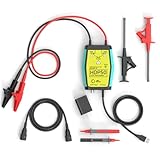
- The HDP50 differential probe is designed for high frequency and high voltage measurements. The 100Mhz BD and 1400V range will help you with most high voltage situations.
- Two ranges are available for different applications: 50x attenuation (140V range) and 500x attenuation (1400V range). 5V DC adapter included, no batteries required. Power supplies are also available from power packs, PC USB, and mobile phone charging.
- Compatible with a wide range of oscilloscopes, requiring only that the device be equipped with standard BNC connectors. Designed for measuring high-voltage differential signals for floating measurements. Comes with a black storage case for easy portability.
- Package include: 1 x HDP50 differential probe with USB connector, 2 x alligator clips, 2 x multimeter pens, 2 x high voltage test hook clips, 1 x BNC to BNC cable, 1 x 5v adapter for power supply, 1 x black storage box.
- Hope you can be satisfied with our products. We will always provide friendly customer service.
What 400 MHz bandwidth means for SiC and GaN testing
Yokogawa gives an approximate 1 ns voltage rise time for the 400 MHz bandwidth and says the wider bandwidth is intended to accommodate the faster switching of newer power devices. That makes these probes relevant to SiC and GaN waveform measurements, but bandwidth alone cannot establish whether a probe will capture a particular switching edge accurately. Compare the edge speed and frequency content of the signal with the probe’s bandwidth, and account for the measurement setup and loading.
CMRR also falls as frequency rises. Yokogawa’s technical report publishes these typical values for the 702921/702922:
Rank #2

- Cutting-Edge Technology: Originating from Micsig’s advanced SigOFIT technology, this probe offers a very low noise floor, excellent amplitude-frequency characteristics, and an industry-leading common mode rejection capability.
- High Accuracy: The DP series probe has superior bandwidth flatness, with amplitude fluctuation less than 0.5dB within its half bandwidth range, ensuring high accuracy even in high-frequency bands.
- User-Friendly Features: With a 5MHz Bandwidth Limit, Quick Zero function, and Dual Range Selection feature, this probe is designed for user convenience and flexibility.
- Versatile Compatibility: The standard BNC interface allows it to work with any oscilloscope, making it a versatile addition to your toolkit.
- Compact Design & Over-Range Alert: Much smaller than other differential probes, this sleek device also includes an over-range alert with an LED indicator and buzzer for added safety.
| Frequency | Typical CMRR |
|---|---|
| DC | 80 dB |
| 100 kHz | 70 dB |
| 1 MHz | 70 dB |
| 2 MHz | 60 dB |
| 10 MHz | 50 dB |
| 50 MHz | 40 dB |
| 100 MHz | 30 dB |
| 400 MHz | 20 dB |
For example, the published typical CMRR is 20 dB at 400 MHz, substantially lower than at DC. If common-mode content is significant at the frequencies of interest, evaluate the corresponding CMRR rather than relying on a single headline figure. The report does not provide input impedance or capacitance values in the specifications summarized here, so those loading details should be checked in the current product documentation before use.
Oscilloscope compatibility and probe power
The dedicated-interface 702921 and 702922 are designed for Yokogawa DLM3000, DLM3000HD, DLM5000, and DLM5000HD oscilloscopes. Confirm the exact scope model and interface before ordering; the family should not be assumed to connect to an arbitrary oscilloscope through BNC.
Rank #3

- Advanced Technology: Powered by Micsig's advanced SigOFIT technology, this probe offers a very low noise floor, excellent amplitude-frequency characteristics, and industry-leading common mode rejection capability
- High Precision: The DP series probe has a higher band flatness, with an amplitude fluctuation of less than 0.5dB in its half-bandwidth range, which ensures high accuracy even in high-frequency bands
- User-friendly Features: With 5MHz bandwidth limit, fast zero function and dual range selection function, this probe is designed for user convenience and flexibility
- Versatile Compatibility: The standard BNC interface allows it to work with any oscilloscope, making it a versatile addition to your toolbox
- Compact Design & Over-Range Alert - Much smaller than other differential probes, this stylish probe also features a range overshoot alert with an LED indicator and buzzer for added safety
Yokogawa also lists related BNC-connected models, including the 702924, with a different connection and power arrangement. Its product quote information identifies the 702924 as compatible with DLM3000HD and DLM5000HD and says it requires either a DLM probe-power option or the separately sold 701934 external probe power supply. That requirement applies to the 702924 information, not automatically to the dedicated-interface 702921/702922. Verify the selected probe’s connector and the scope’s probe-power configuration before purchase.
Quick Recap
Best Value

- Cutting-Edge Technology: Originating from Micsig’s advanced SigOFIT technology, this probe offers a very low noise floor, excellent amplitude-frequency characteristics, and an industry-leading common mode rejection capability.
- High Accuracy: The MDP series probe has superior bandwidth flatness, with amplitude fluctuation less than 0.5dB within its half bandwidth range, ensuring high accuracy even in high frequency bands.
- User-Friendly Features: With a 5MHz Bandwidth Limit, Quick Zero function, and Dual Range Selection feature, this probe is designed for user convenience and flexibility.
- Versatile Compatibility: The standard BNC interface allows it to work with any oscilloscope, making it a versatile addition to your toolkit.
- Compact Design & Over-Range Alert: Much smaller than other differential probes, this sleek device also includes an over-range alert with an LED indicator and buzzer for added safety.
Rank #4

- Widely Used: The attenuation rate is 10X/100X, widely used in any brand of oscilloscope.
- Maximum differential test voltage (DC+ACPK-PK): 70V (10X), 700V (100X). You can safely measure floating voltages up to 700V and have a bandwidth up to 100 MHz.
- Easier and Safer Use: High voltage differential probes sample high impedance isolation between input and output to protect person safety. Power supply USB DC 5V output, more portable while Oscilloscope has USB interface.
- Versatile Kit: All 6 pieces with three different connectors help to test various on different occasions, including 2 alligator clips, 2 hook clips and 2 pincer clips.
- Applications: Floating Measurements, Switch-Mode Power Supply (SMPS), Motor Drive Design, Power Device Testing & Evaluation, Power Converter Testing & Design.
What to check before choosing a probe
- Voltage limits: Match the differential voltage and input range to the applicable rated and maximum-input specifications; do not treat the non-destructive limit as an operating rating.
- Switching edge: Compare the signal’s edge speed with the 400 MHz bandwidth and approximately 1 ns rise-time specification.
- Common-mode rejection: Use the frequency-dependent CMRR values relevant to the noise and switching content in the measurement.
- Attenuation and loading: Choose a model and attenuation range that fit the signal. Confirm input impedance and capacitance in the current manufacturer documentation.
- Connection and power: Check whether the scope supports the dedicated Yokogawa interface or whether a BNC model and a specific probe-power arrangement are required.
- Safety category: Confirm that the published category and voltage ratings match the circuit and measurement environment. The cited 2024 report lists categories for the 702921, but not for the 702922.
Product prices and availability are accurate as of the date/time indicated and are subject to change. Any price and availability information displayed on Amazon at the time of purchase will apply.

