
In a low-voltage wireless design, a very-low-dropout regulator (VLDO) can provide a quiet final voltage rail when an upstream converter has already brought its input close to the load voltage. It is a linear post-regulator, not a step-up converter. That was the central design case made by Tony Armstrong in a July 1, 2005 Electronic Design article: use switching conversion for the large voltage reduction, then use VLDOs for nearby, noise-sensitive rails.
What problem was a VLDO meant to solve?
Wireless products were adding low-voltage digital loads, including DSP cores, while designers also had to manage battery life, board space, heat and supply noise. The article frames a practical question: if a 1.5 V main rail is available, how can a designer power a 1.2 V DSP core? A VLDO can make that smaller final reduction while maintaining a low input-to-output voltage difference.
The important condition is that the input rail must already be close to the desired output. A linear regulator cannot raise voltage, and it is generally wasteful to ask one to absorb a large voltage difference at substantial load current.
How the 2005 example architecture works
Armstrong’s period example starts with a nominal 3.6 V Li-ion battery rail. A switching regulator reduces it to 1.5 V; VLDOs then derive lower rails such as 1.375 V and 1.2 V. This divides the work: the switching stage handles the larger conversion, while the VLDOs provide local post-regulation. These are examples from the 2005 article, not a description of current wireless-device designs.
Free tools Windows power users keep installed
One-click scans. No signup required.
#1 Best Overall

- [Compatible With]: The voltage regulator rectifier assy w/Wire harness is compatible with Honda GX270, GX440, GX610, GX620, GX630, GX630R, GX630RH, GX640, GX660, GX660R, GX660RH, GX670, GX690, GX690R, GX690RH Engines.
- [Compatible With]: The voltage regulator rectifier assy w/Wire harness is compatible with Honda GXV630, GXV630R, GXV630RH, GXV660, GXV660R, GXV660RH, GXV690, GXV690R, GXV690RH, GX270UT2, GX440IU Engines.
- [Replace Part Number]: 31620-ZG5-033, 31750-Z2E-803, SH748AA (voltage regulator rectifier); 32105-Z6L-0001, 32105-Z6L-000 (wire harness). This is not an original factory part, but it will be a perfect replacement part.
- [High Quality]: Our products are made of high-quality raw materials through professional production technology, so that the products have excellent performance and long service life.
- [Warranty & Service]: We will provide you with a one-year product return service. If you have any questions during purchase and use, please feel free to contact us. It is our honor to serve you.
For a linear regulator, the article uses the approximation that efficiency is output voltage divided by input voltage. On that basis, converting 1.5 V to 1.375 V gives about 91.7%, while 1.5 V to 1.2 V gives 80%. By contrast, its 3.6 V-to-1.8 V example gives 50%. These are calculated voltage-ratio examples, not measured system efficiencies; actual efficiency also depends on quiescent current and operating conditions.
The article also attributes an 80% to 90% efficiency range to VLDO use at low nominal operating currents. It says a switching regulator can exhibit efficiency up to 96%. Those are source-era claims, not current benchmarks or guarantees for a particular design. Compare candidate devices using the actual input range, load profile and operating conditions.
Rank #2
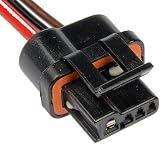
- Direct replacement - this voltage regulator connector matches the appearance and function of the factory hardware on specified applications
- Ideal solution - this connector is a reliable replacement for an original part that is missing or has failed due to fatigue
- Durable construction - this part is made from quality materials to ensure reliable performance and long service life
- Trustworthy quality - backed by team of product experts in the United States and more than a century of automotive experience
- Ensure fit - to make sure this part fits your exact vehicle, input your make, model and trim level into the garage tool
How VLDOs compare with other regulator approaches
| Approach | Strengths in the article’s comparison | Trade-offs |
|---|---|---|
| Linear LDO or VLDO | Simple design and low output noise; a VLDO can regulate when input and output are close. | For a given load current, a larger input-to-output drop means more power dissipated as heat and lower voltage-ratio efficiency. |
| Charge pump | Does not require an inductor. | Has conversion-ratio and output-current limits that must suit the load. |
| Switching regulator | Can be efficient when making a substantial voltage conversion. | Introduces switching noise and typically requires magnetic components; design and layout are more involved. |
These are qualitative comparisons from a 2005 trade article, not a ranking of modern parts. A real selection depends on the rail’s input range and target voltage, steady and transient load current, noise limit, thermal budget, board area and required external components. Armstrong wrote that switching-regulator disadvantages “are minor and can usually be overcome with good design techniques.” That is his assessment in a vendor-authored article, not a universal finding.
Why noise and transient response matter
The article’s phone-era context describes noise-sensitive digital devices as typically requiring ripple below 1 mV peak-to-peak. Treat that as a historical requirement cited by the article, not a universal limit for wireless products today. The relevant target must come from the load’s specifications and the complete power-distribution design.
Rank #3

- A simple socket board which is for NRF24L01+ module.
- 6 pin headers correspond to the SPI interface; from left to right: CE, , SCK, MOSI, MISO, IRQ.
- The operating voltage of the module is generally 3.3V, while the ordinary 51 single-chip microcomputer is 5V.
- This module is module with 51 single-chip board used in conjunction.
- materials with good performance, stable and .
A low-noise linear post-regulator may help isolate a load from upstream switching ripple, but its output behavior still depends on the regulator, capacitors, layout and changing load. When a digital core suddenly draws current, the output capacitor and regulator response affect the size and duration of the voltage deviation.
What to check when selecting a VLDO
- Input and output ranges: Confirm the minimum and maximum upstream voltage, the required output voltage and the regulator’s dropout behavior across the intended load.
- Load current and transients: Check continuous current as well as the load’s current steps and the device’s transient response.
- Noise and ripple: Use the load’s stated tolerance and assess the regulator’s behavior in the actual circuit, rather than treating the article’s historical ripple figure as a general rule.
- Thermal budget: Estimate dissipation from the input-to-output difference and load current, then check the package and board’s ability to remove heat.
- Capacitor requirements: Verify the required output capacitance, ESR range and stability conditions in the specific regulator’s datasheet. Account for effective ceramic capacitance under DC bias, as well as voltage rating, package and temperature range.
- Protection and regulation: Review line and load regulation, reverse input/output protection and behavior during startup or unusual supply conditions.
The article discusses X7R and X5R ceramic dielectrics, describing X7R as more temperature-stable and X5R as potentially less expensive and available in higher capacitance values. That does not make every capacitor of either type suitable: the regulator’s current datasheet sets the relevant capacitance and ESR requirements.
Rank #4

- Wide Voltage Range: This voltage regulator module support convert DC 3-30V or AC 3-20V input to adjustable 1.25V-28V output for versatile power supply needs
- Precise Voltage Control: The converter board equipped with duplex potentiometer for effortless and accurate voltage adjustment to match your specific requirements
- Digital Voltage Display: Features digital display voltage function, integrated digital voltmeter provides real-time output monitoring ensuring precise voltage settings for your experiments
- Efficient Heat Dissipation: This voltage regulator module with special-shaped heatsinks effectively manage thermal performance maintaining stable operating under 2A load conditions
- Compact and Versatile Design: Measuring 2.7 x 2 in this converter board offers easy installation and compatibility with various electronic equipments
The LT3021 example—and its limits
As a concrete example, the 2005 article names Linear Technology’s LT3021 and reports input operation down to 0.9 V, 500 mA output current, typical dropout of 160 mV, and support for ceramic output capacitance as small as 3.3 µF. These values are what the article reported at the time. Its present availability, current specifications and successor status are not established here, so check current manufacturer documentation before treating it as a design candidate.
Independent reader supportYour contribution helps us test, update, and keep practical guides available for everyone.When this architecture makes sense
A VLDO post-regulator is worth considering when a system already has a suitable upstream rail, the final voltage step is small, the load benefits from low-noise regulation, and the linear stage can meet current and thermal requirements. If the input-to-output difference is large, the load is heavy, or the thermal budget is tight, compare alternatives such as switching conversion rather than assuming a VLDO is the better choice.
The Tool Desk
Outbyte Driver Updater FREEFix the driver behind crashes, sound loss and screen glitchesFind Drivers →Outbyte PC Repair FREERepair Windows errors before they cause bigger problemsFix Now →Quick Recap
Best Value

- Fitment: Fit for GX270, GX440, GX610, GX620, GX630, GX630R, GX630RH, GX640, GX660, GX660R, GX660RH, GX670, GX690, GX690R, GX690RH Engines
- Fitment: Fit for GXV630, GXV630R, GXV630RH, GXV660, GXV660R, GXV660RH, GXV690, GXV690R, GXV690RH, GX270UT2, GX440IU Engines
- Replace Part Number: Regulator Module# 31620-ZG5-033, 31750-Z2E-803, SH748AA, Cable Wire Assy# 32105-Z6L-0001, 32105-Z6L-000
- High-quality: Made of high-quality raw materials, with wear-resistant and anti-corrosive performance, the rectifier can be used for a long time
- Specification: Applicable battery: 12V; Output voltage: 14.5 ± 0.5V; Output current: 0to 20A
Product prices and availability are accurate as of the date/time indicated and are subject to change. Any price and availability information displayed on Amazon at the time of purchase will apply.

