
Outdated Drivers Are Slowing You Down
One free scan finds every outdated or missing driver and matches the right update for your exact hardware.Free scan · exact hardware matchPC Slower Than It Used to Be?
A free scan shows the junk files, broken settings and background clutter dragging Windows down - then fixes them in one click.Free scan · Windows 10 & 11A large passive CPU heatsink cannot cool a whole PC by itself. If the case does not let cool air enter and hot air rise out—or if the CPU, graphics card, power supply, or motherboard components produce more heat than the setup can shed—the computer can overheat or throttle. Diagnose the full airflow and heat path, then decide whether fully passive operation is realistic for your workload.
Why a fanless PC can overheat despite a large heatsink
Passive cooling depends on natural convection: cooler air enters low in the enclosure, warms as it passes over components, and rises out through an open upper path. A heatsink may be physically large yet perform poorly if the case blocks that movement, leaves too little clearance, or traps the warmed air. In tower cases, vertically aligned heatsink fins can help support this bottom-to-top flow.
Heat output over time matters more than a processor’s headline TDP alone. Noctua says passive cooling works best with mixed, non-continuous workloads that give the heatsink time to cool between periods of demand. Its NH-P1 setup guide cautions that CPUs dissipating 80 W or more may operate at or near their thermal limits in passive setups. That is manufacturer guidance for that cooler, not a universal cutoff for every CPU, case, or build. Read Noctua’s passive-cooling guidance.
Nor is CPU temperature the only measure of success. Motherboard voltage-regulator modules (VRMs) can overheat and throttle even when the CPU itself is at a reasonable temperature. A discrete GPU and power supply (PSU) also add heat inside the enclosure; a passively cooled GPU still warms the case, while an actively cooled GPU or semi-passive PSU may run its fan more often as surrounding temperatures rise.
What’s actually slowing this PC down?
Pick the symptom - the matching free tool is one click away.
#1 Best Overall
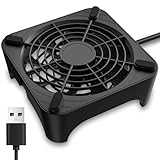
- 【Universal Compatibility】This USB cooling fan works seamlessly with Mini PC, PS5, routers, Apple TV, modems, PlayStation, receivers, Rokus, T-Mobile 5G Home Internet, Xbox Series, and other audio-video electronics. Whether cooling a gaming console, router, or streaming device, it eliminates overheating worries across your digital ecosystem.
- 【Powerful Cooling Performance】Equipped with a 120mm fan boasting 55.8 CFM airflow and 850RPM±10% speed, this USB PC fan delivers rapid cooling—dropping device temperatures by 20% in seconds. The 9-blade design ensures powerful airflow to tackle heat buildup in routers, mini PCs, and gaming consoles, preventing lag and performance drops caused by overheating.
- 【Ultra-Quiet Operation & Scratch-Proof Protection】 Designed for ultra-quiet and scratch-resistant cooling needs, this USB computer fan comes with 4 shock-absorbing pads and operates at just 18dB(A)±10% noise—whisper-quiet, quieter than library silence (30dB) and close to the sound of rustling leaves (20dB). It enables efficient device cooling without noise interference or surface scratches, letting you fully immerse in video, audio, and gaming. It’s perfect for home offices, living rooms, and gaming setups.
- 【USB-Powered & Space-Saving Setup】This USB powered fan features an integrated 530mm (20.87-inch) USB cable, connecting easily to chargers, mobile power banks, or laptops—no extra wires needed. With dimensions of 130mm×130mm×48.6mm (5.12×5.12×1.91 inches), it can be placed flat or upright, making it perfect for narrow spaces while keeping your setup tidy.
- 【Sturdy & Long-Lasting Durability】Made from premium eco-friendly ABS material, this USB fan (with a box fan-like structure) supports heavy-duty use and can withstand weights up to 11LB. With a lifespan of 40000 hours, it offers long-term cooling for your devices, ensuring stable performance and protection against overheating for years to come.
What throttling tells you
Intel describes thermal throttling as reducing processor clock speed when the CPU reaches its thermal limit. If operating frequency falls below expectations under sustained work, overheating or inadequate cooling is one possible explanation—not proof that the CPU is damaged. Modern processors use thermal management to reduce heat when needed. Intel explains processor thermal management, and its overheating troubleshooting guidance includes lower-than-expected frequency and chassis airflow among the clues to check.
Thermal limits vary by processor model. Noctua gives examples of 90/95°C for current AMD Ryzen CPUs and 100/115°C for current Intel CPUs in its guidance, but those examples are not specifications for every model. Check the exact processor’s documentation rather than using a generic temperature as a universal target. See Noctua’s examples and qualifications.
Rank #2

- 120mm Quiet Adjustable Cooling Fan: Built with a high-quality 120mm adjustable-speed fan, this cooling base delivers up to 1550 RPM and 66.17 CFM airflow to help reduce heat buildup for routers, mini PCs, modems, receivers, DVRs, game consoles, and other small electronics. The built-in speed controller supports 0%–100% duty cycle adjustment, allowing you to balance cooling performance and quiet operation.
- Flexible USB-C 5V Power Input: Designed with USB-C 5V input and includes a USB-A to USB-C cable for convenient power connection. It can be used with a USB charger, computer USB port, power strip USB port, router USB port, or other desktop USB devices with 5V output. Power adapter is not included.
- Aluminum Body, Durable & Easy to Clean:Made of aluminum material for a refined appearance, fast heat dissipation, and long-lasting durability. The sturdy aluminum structure provides stable support for your device, while the removable design makes it easier to clean dust from the fan and maintain efficient cooling performance.
- Compact Size with Raised Airflow Pads: Measuring 17 × 15 × 4.8 cm, this cooling fan stand is ideal for small high-heat devices. Included foot pads can be placed between the cooling base and your device to create an airflow channel, helping hot air escape more easily and improving overall cooling efficiency.
- Package Includes: 1 × adjustable-speed full aluminum cooling fan base ; 1 × 1-meter USB-A to Type-C cable
How to diagnose and recover a struggling build
- Confirm when the problem occurs. Observe CPU temperature and clock behavior during the workload that triggers the issue. Note whether performance declines only during sustained work or also during shorter tasks. A stress test holds heat more continuously than some everyday applications, so interpret it as a demanding case—not a prediction of every real-world workload.
- Check the cooler installation. Verify that the cooler is compatible with the processor and motherboard, mounted securely with appropriate pressure, and has thermal interface material (TIM) applied correctly. Intel includes cooler compatibility and TIM application among its overheating checks. Review Intel’s processor troubleshooting steps.
- Clear the natural-convection route. Check that the case has a low, unobstructed inlet and an open path near the top for warm air to escape. Keep bottom openings clear of desks, carpet, filters, cables, and nearby components that impede airflow. Look for sufficient internal volume and avoid panels that insulate or seal off the airflow route. In a tower, check whether the heatsink fins run vertically.
- Look beyond the CPU. Inspect VRM heatsinks and other motherboard components, and account for heat from the GPU and PSU. A reasonable CPU reading does not rule out a board-level thermal bottleneck. Noctua specifically warns that motherboards with inadequate VRM heatsinks may throttle under passive cooling. See Noctua’s guidance on motherboard, GPU, and case factors.
- Match the setup to the workload. Passive operation is a better fit for low-to-moderate heat output and work that includes idle or cooldown periods than for sustained high output. If your normal workload keeps the CPU or other components hot, a passive cooler and case may simply be the wrong thermal design for that use.
- Reduce heat or add airflow if needed. Reduce sustained workload or heat output where practical, or add one or two quiet case fans to move air through the enclosure. Noctua says quiet fans can significantly improve performance when natural convection alone is insufficient, but the result depends on the components and case. Once a case fan is installed, describe the system as semi-passive or quiet—not fully fanless.
Choosing between fully passive, semi-passive, and quiet cooling
| Approach | Best fit | Main trade-off |
|---|---|---|
| Fully passive | Low-to-moderate heat output, intermittent workloads, and a case designed to support an unobstructed bottom-to-top convection path. | More sensitive to enclosure layout, component heat, and sustained workload; some components may still reach thermal limits. |
| Semi-passive with quiet case airflow | Systems where natural convection is inadequate but the goal remains low noise and reliable sustained operation. | A case fan means the PC is no longer fully fanless, though a small airflow compromise may prevent instability or heavy throttling. |
| Conventional quiet cooling | Workloads or component combinations that need active airflow to shed heat consistently. | Fans are part of the cooling design; this gives up absolute zero-fan operation in favor of more direct airflow. |
Before choosing a passive CPU cooler
A cooler such as Noctua’s NH-P1 is designed for fanless operation in an enclosure with good natural convection and low-to-moderate heat dissipation. It is not a universal solution: confirm CPU and socket compatibility, physical clearance in the case, and whether the whole system’s workload and airflow suit passive cooling. Check the NH-P1 product information and the manufacturer’s setup guidance before selecting a cooler.
Quick Recap
Best Value

- Effective Cooling: USB fans designed to cool various electronics and components, like TV box, AV receiver, DVR, router, modem, for xbox series x cooling , playstation, microcomputer, survelllance recorder, mini PCs, T-Mobile home internet gateway and other audio aideo electronics
- Mini Box Fan: Versatile fans cool a wide range of devices. From routers and modems to computer components and entertainment centers, Xbox consoles and other equipment, enclosed spaces
- Easy Installation: Simple USB connection for quick setup. Fits easily in tight spaces.Keeps your devices cool & functioning. Say goodbye to overheating! Effective cooling performance, with no heat build-up and efficient router cooling
- USB Fan: Dimension: 120mm x 120mm x 25mm / 4.7x4.7x1 in. per fan; Rated Voltage:5V 0.2A; Speed: 1500RPM; Air flow: 56.7CFM; Noise:23dBA; Cable Length: 55cm Or 21 inches; Bearing: Sleeve ; Life: 35000 hours
- High Performance: Good for use in home theaters and other electronics.1 Piece fan include fan Protective net, 4X Foot columnsand 4Xmounting screws & nuts
Rank #4

- for BeelinK Mini PC EQ12 N100, EQ12 Pro N305, S12 Pro N100, Model: 6005 BF06005H05FP 14.11.02490000, DC 5V 0.5A 4-Pin Internal Cooler Fan
Rank #3

- 120mm Quiet RGB Cooling Fan with Fan Speed Controller: Built with a 120mm adjustable-speed fan, this cooling base delivers up to 1550 RPM and 66.17 CFM airflow to help reduce heat buildup for routers, mini PCs, modems, receivers, DVRs, game consoles, and other small electronics. The RGB light glows from the bottom of the stand, creating a stylish ambient effect for your desktop.The built-in speed controller supports 0%–100% duty cycle adjustment, allowing you to balance cooling performance and quiet operation.
- USB-C 5V Power Input: Designed with USB-C 5V input and includes a 1M USB-A to USB-C cable for convenient power connection. It can be used with a USB charger, computer USB port, power strip USB port, router USB port, or other desktop USB devices with 5V output. Charger is not included
- Aluminum build, sturdy & easy to clean: Aluminum delivers sleek looks, quick heat dissipation and long service life. Its solid frame holds your device steady; removable parts let you clear fan dust effortlessly to keep cooling efficient.
- Compact Size with Raised Airflow Pads: Measuring 17 × 15 × 4.8 cm, this cooling fan stand is ideal for small high-heat devices. Included foot pads can be placed between the cooling base and your device to create an airflow channel, helping hot air escape more easily and improving overall cooling efficiency.
- Package Includes: 1 × adjustable-speed full aluminum cooling fan base with RGB ; 1 × 1M USB-A to Type-C cable
Product prices and availability are accurate as of the date/time indicated and are subject to change. Any price and availability information displayed on Amazon at the time of purchase will apply.
Do these 3 things before closing this tab:
1Clear out junk files and repair common Windows errors2Fix the driver behind crashes, sound loss and screen glitches3Repair Windows errors before they cause bigger problems
