
Search and retrieval can distinguish AI products when their answers depend on external, changing or company-specific information. A model cannot use evidence its system never found, and a complex question may require several searches across different sources. But the evidence supports this as a meaningful advantage in search- and retrieval-heavy products—not as a proven ranking of the most important feature across all AI products.
Why is search important for AI products?
For an AI product that answers questions about documents, business systems or other external information, answer quality depends partly on what the system can retrieve and pass to the model. A fluent answer can still be incomplete or wrong if relevant evidence was missed. Retrieval is therefore part of the product experience, not just a behind-the-scenes implementation detail.
This matters especially when users ask questions that involve several facts, sources or steps. The system may need to find an initial document, follow an identifier or reference in it, and search another source for the missing detail. If it stops after the first search, the model is left to reason from partial context.
One example of the difficulty comes from Choubey and co-authors’ EMNLP 2025 Industry Track benchmark. It models 39,190 synthetic enterprise artifacts, including documents, meeting transcripts, Slack messages, GitHub content and URLs, and tests source-aware, multi-hop questions. The authors report an average performance score of 32.96 on that benchmark and describe retrieval failures that leave systems reasoning over partial context. That score characterizes this benchmark; it is not a general measure of AI product quality.
What’s actually slowing this PC down?
Pick the symptom - the matching free tool is one click away.
#1 Best Overall

- Built for Local AI Development: AMD Ryzen AI Halo is designed for local AI development and inference, featuring 128GB unified memory and support for up to 200B parameter models to build and run intensive AI workloads locally.
- 128GB Unified Memory: Features 128GB LPDDR5x unified memory at 8000 MT/s with 256 GB/s memory bandwidth, providing a shared memory pool across the CPU, GPU, and NPU to support larger AI models.
- AMD Ryzen AI Max+ 395 Processor: Features 16 cores, 32 threads, and Zen 5 architecture, paired with AMD Radeon 8060S integrated graphics featuring 40 RDNA 3.5 compute units and an AMD XDNA 2 NPU with up to 50 TOPS.
- Linux AI Developer Platform: Purpose-built for Linux-based AI development with full AMD ROCm software support and preloaded tools, models, and workflows optimized for local AI development.
- Compact, Connected Design: Includes a 2TB M.2 SSD, 10GbE LAN, Wi-Fi 7, Bluetooth 5.4, USB-C connectivity, and HDMI 2.1b.
What is retrieval-augmented generation?
Retrieval-augmented generation (RAG) is an approach in which a system searches a body of information for relevant material and supplies that material to a language model as context for an answer. The search step is retrieval; producing an answer from the question and retrieved context is generation. In practice, the usefulness of the result depends on both stages: a model cannot cite or reason from evidence it did not receive, and retrieved passages do not automatically guarantee a correct answer.
NIST’s TREC 2025 RAG track treats passage retrieval, augmented generation, full retrieval-augmented generation and relevance-judgment generation as separate tasks. That separation is useful for product teams because it helps identify whether a failure began with missing or irrelevant evidence, or with the model’s handling of evidence it did receive.
How does retrieval affect AI answer quality?
Missing evidence limits the answer
If a system retrieves only part of the evidence needed for a question, generation operates on an incomplete picture. The EMNLP 2025 benchmark is designed around this kind of source-aware, multi-hop challenge. Its results are a warning about the benchmark’s task, not a universal estimate of how often commercial systems fail.
Follow-up searches can resolve references
Google Research describes an agentic RAG framework that decomposes a complex question, routes searches across data sources and continues searching when the available context appears incomplete. Its example is a project document that contains a server ID: answering a question about the server may require another search for its specifications. This illustrates why a single search can be inadequate when the answer depends on a chain of related facts.
Windows Errors? Fix Them Before They Spread
Repair common Windows errors and clear accumulated junk for a smoother, more stable PC - no reinstall needed.Free scan · no reinstallCrashes, No Sound, or Screen Glitches?
Random freezes, missing sound and display glitches usually trace back to one bad driver. Find and replace yours safely.Free scan · under a minuteGoogle Research reports that its framework achieved up to 34% higher accuracy on factuality datasets than standard RAG. This is Google’s own report about its framework, not an independent market-wide comparison; the reported improvement should be understood in that context.
Rank #2

- EVOLUTION AMD RYZEN AI MAX+ 395 MINI PC - GMKtec EVO-X2 is the next evolution in AI mini PC Ryzen Strix Halo series. Thanks to AMD Simultaneous Multithreading (SMT) the core-count is effectively doubled, to 32 threads. Ryzen AI Max+ 395 has 64 MB of L3 cache and can boost up to 5.1 GHz, depending on the workload. The Ryzen AI Max+ 395 is currently rated as the "most powerful x86 APU" on the market for AI computing.
- AI NPU with XDNA 2 ARCHITECTURE - Powered by 16 “Zen 5” CPU cores, 50+ peak AI TOPS XDNA 2 NPU and a truly massive integrated GPU driven by 40 AMD RDNA 3.5 CUs, the Ryzen AI MAX+ 395 is a transformative upgrade and delivers a significant performance boost over the competition. The Ryzen AI Max+ 395 excels in consumer AI workloads like the llama.cpp-powered application: LM Studio. Shaping up to be the must-have app for client LLM workloads, LM Studio allows users to locally run the latest language model without any technical knowledge required and unleash their creativity and productivity.
- AMD RADEON 8090S iGPU GAMING PC - The AMD Radeon RX 8060S offers all 40 CUs with up to 2.9 GHz graphics clock and uses the new RDNA 3.5 architecture. The powerful iGPU is positioned between an RTX 4060 and 4070 laptop GPU and therefore enables gaming in FHD at maximum details in most demanding games. The 8060S can also utilize the full 64GB pool, which is perfect for running LLMs such as Deepseek 32B, which runs comfortably on this machine.
- EIGHT CHANNEL LPDDR5X - LPDDR5X is a new ground breaking memory small form factor installed on-board. With blazing speeds up to to 8000MT/s, it runs 1.5x faster than the DDR5 SODIMMs; 90% better performance over DDR5 SODIMMs in video conferencing and photo editing; 30% better performance in productivity apps; 4% better performance in digital content workloads.
- QUAD SCREEN 8K DISPLAY SUPPORT - EVO-X2 AI Mini PC support 4-screen 4K/8K output via HDMI 2.1 (8K@60Hz), DisplayPort 1.4 (4K@60Hz), and dual USB 4 40Gbps Transfer speed (supporting PD3.0/DP1.4/DATA). Ideal for gaming, video editing, and multitasking, it provides expansive and crisp multi-display support.
Tool use results depend on the benchmark
The AgenticRAG paper’s Microsoft Research page reports results on three distinct benchmarks: 49.6% recall@1 on BRIGHT, 0.96 factuality on WixQA and 92% answer correctness on FinanceBench. The authors also report that moving from single-shot retrieval to agentic tool use was the most significant factor in their ablation. These results describe the authors’ experiments on those benchmarks. They are not a direct comparison of commercial products, and the three scores measure different tasks.
How can AI find information across multiple company data sources?
A system designed for multi-source questions needs to do more than issue one query and pass back the first useful-looking result. A practical approach is to identify what the question requires, search the relevant sources, and check whether the evidence found is sufficient to answer. When one source introduces an identifier, entity or unresolved detail, the system may need to search again using that clue.
Google Research’s description of agentic RAG provides an example of this pattern: decompose the question, route searches across sources and persist with additional searches when context is incomplete. That is a proposed system design, not proof that every agentic system will retrieve comprehensively or answer accurately. Product teams should test whether the system follows cross-source references reliably in their own data and tasks.
Quick wins for a faster PC:
Fix the driver behind crashes, sound loss and screen glitchesFind Drivers →Repair Windows errors before they cause bigger problemsFix Now →Search also needs to operate over the information the user is authorized to access. Permission handling is an important buyer check, but the sources summarized here do not establish a particular security implementation or show that any named framework meets a specific organization’s access-control requirements.
How do I evaluate enterprise AI search?
Evaluate retrieval and answer generation separately before judging the end-to-end experience. Build a representative set of real questions, including questions with evidence in more than one source and questions that cannot be answered from the available corpus. Inspect both what the system retrieved and what it answered; a plausible response alone does not show that it found complete support.
Rank #3
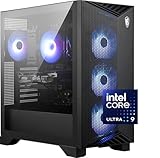
- Intel Core Ultra 9 285 Processor: Newly developed cores deliver ultra-smooth and responsive gameplay. AI accelerators prepare users for the next era of gaming on an AI PC.
- Simplistic Design: Enjoy the latest generation of Windows 11 Home for your everyday needs. *MSI recommends Windows 11 Pro for business use.
- NVIDIA GeForce RTX 5070 Ti GPU
- Cool While Gaming: In conjunction with an RGB CPU Air Cooler, the Aegis RS features four system cooling fans; three in the front and one in the rear to pull in cool air and push heat out of the PC.
- Turn on the Bright Lights: With the built-in RGB lighting, take your gaming experience to the next level by pressing the MSI LED button to cycle through lighting options. Customize lighting even further with MSI Center software.
- Evidence coverage: Did retrieval return the passages or documents needed to support the answer, or did it miss a required fact?
- Multi-hop and cross-source support: Can the system follow a reference, identifier or relationship from one source into another?
- Freshness and source access: Does it search the current, authorized information relevant to the task?
- Grounding and answer quality: Can substantive claims be traced to retrieved sources? Does the system keep searching or abstain when evidence is insufficient?
- Evaluation design: Are retrieval and generation scored separately on representative answerable and unanswerable questions?
- Operational trade-offs: Measure latency, cost and complexity alongside quality in the intended use case.
These are evaluation dimensions, not results from a common vendor test. The sources summarized here do not provide cross-vendor measurements for latency, cost or operational complexity. TREC’s separation of retrieval and generation tasks offers a useful model for avoiding a single end-to-end score that hides where a system succeeds or fails.
Independent reader supportYour contribution helps us test, update, and keep practical guides available for everyone.What do the reported benchmark numbers show?
The figures below come from different studies and tasks. They should not be combined into a ranking or treated as comparable product scores.
The Tool Desk
Outbyte PC Repair FREEClear out junk files and repair common Windows errorsFree Scan →Outbyte Driver Updater FREEFix the driver behind crashes, sound loss and screen glitchesFind Drivers →| Source and year | Reported result | What it applies to |
|---|---|---|
| Choubey et al., EMNLP 2025 Industry Track | 32.96 average performance score | A benchmark of 39,190 synthetic enterprise artifacts and source-aware, multi-hop questions. |
| Google Research, 2026 | Up to 34% higher accuracy | Google’s report for its agentic RAG framework on factuality datasets, compared with standard RAG. |
| AgenticRAG authors, 2026 | 49.6% recall@1 | BRIGHT benchmark. |
| AgenticRAG authors, 2026 | 0.96 factuality | WixQA benchmark. |
| AgenticRAG authors, 2026 | 92% answer correctness | FinanceBench benchmark. |
The measures, datasets and tasks differ, and the results do not constitute an independent apples-to-apples comparison of commercial AI products. In particular, Google’s improvement is vendor-reported, while the AgenticRAG figures are author-reported benchmark results.
Does search and retrieval decide which AI product is best?
Not universally. The available evidence focuses on enterprise RAG and search evaluation; it does not establish that retrieval is the leading differentiator across every category of AI product. Nor does it provide a market-wide independent comparison, establish broad adoption or willingness to pay, or show that better retrieval causes commercial success.
For products whose value depends on answering questions over external or enterprise information, however, retrieval quality is a consequential capability. Buyers and product teams should compare systems on the same representative tasks, inspect the evidence behind their answers and weigh answer quality against operational needs rather than treating one benchmark result as a universal verdict.
Quick Recap
Product prices and availability are accurate as of the date/time indicated and are subject to change. Any price and availability information displayed on Amazon at the time of purchase will apply.

