
The Tool Desk
Outbyte Driver Updater FREEScan for outdated or missing drivers - takes under a minuteDriver Scan →Outbyte PC Repair FREEClear out junk files and repair common Windows errorsFree Scan →A gaming PC uses more electricity under load because a demanding game makes its processor and graphics card do more work than they do while idle or handling routine tasks. How much that extra use matters depends on your PC’s measured power, how long you play, what equipment you include in the measurement, and your electricity rate—not on a single wattage figure that applies to every gaming PC.
Why does my gaming PC use more electricity under load?
Games can push the CPU and graphics processor into sustained, high-performance work. That activity takes more power than sitting idle or doing lighter tasks. The European Commission Joint Research Centre distinguishes routine office activity, such as browsing and video streaming, from demanding graphics and CPU work: the latter can notably raise energy use at full load. Its finding explains the cause, but it is not a benchmark of current gaming PCs or a universal estimate of their power draw. European Commission Joint Research Centre report.
“Under load” means the hardware is actively doing more work; it does not by itself specify how many watts a particular computer draws. The game, settings, frame-rate cap, and PC configuration all matter. A power supply’s rated capacity and component TDP figures are not measurements of electricity drawn from the wall, so they cannot tell you your actual gaming-session energy use.
How much does the extra electricity matter?
The practical impact depends on how far your gaming power differs from idle power and how many hours the PC spends in each state. A high draw for a short session is not equivalent to leaving a game running for hours. ENERGY STAR notes that a game left running in the background can keep a computer from sleeping, even if it is paused. ENERGY STAR computer guidance.
What’s actually slowing this PC down?
Pick the symptom - the matching free tool is one click away.
#1 Best Overall

- 80 PLUS GOLD CERTIFIED
- 10-year limited warranty, guaranteeing long term reliable operation
- Fully modular design
- ATX 3.1 & PCIE 5.1
There is no well-supported, representative gaming-versus-idle wattage range or annual energy figure established here for modern gaming PCs. Without a specific system, workload, schedule, measurement boundary, and location, an annual kWh or cost estimate would be guesswork.
How to measure your PC and estimate the cost
A plug-in true-power meter at the AC outlet can show wall power or accumulated energy for the equipment plugged into it. The U.S. Environmental Protection Agency’s archived Version 4.0 test procedure describes AC-source measurement with a true-power meter; it supplies a measurement method, not a validation of any particular consumer meter or current gaming-PC benchmark. EPA Version 4.0 computer test procedure (archived).
Rank #2

- 80 PLUS GOLD CERTIFIED
- 10-year limited warranty, guaranteeing long term reliable operation
- Fully modular design
- ATX 3.1 & PCIE 5.1
- Choose a consistent measurement boundary. Decide whether you are measuring the PC alone or the PC, monitor, and peripherals together. Keep that choice the same for idle and gaming measurements.
- Measure representative periods. Record an idle period and a gaming session that reflects how you actually play. Note the game, resolution, graphics settings, frame-rate cap, and session length.
- Convert average power to energy. Use average watts ÷ 1,000 × hours = kWh. For a clearly hypothetical example, a device averaging 300 W for 2 hours would use 0.6 kWh (300 ÷ 1,000 × 2); this is arithmetic, not a typical gaming-PC result.
- Estimate the cost. Multiply the measured kWh by the price per kWh on your electricity bill. Taxes, tariffs, and time-of-use rates can change the actual charge.
Watts describe a rate of electricity use at a moment or averaged over a period; kilowatt-hours measure energy accumulated over time. Comparing average wall power, total kWh, and hours in each state over the same period gives a more useful comparison than comparing component labels.
Independent reader supportYour contribution helps us test, update, and keep practical guides available for everyone.Can power settings reduce electricity use?
ENERGY STAR says certified computers are expected to operate efficiently across Off, Sleep, and Idle modes and to include power-management features. Its computer page lists a specification effective date of October 2025. Leaving sleep settings enabled can reduce the time a computer remains fully active when unused.
Quick wins for a faster PC:
Repair Windows errors before they cause bigger problemsFix Now →Fix the driver behind crashes, sound loss and screen glitchesFind Drivers →Clear out junk files and repair common Windows errorsFree Scan →Rank #3
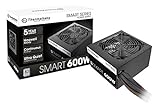
- Delivers 600W Continuous output at plus 40℃. Compliance with Intel ATX 12V 2. 31 and EPS 12V 2. 92 standards
- 80 PLUS Certified – 80% efficiency under typical load. Power good signal is 100-500 millisecond
- Supports (2) PCI-E 6 plus 2pin Connectors. Active (PFC) Power Factor Correction, MTBF: 100, 000 hours
- Industry Grade Protections: (OPP) Over Power Protection, (OVP) Over Voltage Protection, (SCP) Short Circuit Protection
- Hold up time is 16 millisecond minimum within 60 percent load. Input frequency range 50 - 60 in Hz
The U.S. Department of Energy Federal Energy Management Program says leaving a computer’s power-saving mode enabled can reduce annual computer energy use by up to 27%. That is broad guidance, not a gaming-PC-specific prediction or guaranteed saving for an individual household. DOE FEMP computer power-management guidance. FEMP also defines standby as electricity used in a product’s lowest-energy mode, typically when it is switched off or not performing its primary function; standby use is distinct from gaming under load.
Quick Recap
Best Value

- 80 PLUS GOLD CERTIFIED: Delivering gold-level performance with 92% efficiency, ensuring effective power transmission to your components.
- Fully Modular Design: Unique dragon-pattern fully modular cables cut redundant wiring to tidy your chassis, improve airflow and optimize system heat dissipation. With dimensions of 150×150×86mm (5.91×5.91×3.39in), the PSU fits most mainstream ATX cases.
- Support ATX 3.1 & PCIe 5.1: Compliant with the ATX 3.1 standard to fuel high-performance PC components with stability, efficiency, and power spike resistance. Meanwhile, supporting PCIe 5.1 platform withstands 2x transient power excursions from the GPU.
- Dual-Colour 16-Pin Cable: The Dual-color dragon-pattern 12V-2x6 PCI-E 5.1 cable for modern high-end graphics cards. With yellow connector can easily show you whether the cable has been plugged in properly.
- RGB Silent Fan & RGB Lighting Model: This 140mm low-noise fan comes with a silent mode, it outperforms standard 120mm fans in terms of quietness, heat dissipation capability and durability. What's more, the psu features ARGB lighting model, allowing you to adjust the lights style according to your needs.
Rank #4

- Fully Modular PSU: Reliable and efficient, low-noise power supply with fully modular cabling, so you only have to connect the cables your system build needs.
- Intel ATX 3.1 Certified: Compliant with the ATX 3.1 power standard, supporting PCIe 5.1 platform withstands 2x transient power excursions from the GPU.
- Keeps Quiet: A 120mm rifle bearing fan with a specially calculated fan curve keeps fan noise down, even when operating at full load.
- 105°C-Rated Capacitors: Delivers steady, reliable power and dependable electrical performance.
- Modern Standby Compatible: Extremely fast wake-from-sleep times and better low-load efficiency.
Product prices and availability are accurate as of the date/time indicated and are subject to change. Any price and availability information displayed on Amazon at the time of purchase will apply.

