
2013 did not mark the invention of drones or the start of unrestricted civilian flying. It was a turning point in planning: in the United States and Europe, regulators began turning the prospect of civil drone operations into concrete roadmaps, research programs, and policy questions. Military aircraft remained the best-known example, while civilian and commercial uses were emerging under significant limits.
Why was 2013 called the year of the drone?
The phrase is best understood as an interpretation of a transition, not as a claim that drones suddenly appeared. By 2013, unmanned aircraft were familiar largely through military use. The new development was that governments were planning how aircraft without onboard pilots might eventually operate alongside other traffic in shared airspace.
In the United States, the FAA Modernization and Reform Act of 2012 directed the Federal Aviation Administration to prepare a comprehensive plan for safe civil integration of unmanned aircraft systems (UAS). It required a five-year roadmap by February 14, 2013, and called for phased work on safety, standards, operator requirements, testing, and airspace management. The statutory direction is set out in the FAA Reauthorization Act of 2018, which retains the historical 2012 Act provisions.
A European Parliament document reports that the FAA released its first annual integration roadmap on November 7, 2013. That date is reported by the parliamentary document; the roadmap itself set out policy, regulatory, technological, and procedural work rather than granting general commercial flight rights. In Europe, the RPAS Steering Group had presented an integration roadmap in June 2013, with a European Commission policy communication following in 2014.
Do these 3 things before closing this tab:
1Clear out junk files and repair common Windows errors2Scan for outdated or missing drivers - takes under a minute3Repair Windows errors before they cause bigger problems#1 Best Overall

- No Registration Needed - Under 249 g, FAA Registration, and Remote ID are not required if you fly for recreational purposes.
- 4K UHD Stunning Imagery- Film in 4K HDR Video for crystal clear aerial shots. With Dual Native ISO Fusion, Mini 3 enables the capture of details in highlights and shadows, both day and night. [3]
- Striking Vertical Videos are Ready to Share - With True Vertical Shooting, you can easily capture tall landmarks like skyscrapers and waterfalls.
- Extended Battery Life - Its flight time can be extended up to 51 minutes with the Intelligent Flight Battery Plus (sold separately), but the aircraft will weigh more than 249 g. Fly More combo offers up to 114 minutes of total flight time.[2]
- 38kph (Level 5) Wind Resistant and 3-Axis Gimbal for Stable - With its Level 5 wind resistant and 3-axis mechanical gimbal, Mini 3 can capture consistently smooth 4K imagery. Brushless motors enhance power and allow takeoff at altitudes up to 4,000 meters.
These steps made civil integration a practical institutional project. They did not mean routine, unrestricted commercial drone flights were already happening.
What changed for drones in 2013?
The United States began building an integration program
In December 2013, the FAA announced six UAS research and test sites. Their work covered issues such as operating in different climates, certification, safety, navigation, airspace integration, and sense-and-avoid—the ability to detect and avoid other aircraft or obstacles. The sites were research infrastructure, not blanket authorization for businesses or individuals to fly anywhere.
The distinction between research and ordinary access matters. A test site can help investigators examine technical and operational problems under defined conditions; it does not resolve the rules, equipment, or safety procedures needed for routine operations in shared airspace.
Rank #2
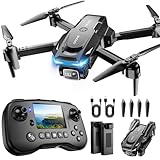
- The PK01 drone's remote comes with a super handy built-in screen—no phone needed—so you can watch live HD footage and check flight stats right in your hands. (An SD card is required to save images and videos; not included) Powered by tough brushless motors, this little flyer is strong, smooth, and built to last. With one-key takeoff/landing, headless mode, and even 360° flips, you’ll look like a pro in no time. Ready for takeoff?🤩
- 📷【Drone with Camera】 Equipped with a 1080P HD 80°adjustable lens, the drone not only assists you in catching every wonderful moment from a bird's-eye perspective but is also perfect for selfies. It can even be used to check the roof of a house or other hard-to-reach areas. You can enjoy the real-time HD pictures and videos via the remote screen & APP. Automatically take photos/videos with gestures. First flight tip: choose a windless indoor space, keep the altitude below 6 meters and the distance below 30 meters to help better practice and control the drone.
- 🕹️【More Fun to Fly】 This foldable drone has 2 control modes: remote control, APP control. You can enjoy exciting features such as one-click 360° flips, 3D flip, waypoint flyflight, gravity control, circle fly, rotation fly, 3 speed gear, gravity sensing and Emergency Stop. (Some functions should be controlled by the app) You can also effortlessly command the remote control drone with simple voice instructions like "Take off"and more.
- 🔋【Long Flying Time and Safer】 The upgraded FPV drone is equipped with two enhanced batteries, extending the flight time to 25 minutes, providing no-worry flying experience. The controller has built-in battery and comes with 2pcs USB charging cable, enables you to charge it effortlessly. Features with emergency stop, 4 propeller guards, child lock feature and low power alarm to ensure a safe and reliable flight. PK01 is lightweight, portable and No FAA Registration needed, makes it a ideal drone for indoor and outdoor activities.
- 📲【How to Connect Your Phone】1.Power off the remote controller. 2. Turn on the drone. Note: Make sure the tail of the drone is facing towards you. 3. Download and log in to the "PK01 DRONE" app. 4. Connect your phone to the Wi-Fi network named "PK01DRONE_XXXXXX" via the app. 5. Move the left and right joysticks of the remote control to the lower left or lower right 45 degrees at the same time. The drone light flashes and then turns on, completing horizontal calibration. 6. Enter the app control interface, tap the "Control Switch" icon, and then select "Take Off" for a successful launch.
Europe treated civilian operations as a cross-border policy question
European planning focused on how to enable an emerging industry while protecting public interests. In a 2014 communication, the European Commission argued for a common approach to rules, reflecting that remotely piloted aircraft could cross national borders. Siim Kallas, then European Commission Vice-President and Commissioner for Mobility and Transport, said at the communication’s launch:
What’s actually slowing this PC down?
Pick the symptom - the matching free tool is one click away.
“If ever there was a right time to do this, and to do this at a European level, it is now. Because remotely piloted aircraft, almost by definition, are going to cross borders and the industry is still in its infancy. We have an opportunity now to make a single set of rules that everyone can work with, just like we do for larger aircraft.”
The statement captures the period’s central tension: civil use looked promising, but cross-border operations required shared rules and safeguards.
Rank #3

- No Registration Needed - Under 249 g, FAA Registration, and Remote ID are not required if you fly for recreational purposes.
- 4K UHD Stunning Imagery- Film in 4K HDR Video for crystal clear aerial shots. With Dual Native ISO Fusion, Mini 3 enables the capture of details in highlights and shadows, both day and night. [3]
- Striking Vertical Videos are Ready to Share - With True Vertical Shooting, you can easily capture tall landmarks like skyscrapers and waterfalls.
- Extended Battery Life - Its flight time can be extended up to 51 minutes with the Intelligent Flight Battery Plus (sold separately), but the aircraft will weigh more than 249 g. Fly More combo offers up to 114 minutes of total flight time.[2]
- 38kph (Level 5) Wind Resistant and 3-Axis Gimbal for Stable - With its Level 5 wind resistant and 3-axis mechanical gimbal, Mini 3 can capture consistently smooth 4K imagery. Brushless motors enhance power and allow takeoff at altitudes up to 4,000 meters.
How did military drones differ from civilian drones?
A UAS is more than the aircraft: it includes the aircraft and the control and communication elements that let a person operate it remotely or use onboard navigation. The familiar word “drone” covers systems with very different capabilities and purposes, so military aircraft should not be treated as equivalent to consumer camera drones or small commercial aircraft.
Military use strongly shaped public understanding. The Congressional Research Service (CRS) traces U.S. UAS development from limited early military roles through reconnaissance, the Gulf War, and later armed reconnaissance. Its historical account reports that the U.S. Department of Defense inventory grew from 167 aircraft in 2002 to nearly 7,500 in 2010. CRS also reports an approximately $667 million U.S. UAS investment in FY2001 and a Defense Department request of approximately $3.9 billion for procurement and development in FY2012; the latter was a requested amount, not final spending. These figures describe the military context, not the size of the civilian market.
Outdated Drivers Are Slowing You Down
One free scan finds every outdated or missing driver and matches the right update for your exact hardware.Free scan · exact hardware matchWindows Errors? Fix Them Before They Spread
Repair common Windows errors and clear accumulated junk for a smoother, more stable PC - no reinstall needed.Free scan · no reinstallCivilian operations had different goals and constraints. The House of Lords European Union Committee’s 2015 report describes photography and land surveying as commercial RPAS services in the UK and notes aerial surveillance as another use. It identifies search and rescue, delivery, and construction repair as possible future tasks, not established widespread services. Private leisure use was also becoming more popular, but that does not make consumer flying interchangeable with commercial or military operations.
Rank #4

- 【Easy to Fly: Master the Sky Instantly】 No experience? No problem! Equipped with One-Key Takeoff/Landing and Altitude Hold, this beginner friendly drone stays rock-solid in the air. It’s so easy to fly that even kids 8-12 and adults who have never flown can master the controls in seconds. Perfect for stable indoor outdoor play, ensuring a stress-free start for every new pilot.
- 【1080P HD Camera & Real-Time FPV View】 Capture your world from a brand-new perspective! The integrated 1080P HD camera delivers crystal-clear aerial snapshots and smooth FPV live video directly to your phone. Use Gesture Selfie to snap photos with a simple hand movement—making it the ultimate smart gadget for creative family fun, backyard adventures, or park exploration.
- 【Double the Flight for Non-Stop Entertainment】 Enjoy twice the joy with 2 modular batteries, providing up to 24 minutes of total flight time. This foldable mini drone is compact and comes with a premium carrying case, making it a portable lightweight companion. Whether it's a camping trip, a beach day, or a weekend family garden play, your aerial entertainment never has to stop.
- 【Thrilling Smart Features for Exciting Play】 Take your recreational flight to the next level! Master breathtaking 360° 3D Flips, steer by tilting your phone with Gravity Control, or design custom paths with Trajectory Flight via the Smart App. With 3-speed adjustments, this RC quadcopter offers a versatile and exciting pastime that grows with your skills, from casual drifting to high-speed stunts.
- 【Safe, Durable & Worry-Free House Fun】 Safety is our priority for every hobbyist. Featuring Headless Mode for easy orientation and 4 protective propeller guards to withstand accidental bumps. Built with high-toughness materials, this small drone is safe for indoor play and sturdy enough for outdoor exploration. It’s the go-to flying toy for boys and girls seeking a reliable and fun-filled adventure.
Were civilian drones used in 2013?
Yes, civilian applications existed and interest was growing, but the available accounts do not support the idea that commercial drones were already in routine, unrestricted use. Photography and surveying were among the commercial services described in the UK report. Other applications discussed at the time ranged from public-sector work to proposals and possibilities, and their status varied.
CRS’s September 2015 commercial outlook described the U.S. commercial UAS sector as early-stage. It listed fields such as homeland security, law enforcement, surveying, and crop dusting as proposed or developing applications, while emphasizing that technology and regulation would shape deployment. The report does not establish that every listed use was widespread or routinely authorized.
The regulatory picture remained constrained after 2013. CRS reports that the FAA began accepting commercial exemption requests in May 2014; in the first year, the Association for Unmanned Vehicle Systems International reviewed 1,500 petitions, and 500 exemptions were granted. Those are counts of petitions and exemptions—not necessarily unique aircraft, distinct operators, or ongoing operations.
Best Value

- No Registration Needed - Under 249 g, this drone with camera for adults 4K does not require FAA registration or Remote ID for recreational use. Visit the FAA's official website for requirements related to drone registration and Remote ID. [1]
- 4K Ultra HD & 3-Axis Gimbal for Cinematic Quality Shooting - Capture stunning moments in any light—sunrises, sunsets, and night scenes with crystal-clear 4K resolution. Thanks to the 3-axis gimbal, you can achieve cinematic-quality footage with this advanced drone with camera.
- 38kph (Level 5) Wind Resistant - This drone for adults has a stable flight even in Level 5 winds. Brushless motors enhance power and allow takeoff at altitudes up to 4,000 meters.
- 10km Max HD Video Transmission-up to 10 km (32,800 feet) [2] of HD video transmission and has excellent anti-interference capabilities, giving you the ability to freely explore vast landscapes and see clearer.
- Due to platform compatibility issue, the DJI Fly app has been removed from Google Play. To ensure a better product usage experience, please log in to the DJI official website to download the latest version of DJI Fly.
A separate UK-specific measure illustrates why geography and date matter: the House of Lords report records more than 600 permissions for commercial RPAS operations in the UK in its 2014–15 context. That figure is not a U.S. count or a worldwide total.
What were the main benefits and concerns?
The debate was not simply whether drones were useful. It was how to balance potential benefits with the risks and responsibilities of operating aircraft without an onboard pilot.
| Potential value | Questions and risks |
|---|---|
| Photography and land surveying were identified as commercial services in the UK; public-service and industrial tasks were also under discussion. | Safety, airworthiness, sense-and-avoid capability, and management of shared airspace remained central challenges. |
| Future possibilities included tasks such as search and rescue, delivery, and construction repair. | Privacy and data protection raised concerns about what aircraft could observe, collect, and retain. |
| Commercial growth could create new services and uses. | Security, liability, operator requirements, and public acceptance affected whether and how those uses could proceed. |
The European report also raised where rule-making authority should sit, alongside safety, airworthiness, data protection, and liability. In the United States, the statutory approach emphasized phased integration, standards, operator requirements, testing, and airspace management. The challenge was to allow useful operations without treating a research program or a limited exemption as proof that the broader safety and public-interest questions had been settled.
When did commercial drones start?
There is no single start date in these accounts: civilian uses, private leisure flying, regulatory planning, and routine commercial access are different milestones. By 2013, regulators were making integration plans and establishing test infrastructure. The available U.S. evidence describes commercial activity as early-stage in 2015, with exemptions and unresolved rules playing an important role.
Free tools Windows power users keep installed
One-click scans. No signup required.
So 2013 is a useful marker for the beginning of a more concrete policy and infrastructure effort—not the year civilian drones were invented, nor the moment commercial drone flights became broadly unrestricted.
Quick Recap
What the 2013 milestone does—and does not—mean
- It does mean: U.S. and European institutions were moving from general interest toward roadmaps, research, and policy for civil integration.
- It does not mean: all commercial operators could fly freely in shared airspace, or that test sites created universal permission.
- It does not make every drone the same: military reconnaissance, commercial aircraft, public-sector operations, and leisure camera drones serve different purposes and face different operating contexts.
- It is historical context, not present-day flight guidance: current operating rules require up-to-date FAA or EASA information for the relevant location and type of operation.
Product prices and availability are accurate as of the date/time indicated and are subject to change. Any price and availability information displayed on Amazon at the time of purchase will apply.

