
The Tool Desk
Outbyte Driver Updater FREEScan for outdated or missing drivers - takes under a minuteDriver Scan →Outbyte PC Repair FREERepair Windows errors before they cause bigger problemsFix Now →For most Ryzen 9 9950X3D builds, start with stable motherboard defaults. The main optional change to consider is enabling a compatible DDR5 kit’s AMD EXPO profile, then checking that your system is stable. PBO and Curve Optimizer are optional tuning features—not required setup steps—and there is no universal safe profile for every processor, motherboard, memory kit, and cooler.
Start with a stable baseline
Before changing firmware settings, note your motherboard’s exact model and revision, current BIOS version, memory-kit model, number of DIMMs, and current settings. Verify that the system works reliably at its existing defaults. A known baseline makes it easier to identify the cause of a boot or stability problem after a change.
| # | Preview | Product | Price | |
|---|---|---|---|---|
| 1 |

|
AMD Ryzen 9 9950X3D 16-Core Processor | $689.45 | Buy on Amazon |
| 2 |

|
AMD Ryzen™ 9 9950X3D2 Dual Edition | $889.00 | Buy on Amazon |
| 3 |

|
AMD Ryzen™ 9 9950X 16-Core, 32-Thread Unlocked Desktop Processor | $549.00 | Buy on Amazon |
| 4 |

|
AMD RYZEN 7 9800X3D 8-Core, 16-Thread Desktop Processor | $411.00 | Buy on Amazon |
| 5 |
|
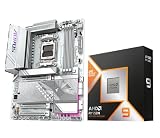
AMD 9950X3D Processor with GIGABYTE X870E AORUS Elite WIFI7 ICE Motherboard | $1,069.99 | Buy on Amazon |
Use the motherboard maker’s support page and manual for BIOS instructions and menu names. Options and labels vary by board and firmware, so a setting path for one AM5 motherboard may not apply to another.
Should you enable EXPO?
If your DDR5 kit has an AMD EXPO profile and the motherboard supports the kit and configuration, enabling the profile is the main optional memory setting to consider. EXPO applies memory settings intended to run the kit at its advertised profile; it is a memory overclocking choice, not a guarantee that every CPU-and-board combination will run that profile stably.
#1 Best Overall
- AMD Ryzen 9 9950X3D Gaming and Content Creation Processor
- Max. Boost Clock : Up to 5.7 GHz; Base Clock: 4.3 GHz
- Form Factor: Desktops , Boxed Processor
- Architecture: Zen 5; Former Codename: Granite Ridge AM5
After enabling EXPO, confirm the computer boots consistently and validate stability in the workloads you actually use. If problems appear, return to the prior settings or try a less aggressive memory configuration rather than assuming the profile is guaranteed.
Keep DIMM configuration in mind
AMD lists different maximum memory speeds depending on the number and rank of the DIMMs. Its current Ryzen 9 9950X3D specifications list DDR5-5600 for 2x1R and 2x2R configurations, and DDR5-3600 for 4x1R and 4x2R configurations. These are the processor’s listed maximum speeds for those configurations; an EXPO profile may specify a higher data rate and should not be mistaken for a guaranteed result.
Rank #2
- AMD Ryzen 9 9950X3D2 Dual Edition
Before choosing a profile, check the motherboard’s memory support information for your kit and intended DIMM arrangement. The relevant factors include the kit’s EXPO support, capacity, DIMM count and rank, and whether the board lists the kit.
Should you turn on PBO or Curve Optimizer?
Neither is necessary for a normal setup. AMD lists Precision Boost Overdrive (PBO) and Curve Optimizer Voltage Offsets as supported features, but that does not establish a stable setting or a performance gain for every system.
Recommended Free Tools
Rank #3
- The best for creators meets the best for gamers, can deliver ultra-fast 100+ FPS performance in the world's most popular games
- 16 Cores and 32 processing threads, based on AMD "Zen 5" architecture
- 5.7 GHz Max Boost, unlocked for overclocking, 80 MB cache, DDR5-5600 support
- For the state-of-the-art Socket AM5 platform, can support PCIe 5.0 on select motherboards
- Cooler not included, liquid cooler recommended
AMD describes PBO as allowing operation beyond default infrastructure limits, potentially up to motherboard limits. AMD warns that PBO operates outside specifications and factory settings and says its use invalidates the AMD product warranty and may also affect warranties from a system manufacturer or retailer. This warning is AMD’s stated position on PBO; it should not be generalized to every BIOS setting.
AMD’s Ryzen Master documentation also describes an AMD Spec mode that allows PBO parameter changes up to, but not above, AMD specification limits. The available options depend on the motherboard firmware. Ryzen Master documentation says PBO and Curve Optimizer parameters can be managed through BIOS and persist across restarts, but it does not provide a universally safe offset or guarantee a benefit.
Rank #4
- The world’s fastest gaming processor, built on AMD ‘Zen5’ technology and Next Gen 3D V-Cache.
- 8 cores and 16 threads, delivering +~16% IPC uplift and great power efficiency
- 96MB L3 cache with better thermal performance vs. previous gen and allowing higher clock speeds, up to 5.2GHz
- Drop-in ready for proven Socket AM5 infrastructure
- Cooler not included
If you choose to experiment, change one setting at a time and check stability, temperatures, and behavior in your own workloads. Avoid copying a PBO limit, boost override, voltage, or Curve Optimizer offset as if it were suitable for every 9950X3D system.
Do you need to update the BIOS?
There is no single BIOS version to recommend without the motherboard’s exact make, model, and revision. Check its vendor support page for CPU support, release notes, and fixes relevant to your system, then follow that board’s flashing instructions. Compare the available release with your installed version and consider whether it addresses a problem or need you actually have.
Free tools Windows power users keep installed
One-click scans. No signup required.
Best Value
- AMD Ryzen 9 9950X3D Desktop Processor, 16-Core, 32-Thread, 5.7 GHz Max Boost, Unlocked for overclocking, L2+L3 144 MB cache, DDR5, Default TDP 170W. The world's fastest gaming processor, built on AMD Zen5 technology and Next Gen 3D V-Cache
- For the state-of-the-art Socket AM5 platform, can support PCIe 5.0 on select motherboards. OS Support: Windows 11/ 10-64-Bit Edition. Cooler & Thermal Solution (PIB) not included. AMD Radeon Graphics Integrated
- GIGABYTE X870E AORUS Elite WIFI7 ICE Motherboard, ATX Form Factor, Dual channel memory DDR4 up to 256 GB, Support PCIe 5.0, 4x M.2 connector, 4 x SATA 6Gb/s connectors, USB4 USB Type-C, Support for Windows 11 64-bit, Supports AMD Ryzen 9000/ Ryzen 8000/ Ryzen 7000 Series Processors
- Digital twin 16+2+2 phases VRM solution;/ Dual Channel DDR5:4*DIMMs with AMD EXPO Memory Module Support;/ WIFI EZ-Plug: Quick and easy design for Wi-Fi antenna installation
- EZ-Latch Plus:PCIe and M.2 slots with Quick Release & Screwless Design;/ EZ-Latch Click:M.2 heatsinks with screwless design;/ Sensor Panel Link:Onboard video port for hassle-free in-chassis panel setup
“Latest” is not, by itself, a universal reason to flash. For example, Gigabyte’s support page for the X870E AORUS ELITE X3D advises against flashing when the current BIOS causes no problems. That is guidance for the cited board page, not a policy that applies to every manufacturer or motherboard.
Independent reader supportYour contribution helps us test, update, and keep practical guides available for everyone.Account for temperature and cooling
AMD lists 95°C as the Ryzen 9 9950X3D’s maximum operating temperature, recommends a liquid cooler for optimal performance, and states that the boxed processor does not include a thermal solution. Cooling is therefore part of the build and can affect sustained behavior, but these specifications do not mean a particular cooler is mandatory or that every workload will reach the maximum temperature.
When assessing a change such as PBO or a memory profile, consider the system’s temperatures and stability under your own workloads rather than relying on a setting value alone.
Quick Recap
A practical order for BIOS changes
- Record the baseline: Write down the board model and revision, BIOS version, memory kit, DIMM count, and current settings.
- Check the board documentation: Confirm CPU support, memory support, and any relevant BIOS release notes on the exact model’s vendor page.
- Change memory only if appropriate: If both kit and board support the configuration, enable EXPO and verify consistent booting and workload stability.
- Leave advanced tuning optional: Keep PBO and Curve Optimizer at defaults unless you deliberately want to tune and can validate the result, including the warranty implications AMD states for PBO.
- Revert a change that causes problems: Return to the last known stable settings before testing another change.
Product prices and availability are accurate as of the date/time indicated and are subject to change. Any price and availability information displayed on Amazon at the time of purchase will apply.
What’s actually slowing this PC down?
Pick the symptom - the matching free tool is one click away.

