
When two sensors disagree, do not pick a winner by brand, price, or the number of digits on the screen. First check that they measure the same quantity under comparable conditions; then weigh their uncertainty, calibration and performance history against the decision you need to make. If the difference could affect an important decision and the evidence does not resolve it, compare them with a suitable reference.
Start by defining the measurement and the decision
Before comparing readings, define the measurand: the physical quantity or property you actually want to know. Two devices can produce different values because they measure different things, or because one reports an estimate derived from another quantity. A reading is meaningful only in relation to the quantity and decision it is meant to support. NIST explains why defining the measurand comes first in What To Do When Measurement Methods Produce Different Answers.
Then state the decision and the tolerance it allows. A rough trend, a home alert, a process-control action and a regulated result may require different levels of confidence. There is no universal disagreement threshold that determines which sensor wins; the relevant acceptance criteria depend on the application and any applicable requirements.
Check that the readings are comparable
A disagreement may come from mismatched data rather than a faulty instrument. Compare the readings only after checking:
The Tool Desk
Outbyte PC Repair FREEClear out junk files and repair common Windows errorsFree Scan →Outbyte Driver Updater FREEScan for outdated or missing drivers - takes under a minuteDriver Scan →#1 Best Overall

- Face Icon Comfort Indicator: Humidity temperature gauge features face icons to indicate DRY/COMFORT/WET air conditions, quickly informs you how to adjust your humidifier or dehumidifier to achieve optimal comfort.
- Highly Accurate Sensors: This temperature humidity sensor features a high accuracy of +/-1°F/°C and +/-2% to 3%RH, making it ideal for measuring dynamic environments like greenhouses.
- Fast Refresh Rate: This digital indoor thermometer refreshes every 10 seconds to provide the latest updates for temperature and humidity readings.
- Compact Display with Large Digits: This digital thermometer indoor outdoor features a compact LCD display with large bold digits, allowing you to read the room thermometer indoor from any angle and distance.
- Mini Size, 3-Way Mount, Use Anywhere: Compact mini humidistat with 3 placement options — Tabletop Stand / Magnetic Back / Hanging Mount, easily fits a nursery, baby room, craft room, grow tent, greenhouse, chick brooder, RV, outdoor patio, kitchen, guitar room, office or cellar.
- Quantity and definition: both devices report the same measurand, not related but distinct quantities.
- Units and scale: convert units consistently and check whether a stated range refers to the reading or the instrument’s full scale.
- Time: align timestamps, time zones and averaging windows. Different sampling intervals or response times can make simultaneous displays represent different periods.
- Place and sampling: check sensor placement and whether the devices sample the same location, volume or surface. Nearby instruments can still experience different conditions.
- Operating conditions: compare the environment and operating range with each sensor’s stated limits, and consider known environmental sensitivities.
EPA includes unit and time checks among its air-sensor quality practices. Its guidance is specific to air sensors, but the general lesson is useful: validate the data’s context before interpreting a mismatch. See EPA’s Quality Assurance for Air Sensors.
Compare evidence, not display precision
A display with more decimal places is not necessarily more accurate. Look for each instrument’s uncertainty statement and check what it covers: the relevant range, operating conditions, and whether the figure is a percentage of the reading or of full scale. Include known contributions from the measurement method, operator and environment, not just the calibration result. NIST’s Policy on Metrological Traceability explains that traceability alone does not establish that uncertainty is small enough for a particular measurement need.
Rank #2

- Wellness Indicator: This humidity meter with humidity level icon indicates air conditions - DRY/COMFORT/WET, allowing this humidity sensor to ensure you’re always aware of changes to your home/household with just a quick glance
- High Accuracy & Quick Refresh Rate: This inside thermometer features a high accuracy of +/-2 to 3%RH and +/-1°F, making it ideal for measuring fluctuating readings like those found in a greenhouse, data measurements are updated every 10 seconds to give you the latest updates on your environment
- High & Low Records: This hygrometer digital thermometer displays high/low temperature and humidity levels to allow you to make proper comparisons using your home’s data
- Healthier Home & Environment: This thermometer hygrometer with temperature and humidity monitor ensures proper indoor humidity that achieves important health benefits for skin and allergen, can also serve as a refrigerator thermometer, freezer thermometer, reptile thermometer, soil thermometer, humidor hygrometer, cigar hygrometer, and more
- Practical Design: This indoor room thermometer features a tabletop stand and a magnetic back, place the temperature monitor on your counter or fridge; °F/°C selector; Includes 1 AAA battery
If both readings fall within their stated uncertainties, report the values with those uncertainties rather than declaring a winner. If the uncertainty information is incomplete, or the disagreement is larger than the available evidence can explain, treat the result as unresolved rather than choosing the more reassuring number.
Assess calibration, drift and data quality
Calibration is one part of the evidence, not a permanent guarantee. Review available calibration results and dates alongside maintenance, stabilization, sensor age, drift and the conditions in which the device has been used. Check for data patterns that could indicate a fault, such as implausible values, sudden jumps, repeated or stuck readings, outliers, or inconsistent results from duplicate components.
Recommended Free Tools
Rank #3

- 1-【Widely Application】The digital LCD monitor can be used in home, office, garage, schools, hotels, laboratories, kindergartens, aquaculture, instrument workshop, warehouse, reptile tank terrarium, aquarium, hermit crab habitat, and other places where temperature/humidity measurement is required.
- 2-【Fast Response】Built in sensitive sensor that measures every 10 seconds with 24 sensitive VENTS to provide updated and accurate readings, wide measuring range: work temperature from 0℃ to 70℃(+32°F ~ +158°F), work humidity from 10% to 99% RH.
- 3-【Healthy Living Monitor】This portable thermo-hygrometer Measures Indoor humidity and temperature in time, help to adjust the humidifier, dehumidifier settings and humidistats, great for monitoring family's living conditions and health by preventing colds, dry skin, great for your work and life.
- 4-【Fahrenheit/Celsius】The Temperature display can achieve the mutual conversion between Fahrenheit (°F) and Celsius (°C). Temperature measurement accuracy: ±1°F, Humidity measurement accuracy: ±3%RH.
- 5-【Long Service Life】This thermo-Hygrometer Powered by one LR44 button cell and one backup button cell. Each LR44 button cell’s working time up to 10 months. Any problem in use, We will definitely Provide you a satisfactory solution.
Calibration intervals depend on the instrument’s stability, requirements and environmental influences. NIST does not prescribe one interval for every device; its Recommended Calibration Interval guidance explains why the schedule should be set for the instrument and its use.
For air sensors, EPA describes practical checks for implausible ranges, abrupt changes, repeated values, disagreement between duplicate components and inconsistency with nearby sensors or expected parameter relationships. EPA also cautions against relying on automated checks alone. These are air-sensor examples, not a universal checklist for every sensor type.
Rank #4

- Face Icon Comfort Indicator: Humidity temperature gauge features face icons to indicate DRY/COMFORT/WET air conditions, quickly informs you how to adjust your humidifier or dehumidifier to achieve optimal comfort
- Highly Accurate Sensors: This temperature humidity sensor features a high accuracy of +/-1°F/°C and +/-2% to 3%RH, making it ideal for measuring dynamic environments like greenhouses
- Fast Refresh Rate: This digital indoor thermometer refreshes every 10 seconds to provide the latest updates for temperature and humidity readings
- Compact Display with Large Digits: This digital thermometer indoor outdoor features a compact LCD display with large bold digits, allowing you to read the room thermometer indoor from any angle and distance
- Multiple Placement Options: This humidistat has 3 placement options - Tabletop Stand / Magnetic Back / Hanging Mount, place the wall thermometer anywhere you wish such as living room, baby room, kitchen, greenhouse, guitar room, office or cellar
Use a suitable reference when the stakes warrant it
If the difference could change a consequential decision, compare the sensors with a reference or independent method that is appropriate for the measurand and purpose. A method based on a different physical principle can help reveal method-specific bias or interference, but only if both methods measure the same property for the same purpose. NIST discusses this approach in Orthogonal Measurements.
For air sensors, EPA describes collocation—placing a sensor at the same location as a regulatory reference monitor and comparing measurements taken at the same time—as a first step in understanding sensor accuracy. That air-specific procedure should not be assumed to apply unchanged to other kinds of sensors. See EPA’s air-sensor collocation guidance.
Windows Errors? Fix Them Before They Spread
Repair common Windows errors and clear accumulated junk for a smoother, more stable PC - no reinstall needed.Free scan · no reinstallCrashes, No Sound, or Screen Glitches?
Random freezes, missing sound and display glitches usually trace back to one bad driver. Find and replace yours safely.Free scan · under a minuteBest Value
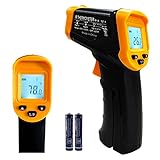
- Temperature measurement range:-50℃-500℃ (-58℉-932℉)Display resolution: 0.1 ℃ or 0.1 ℉
- ℃/℉ conversion selection function
- LCD backlight (convenient for use at night).When backlight is on,any operations will activate the backlight.
- [Data hold]When pull the trigger, LCD display reading with SCAN icon. Release the trigger, display reading with HOLD icon. Built-in 8 sec auto power off function.
- [Emissivity:0.95 preset]Most organic materials and painted or oxidized surfaces have an emissivity of 0.95 (pre-set in the unit). Inaccurate readings will result from measuring shiny or polished metal surfaces. To compensate, cover the target surface with masking tape or flat black paint. Measure the tape or painted surface when the tape or painted reach the same temperature as the material underneath.
A practical sequence for ranking two sensors
- Write down the decision and required tolerance. Identify what action depends on the measurement and what level of disagreement it can tolerate.
- Confirm the measurand. Verify that both devices report the same quantity and definition.
- Align the comparison. Match units, timestamps, averaging periods, location and operating conditions where feasible; account for response-time differences.
- Review uncertainty. Compare what each uncertainty estimate covers in the range and conditions that matter. Do not use display precision as a substitute.
- Review quality history. Check calibration evidence, maintenance, drift, stabilization and data patterns that may indicate a fault or interference.
- Seek a suitable reference if needed. Use a reference or independent method appropriate to the quantity and consequences.
- Record the outcome honestly. If the evidence does not establish which result is more reliable, document the conflict and investigate before treating either value as definitive.
This is a practical decision framework, not a formal ranking standard for every sensor class. Specific applications may have their own technical protocols or legal requirements.
Quick Recap
Product prices and availability are accurate as of the date/time indicated and are subject to change. Any price and availability information displayed on Amazon at the time of purchase will apply.

