
What’s actually slowing this PC down?
Pick the symptom - the matching free tool is one click away.
A molecular test that reports a TB resistance marker as “not detected” does not always rule out drug resistance. Ask the treating clinician and laboratory to review the exact assay, specimen, result wording, and reason resistance was expected; follow-up may involve another specimen or test, sequencing, culture, and drug-susceptibility testing. This article addresses multidrug-resistant tuberculosis (MDR-TB), the best-supported interpretation of “MDR test.” If you mean a test for another organism or a different assay, its result and follow-up may differ—use the test’s exact name and report wording when discussing your case.
First, identify exactly what the result says
A report can distinguish detection of the tuberculosis organism from detection of resistance. For example, an Xpert MTB/RIF result may say that Mycobacterium tuberculosis complex (MTBC) was detected while rifampin resistance was “not detected” or “indeterminate.” These are not interchangeable: “not detected” reports the assay’s finding for the resistance target it examines; “indeterminate” means it did not establish that result. Neither should be interpreted without the report, assay instructions, and clinical context. See the CDC Xpert MTB/RIF guidance.
- Confirm the organism and resistance drug named on the report.
- Record the assay and version, specimen type and collection date, exact result category, and any validity or control flags.
- Ask whether the result concerns resistance specifically or whether the organism itself was not detected.
Why an expected resistance finding can be missed
Molecular assays look for specified genetic targets; they do not necessarily detect every mechanism that can cause resistance. A relevant mutation may lie outside the assay’s coverage, alter primer binding, or be present in a resistant subpopulation below the assay’s detection limit. New or uncommon resistance mechanisms may also be uncharacterized. These limitations are described in the CDC MDDR sequencing user guide and the WHO technical note on molecular antimicrobial-resistance diagnostics.
Coverage is not complete even for well-studied TB drugs. CDC’s 2024 MDDR guide says more than 95% of rifampin-resistant clinical isolates have a single point mutation in the 81-base-pair rpoB rifampin-resistance-determining region. It estimates that sequencing the fabG1-inhA promoter region, fabG1, and katG detects 85–90% of isoniazid-resistant isolates. These are figures for the specified regions and isolates, not guarantees for every assay or patient.
#1 Best Overall

- REALISTIC FOREARM SIMULATION: TB testing model replicates a human forearm with palpable nodules, allowing learners to practice the Mantoux method. TB testing model presents four conditions with visible swelling and measurable induration for accurate interpretation
- TRUE-TO-LIFE MATERIALS: Soft silicone skin combined with a 3D-printed rigid core,TB testing Set provides a realistic feel when locating and assessing induration during training
- DUAL SKIN TONES: Two skin colors palpable arm set allow practice on different skin tones,helping improve accuracy in palpation and interpretation across diverse patient groups; The TB testing Set is durable for repeated use
- BUILT-IN MEASUREMENT GUIDE: A millimeter scale printed on the instruction panel helps learners measure induration diameter correctly, reinforcing proper TB test reading skills
- SAFE TRAINING APPLICATIONS: Palpable TB testing set suitable for classrooms, labs, and simulation courses, offering a safe and effective way to demonstrate and practice tuberculin skin test skills
For additional context, WHO’s 2025 TB diagnostic guideline reports that 6–14% of isoniazid resistance may be missed by moderate-complexity automated nucleic-acid amplification tests (MC-aNAATs) in the specified situation where isoniazid resistance is not detected in someone at high risk of isoniazid-resistant TB. It also reports false rifampin-susceptible molecular rapid diagnostic results in 1–5% of rifampin-resistant TB cases tested with Xpert Ultra across epidemiological settings. Neither range is a general false-negative rate for all MDR tests.
What to do when the result conflicts with the clinical picture
- Explain why resistance was expected. Tell the treating team about prior TB treatment, known exposure to a drug-resistant case, relevant geographic or epidemiologic risks, and lack of clinical response, as applicable. CDC identifies such factors as relevant to considering molecular detection of drug resistance (MDDR) testing; the team and TB program should assess the individual circumstances.
- Have the clinician and laboratory review the result together. Ask whether the specimen and assay were appropriate, whether the result was valid, and whether handling, reporting, or clerical error could explain the discrepancy. WHO guidance includes laboratory review among possible responses when results conflict.
- Choose follow-up testing for the specific discrepancy. Depending on the assay and clinical risk, the team may use a new specimen, another molecular platform, sequencing, or phenotypic drug-susceptibility testing (DST). WHO lists these approaches for relevant TB diagnostic situations; the appropriate next test depends on the case and local guidance.
- Keep culture and susceptibility testing in view. Molecular testing does not replace mycobacterial culture or growth-based DST. CDC directs that MTBC-positive specimens receive growth-based susceptibility testing to first-line TB drugs and advises culture so isolates remain available for DST and genotyping. Its MDDR service combines sequencing with growth-based DST and is not a replacement for conventional culture and DST.
- Use public-health laboratory support when appropriate. In the United States, CDC describes MDDR submissions through public-health laboratories and says its laboratory can assist with result interpretation. Eligibility and submission arrangements are specific to that service; ask the local or state TB program about current procedures.
How to compare conflicting TB test results
Two results can disagree without either being a simple clerical mistake: they may measure different things or have different detection limits. Ask the care team to compare:
Rank #2

- THE ORGINAL DIY BACTERIA TEST KIT that is certified accurate by Good Housekeeping Labs, American Red Cross, Underwriter Labs, and Merck Labs. Designed and developed by our EPA certified scientists. Made in the USA.
- PATENTED TECHNOLOGY: Detects 50 different species of coliform bacteria (including E. coli), as low as 1-organism. Test any freshwater supply.
- 3RD PARTY STERILIZATION: Every Safe Home kit is sterilized by a certified facility (see attached certificate) and guaranteed to be “free from bacteria” before you test. This process assures zero “false positive results” from product contamination, as may be experienced with other kits who skip this sterilization process.
- FAST RESULTS- Get results as quickly as 6 hours. May take up to 72 hours based on incubation conditions, and concentrations of bacteria in the water being tested.
- YOUR PURCHASE MAKES A DIFFERENCE in people’s lives. Safe Home donates a portion of every test kit sale to clean water initiatives around the globe. See attached images with this listing, to learn more.
- What was detected: MTBC itself, a particular resistance marker, or growth under drug exposure.
- Method: targeted molecular testing, sequencing, or phenotypic growth-based DST.
- Specimen and timing: whether tests used the same specimen or samples collected at different times.
- Coverage and detection limits: which genes or regions the molecular assay examines and whether a low-frequency resistant subpopulation could be missed.
- Clinical risk: prior treatment, exposure history, epidemiology, and treatment response.
- Result status: valid, indeterminate, or discordant, including any control or specimen-quality concerns.
CDC notes that MDDR sequencing can miss mutations outside its covered genomic regions and heteroresistance when the resistant subpopulation is below the assay’s detection limit. It also notes that some mutations have uncertain clinical relevance and that sequencing can disagree with growth-based DST. The CDC clinical and laboratory diagnosis guidance and WHO’s 2025 TB diagnostic guideline provide further context on interpreting results and follow-up.
What the result does—and does not—decide
A “resistance not detected” result is a finding about the assay, not universal proof that resistance is absent. Conversely, a test discrepancy alone does not establish resistance. CDC advises interpreting Xpert MTB/RIF alongside clinical, radiographic, and other laboratory findings; the assay does not replace smear, culture, growth-based DST, or genotyping. Treatment decisions should be made by the treating team using the full clinical and laboratory picture, not by treating one molecular result as definitive.
Rank #3
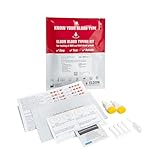
- Quick Results: Learn your blood type in just a couple of minutes with this easy-to-use testing kit
- Simple Interpretation: Easily understand your blood type group with clear and straightforward results
- Permanent Record: Keep as a permanent record of your blood type on the durable card for your records or safekeeping
- Reliable Accuracy: Offers a reliable and accurate way to learn your blood type using proven testing technology
- Convenient Home Use: Can be used conveniently at home without the need for laboratory visits
If “MDR test” means something other than TB
“MDR” is used in contexts beyond TB, and the interpretation depends on the organism and method. For example, CDC’s MRSA laboratory testing guidance describes mixed susceptible and resistant subpopulations as one reason resistance can be difficult to detect and sets organism-specific phenotypic testing and reporting rules for Staphylococcus aureus. That is not a TB testing algorithm. For another organism, confirm the exact test and discuss its result with the clinician and laboratory responsible for that assay.
Quick Recap
Rank #4

- TOP-SELLING CONSUMER DNA TEST: From your origins in over 3,600+ places around the world to the most connections to living relatives, no other DNA test kit delivers an experience as unique and interactive as AncestryDNA.
- YOUR DATA, YOUR CONTROL: We give you full control over your genetic information. You decide what to share, and with whom.
- DNA + TRAITS: Ever wondered where your freckles came from, or why you hate cilantro? AncestryDNA + Traits lets you discover 75+ genetic traits, allowing you to explore how your genes might have influenced a range of appearance, sensory, performance, nutrient, and other personal characteristics.
- A FEW SIMPLE STEPS: Simply activate your DNA kit online and return your saliva sample in the prepaid package to our state-of-the-art lab. Your results will be available online in roughly six weeks.
- ORIGINS AND INHERITANCE: AncestryDNA is the only DNA test that can show your origins results, DNA matches, and traits by each side of the family, without your parents taking a DNA test.
Product prices and availability are accurate as of the date/time indicated and are subject to change. Any price and availability information displayed on Amazon at the time of purchase will apply.

