
If a robot that works in a familiar setup fails around a new object or rearranged room, isolate what changed before concluding the robot cannot do the task. Check object recognition, spatial arrangement, visual conditions, movement during execution, and task sequencing separately; each can fail for a different reason.
First, identify what kind of change triggered the failure
“New object” and “changed layout” describe different tests. A robot may encounter a new instance of an object it already knows, such as a different mug, or an entirely unfamiliar category. A layout change keeps the objects and task but alters where things are or how they relate. A moving object adds a further challenge: the robot must update its understanding while acting.
These distinctions matter because a robot can recognize an object but still fail to reach, grasp, or use it. Likewise, it may handle each item individually but fail when their positions or task order changes. MESA-Bench separates tests for unseen spatial configurations, object instances, object categories, and new compositions of familiar subtasks, rather than treating them as one measure of generalization. MESA project documentation
Check whether the robot grounded the instruction in its current view
Start with the instruction and the robot’s current camera image. Ask whether it selected the intended object, not merely a visually similar one. If the request is “can you get me the pink stuffed whale?”, for example, verify that it identifies the whale in the scene and distinguishes it from other toys or pink objects.
Recommended Free Tools
#1 Best Overall
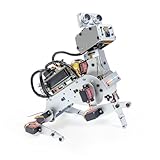
- AI-Powered Raspberry Pi Robot Dog — PiDog: Powered by Raspberry Pi (5/4B/3B+/3B/Zero 2W), OpenClaw, and multi-LLMs like ChatGPT, Gemini, Grok, DeepSeek, Qwen & Ollama. With 12 servos, camera, gyroscope, hearing & touch sensors, PiDog can see, listen, talk, move, and interact intelligently. Supports OpenCV, MediaPipe, TTS & STT, app control, FPV & Python. A great STEM robotics gift for students, makers & tech enthusiasts—perfect for birthdays and holidays. (Raspberry Pi not included)
- Realistic Dog-like Movements: PiDog's 12 powerful servos enable 32 dog-like actions, including walking, sitting, standing, shaking its head, wagging its tail, and performing playful tricks, closely mimicking a real dog and providing an engaging experience. This is an AI development robot product designed for engineers, suitable for ages 15 and above
- Rich Sensor Suite for Interactive Experiences: PiDog features ultrasonic, touch, gyroscope, sound, camera, speaker and microphone. These provide it with advanced hearing, vision, and touch, enabling it to see, detect obstacles, respond to touch, and recognize sounds, making interactions highly engaging
- AI-Powered Interactions with OpenClaw & Multi-LLMs. PiDog combines voice, vision, and gesture recognition for immersive AI experiences. Powered by OpenClaw and multi-LLMs like ChatGPT, Gemini, Grok, DeepSeek, Qwen, Doubao, and Ollama (local LLMs), it can understand questions, respond naturally through TTS & STT, recognize math problems, interpret hand gestures, and hold smart conversations. OpenClaw also enables customizable AI behaviors and personalized robotics development, helping users create their own intelligent robotic companion
- Comprehensive Learning Resources and Support: PiDog offers detailed online documentation, video tutorials, prompt technical support, and an active forum community, ensuring beginners can easily complete all projects and enjoy a great experience
- New instance: Is this a different example of a familiar category, such as a mug with a new shape or pattern?
- New category: Is it an object type the system may not have encountered before?
- Instruction variation: Does a different phrase or description change what it selects?
Then separate recognition from action. If the robot points to or names the correct item but misses it, drops it, or cannot manipulate it, the problem may be grasping, reachability, or the action policy—not object identity alone. The MOO authors describe a method that extracts object-identifying information from a language command and image, then conditions the robot policy on that information. They report zero-shot generalization to novel object categories and environments on a real mobile manipulator; this is a research result, not a guarantee for other robots or objects. MOO paper on arXiv
Another research approach, UAD, distills task-conditioned affordances from foundation models. Its authors report experiments involving unseen instances, categories, and instruction variations, including policies learned from as few as 10 demonstrations. That figure describes their experiments; it is not a general demonstration-count requirement or promise for a deployed robot. UAD project page
Test the layout separately from object novelty
Keep the task and objects the same, then change their positions or relationships. For example, compare picking up the same cup from the same table when it moves from the robot’s left to its right. If the robot succeeds with the original placement but fails in the new one, that points toward spatial generalization or navigation rather than unfamiliar-object recognition.
Rank #2

- Raspberry Pi AI Robot: powered by Raspberry Pi (5/4B/3B+/3B/Zero 2W), features 12 servos and sensors for vision, hearing, and touch. Integrated with ChatGPT-4o, it responds to complex queries. With app control and FPV, users can manage and see its view in real-time. It supports Python programming
- Realistic Movements: 12 powerful servos enable 32 actions, including walking, sitting, standing, shaking its head, wagging its tail, and performing playful tricks, closely mimicking a real and providing an engaging experience
- Rich Sensor Suite for Interactive Experiences: features ultrasonic, touch, gyroscope, sound, camera, speaker and microphone. These provide it with advanced hearing, vision, and touch, enabling it to see, detect obstacles, respond to touch, and recognize sounds, making interactions highly engaging
- Engaging Interactions with ChatGPT-4o: with ChatGPT-4o enables voice interactions and visual recognition, making it smarter and more responsive. Users can have natural conversations, solve math problems via the camera, and interpret gestures, creating diverse and fun interactions
- Comprehensive Learning Resources and Support: offers detailed online documentation, video tutorials, prompt technical support, and an active forum community, ensuring beginners can easily complete all projects and enjoy a great experience
MESA-Bench is designed to distinguish unseen spatial configurations from unfamiliar instances or categories and from composed tasks. Its evaluation structure is useful as a diagnostic model: vary one dimension at a time so a layout failure is not mistaken for an object-recognition failure. MESA project documentation
Do these 3 things before closing this tab:
1Repair Windows errors before they cause bigger problems2Fix the driver behind crashes, sound loss and screen glitches3Clear out junk files and repair common Windows errorsLook for visual and environmental changes
A robot may fail even when the target and task are unchanged if the scene looks different. Check for changes to:
- Target color, texture, size, or physical properties
- Table or receptacle surface, background, or lighting
- Camera pose or viewpoint
- The number and placement of distractor objects
Colosseum evaluates manipulation across 20 tasks and 14 environmental perturbation axes, including object, table, and background appearance and physical properties, lighting, distractors, and camera pose. In the authors’ 2024 benchmark study, five state-of-the-art models’ success rates fell by 30–50% across perturbation factors; when multiple perturbations were combined, degradation exceeded 75%. The authors found that distractor count, target color, and lighting caused particularly large reductions in their experiments. These results describe that benchmark and those models, not expected failure rates for every commercial robot. Colosseum project page
Rank #3

- AI-Powered Raspberry Pi Smart Car — PiCar-X: PiCar-X brings AI learning to life — powered by Openclaw and multi-LLMs including ChatGPT, Gemini, Grok, DeepSeek, Qwen, Doubao, Ollama (Local LLMs), and compatible with many more AI platforms. Featuring OpenCV, MediaPipe, TTS & STT, PiCar-X enables true AI vision and voice interaction — it can see, listen, talk, drive and think like an intelligent companion. Ideal for students (10+), educators, and engineers, PiCar-X is the perfect gateway to explore AI, robotics, and machine learning on Raspberry Pi 5/4/3B+/3B/Zero 2W (Raspberry Pi not included)
- Engaging Interactions with Multi-LLMs: PiCar-X, powered by Openclaw and multi-LLMs — including ChatGPT, Gemini, Grok, DeepSeek, Qwen, Doubao, and Ollama (Local LLMs) — and compatible with many other AI platforms, supports voice interaction and visual recognition to make the robot smarter and more responsive. Users can enjoy natural AI conversations, solve math problems through the camera, and interpret gestures, unlocking a world of diverse and fun AI-driven interactions
- Feature-rich and Adaptable: PiCar-X offers engaging applications like line following and obstacle avoidance, supports TTS (Text-to-Speech) and STT (Speech-to-Text) for interactive voice control, and includes a camera for video and vision recognition. It also comes with various sensors, while its customizable design enables a wide range of creative AI and robotics projects
- Versatile Programming Options: Catering to users of all skill levels, PiCar-X supports both Python and Scratch programming languages, allowing for flexible learning and skill development
- Simplified Assembly & Support: PiCar-X is perfect for beginners, yet learning with experienced users is recommended for best results. It comes with easy assembly instructions and forum support for smooth project completion
Check whether the scene moved during the task
If objects shift, roll, swing, or are moved by another person or robot, check whether the system uses observations over time and revises its plan. A policy that acts on a single image may have an outdated view by the time it reaches for an object. Look at when the robot last observed the target, whether it tracked its movement, and whether it replanned after the scene changed.
DOMINO describes dynamic manipulation as a challenge for vision-language-action systems that rely on single-frame observations. Its 2026 project page reports 35 tasks across five robot embodiments and more than 110,000 expert trajectories. It also describes PUMA, which uses historical optical-flow cues and world queries to forecast object-centric future states. The authors report a 6.3-percentage-point absolute success-rate improvement over baselines. These are project-reported benchmark findings, not proof that temporal modeling is the cause or remedy for every robot’s failure. DOMINO project page
The Tool Desk
Outbyte Driver Updater FREEFix the driver behind crashes, sound loss and screen glitchesFind Drivers →Outbyte PC Repair FREERepair Windows errors before they cause bigger problemsFix Now →Trace failures through long household tasks
For a multi-step job—such as tidying, stocking groceries, or setting a table—note where the sequence breaks. The first object may be recognized correctly, while a later transition between subtasks fails: the robot may not hand off the result of one skill to the next, or may lose track of what remains to be done.
Rank #4

- BUILD, CODE & DRIVE YOUR OWN ROBOT CAR: Turn coding, electronics and engineering into a working programmable robot car you can assemble, program and drive; ideal for weekend family projects, STEM classrooms, coding clubs, robotics lessons and maker challenges
- EXPLORE FPV, LINE TRACKING & OBSTACLE AVOIDANCE: Control the robot with the ELEGOO app or IR remote, view live FPV video through the onboard camera, follow black lines, avoid obstacles with the ultrasonic sensor and explore multiple interactive driving modes
- BEGINNER-FRIENDLY BUILD WITH GUIDED WIRING: Keyed XH2.54 connectors help reduce wiring mistakes, while the illustrated tutorial and example programs guide beginners step by step from chassis assembly and module connection to programming and the first successful run
- GO BEYOND ASSEMBLY WITH CREATIVE CODING: Program with Arduino IDE to explore movement, sensors and control logic, then modify example code to create custom routes, reactions and robotics experiments that develop coding, problem-solving and engineering skills
- COMPLETE RECHARGEABLE STEM ROBOTICS KIT: Includes an ELEGOO UNO R3 controller board, ESP32-WROVER-based camera and Wi-Fi module, line-tracking and ultrasonic sensors, motors, IR remote and a 2000 mAh rechargeable lithium-ion battery; recommended for ages 8+ with adult guidance for first-time builders
Habitat 2.0 combines a physics-enabled simulator and the Home Assistant Benchmark for household rearrangement tasks. In its reported experiments, flat reinforcement-learning policies struggled relative to hierarchical policies, while hierarchies of independent skills had hand-off problems; sense-plan-act pipelines were more brittle than RL policies. These comparisons apply to that benchmark and its experimental setup, not to every architecture or robot. Meta AI Research: Habitat 2.0
Run a controlled comparison and record the failure stage
Change one condition at a time while keeping the task and other conditions steady. Record both the change and the first observable failure; “it failed” is less useful than “it selected the right object, then reached to the old location.”
- Establish a baseline: Run the task in the familiar setup and record the instruction, object placement, camera view, and outcome.
- Change one dimension: Try a new object instance, a new category, a different layout, a visual change, or motion—but not several at once.
- Observe the stages: Note whether the robot identified the target, planned the right movement, reached and grasped successfully, executed the action, and completed any hand-off to the next subtask.
- Repeat and compare: Restore the original condition, then introduce another single change. This helps distinguish a repeatable weakness from a one-off failure.
This is a practical diagnostic method inferred from how the cited benchmarks separate evaluation factors; it is not a universal troubleshooting protocol. The benchmarks themselves are not interchangeable: Colosseum emphasizes environmental perturbations, MESA semantic, spatial, and compositional generalization, and DOMINO dynamic manipulation. Compare results only within the scope each benchmark tests. Colosseum, MESA, and DOMINO
Quick Recap
Product prices and availability are accurate as of the date/time indicated and are subject to change. Any price and availability information displayed on Amazon at the time of purchase will apply.

