
Rolling and bouncing boulders leave tracks that help scientists study movement on Martian slopes, the fine-grained material beneath the rocks, and ongoing erosion. They do not directly reveal Mars’s deep interior, and a visible track alone cannot pinpoint when a boulder moved or what triggered it.
How to read a boulder track
A boulder moving down a dusty slope can leave a line of depressions between its source area and resting place. Continuous marks are consistent with rolling; separated marks can indicate bouncing. The track’s length, spacing, contrast, the terrain it crosses, and the boulder at its end all provide clues about its path and interaction with nearby surface material. NASA/JPL’s 2005 account describes Mars Orbiter Camera images with resolutions ranging from 0.5 to 12 meters per pixel, a source-specific range rather than a universal resolution for Martian imagery: NASA/JPL’s “Rolling Stones Make New Boulder Tracks”.
![Hot Wheels Mars Perseverance Rover, [White] 95/250 Space 1/5](https://m.media-amazon.com/images/I/414UcC4lYuL._SL160_.jpg)
Repeat images can establish that tracks appeared within a time interval. At one south mid-latitude crater, images from November 14, 2003 and December 4, 2004 show more than a dozen new tracks. The boulders moved sometime between those observations, but the images do not establish the exact date of each movement or whether all the tracks formed in one event: NASA/JPL’s 2005 image account.
What tracks reveal about Mars’s surface
Fine-grained debris and rock movement
NASA/JPL explains that geologists can use boulder tracks to learn about physical properties of the fine-grained debris a rock encountered. A track records a boulder’s route across the surface, while its shape and spacing help describe how it moved. Those clues concern local surface materials and movement; they are not, on their own, a complete measurement of the soil’s composition or the planet’s geology.
#1 Best Overall
Layered bedrock and erosion at Eos Chasma
At Eos Chasma, NASA describes boulders along horizons in exposed layered bedrock on a steep cliff. The horizons are thought to correspond to individual lava flows. The boulders’ association with those layers links them to the canyon rim, while their tracks show subsequent downslope movement. Some tracks there extend up to a kilometer, according to NASA Science’s 2016 account: NASA Science, “Trundling Boulders”. NASA interprets the tracks as evidence that erosion of the canyon rim continues today.
Brightness and bouncing
Tracks can be bright or dark, so brightness must be interpreted in its local context. In one HiRISE example, NASA interpreted discontinuous bright spots as marks left by a bouncing boulder. It suggested that a bright trail might result from brighter shallow subsurface soil being exposed, but presented this as a possibility, not a settled explanation for all bright tracks. NASA also ruled out ice as the explanation for that particular track on a warm, equator-facing slope in summer: NASA Science’s “Bright Tracks from Bouncing and Rolling Boulders”.
Rank #2

- Introduce kids to the world of LEGO Technic with this Mars Rover building kit
- This mini build was designed in collaboration with NASA and features realistic arm movement and suspension
- With only 83 pieces, this building toy set makes a great travel toy
- Makes a great Christmas stocking stuffer, Easter basket stuffer, or just because treat for kids ages 7 and up
What may move boulders—and what remains unknown
Gravity drives a boulder’s downslope movement, but a particular track may not reveal what first dislodged the rock. In its account of the crater-wall tracks, NASA/JPL said it was unknown whether a marsquake, strong winds, or another cause triggered the movement. The available image comparison also could not determine whether the tracks formed together or at different times during the roughly 13-month interval.
NASA describes frost heaving and temperature-driven expansion and contraction as contributors to dry mass wasting. Repeated daily and seasonal temperature cycles can gradually destabilize perched rocks or move them closer to an edge. These are general erosion mechanisms, not confirmed triggers for each photographed boulder: NASA/JPL’s “Watch for Falling Rocks!”.
What’s actually slowing this PC down?
Pick the symptom - the matching free tool is one click away.
Rank #3

- ✅【Meaningful Design】Inspired by the action of human exploration on Mars and the Moon, this very different cosmic exploration vehicle style remote control car was created, unfolding the sail panel can automatically turn on the light effect, if closed to save power consumption, and comes with a model astronaut.
- ✅【The Best Gift of Enlightenment】This RC toy car is suitable for children from 4 years old and up, cultivating kids' interest in the future of science and space, having fun, and being educational. It is the best space gift for birthdays, children's days, Christmas, Easter, summer camp activities, and back to school.
- ✅【Rich Control Gameplay】The RC cars have special 6 wheels (4 drive wheels + 2 auxiliary wheels) and can be controlled by a combination of remote controls to achieve a variety of movements [1]. Forward and backward movement. [2]. Lateral movement. [3]. Turning around in place. [4]. Sideways adjustment of body direction. [5]. DEMO auto-drive mode.
- ✅【Adaptable to Multiple Terrains】Powerful damping springs and high-torque wheels allow the remote control cars to drive and climb over rough terrain, both indoors and outdoors and are not prone to rollovers.
- ✅【Strong Signal, No Interference】Using a high-quality 2.4 GHz remote control, the actual test effective control distance of 30 meters (no exaggerated propaganda) is very responsive. The signal stability and control distance are much stronger than the traditional infrared remote control.
Why a track cannot give an exact age
A visible trail establishes that movement occurred, but its preservation depends on local conditions and the kind of mark. NASA notes that winds quickly erased tracks made by the Opportunity rover, while deeper boulder gouges may last longer than shallow wheel compressions. Tracks may also fade at different rates in dustier and less-dusty locations. Visibility therefore does not provide a precise date for a rockfall: NASA/JPL’s “Tracking Boulders” and NASA Science’s bright-track example.
How boulder tracks differ from dust-devil tracks
Not every dark line on Mars is a rock trail. Dust devils leave dark marks when whirlwinds remove a light-colored dust layer and expose darker sand. Boulder tracks, by contrast, are depressions or marks associated with a rock’s downslope path and may lead to the boulder’s resting place. The shape, setting, and presence of a terminus boulder help distinguish the two: NASA Science’s “Dust Devils on Mars”.
Rank #4
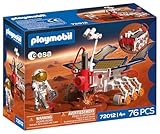
- PREPARE FOR LIFTOFF: With the Mars Rover, you can launch your own mission to Mars!
- HIGH-TECH EXPLORATIONS: Equipped with a drill, cameras, and high-tech sensors, the rover searches deep beneath the surface for signs of alien life.
- STEM‑INSPIRED IMAGINATIVE PLAY: Encourages creative stories and hands‑on exploration for little astronauts.
- SET INCLUDES: Rover with astronaut, solar panels, camera, drill and accessories - the ideal gift for children who love outer space.
What these tracks say about Mars’s interior
Boulder tracks are evidence about the surface and near-surface: where rocks moved, how they interacted with fine material, and how slopes and exposed bedrock are eroding. They do not independently establish the composition or structure of Mars’s deep interior. Answering questions about the interior requires other kinds of evidence; a photograph of a rock trail cannot support that conclusion by itself.
Quick Recap
Best Value
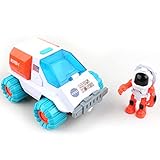
- GET READY FOR ADVENTURE: Open the cockpit and place the astronaut inside, push the button to get the engines' flashing lights and make realistic sound, place the other astronaut inside the space rover and explore outer space using this vehicle, equipped with satellite dish, camera, detector and solar panel. Now you can start your space adventure and explore outer space.
- TAKE ME TO OUTER SPACE: Comes with 9.5 x 7.5 (approx.) inch spaceship, 7 x 8 inches (approx.) space rover car, two Astronaut figures and two 1.5V AA Alkaline batteries.
- FEATURES: Extended turning mechanical arm that's stored behind the compartment opens and closes doors, Rolling wheels, Lights and Sounds, Opens and closes Canopy, and Transparent window. Compatible with our other space toys from Space Adventure Series Mars Mission collection.
- OUR SPACE TOYS: made from non-toxic ABS plastic the space toys design with rounded corners for child’s safety.
- FOR KIDS AGES: 3 years and up
Product prices and availability are accurate as of the date/time indicated and are subject to change. Any price and availability information displayed on Amazon at the time of purchase will apply.
Quick wins for a faster PC:
Fix the driver behind crashes, sound loss and screen glitchesFind Drivers →Repair Windows errors before they cause bigger problemsFix Now →
