
Quick wins for a faster PC:
Clear out junk files and repair common Windows errorsFree Scan →Scan for outdated or missing drivers - takes under a minuteDriver Scan →The clearest difference is how much control the player has over danger. Psychological survival horror tends to make threats uncertain and survival costly, using atmosphere, perception and limited options to sustain dread. Action horror gives greater weight to direct encounters and the player’s ability to fight back. The labels overlap: psychological horror describes an approach to fear, while survival horror is a broader game tradition that can include combat, puzzles and exploration.
Why the labels overlap
“Psychological horror” is best understood as a thematic approach: it focuses on subjective experience, mental states, perception or trauma. It is not, by itself, a gameplay genre. A University of Tampere thesis uses Silent Hill 2 and Amnesia: The Dark Descent as psychological horror examples within survival horror. The thesis on videogames and genre also describes survival horror as a tradition involving constrained survival, exploration and puzzle-solving.

Survival horror is not defined by having no weapons or no combat. Guinness World Records describes the genre as a horror subgenre of action-adventure in which players evade attacks by solving puzzles and unlocking paths and rooms. It records Haunted House (1981) as an early game with horror and suspense elements associated with the genre, and says “survival horror” was coined with the original Resident Evil in 1996. Guinness World Records’ account is useful historical framing, not a rulebook for classifying every later game.
That distinction matters because a game can be psychologically disturbing and still provide substantial combat, or action-oriented and still make survival feel precarious. Genre labels describe emphasis, not mutually exclusive feature lists. Ewan Kirkland’s peer-reviewed analysis of survival horror considers narrative, visual design, virtual space, violence, morality and player identification alongside horror conventions, illustrating why a single mechanic cannot settle the classification. Kirkland’s article provides that broader lens.
#1 Best Overall

- Test How Well You Know Each Other: Guess how closely players feel two personality traits describe themselves on a scale of 1–10 (e.g., Competitive and Funny). The closer you guess, the more points you score
- Never the Same Game Twice: With thousands of possible personality trait combinations, every game helps you uncover new insights about one another
- Fun that Builds Connection: Enjoy laughter and surprising reveals as you learn how your friends and family really see themselves
- Easy-to-Learn Gameplay: The rules are simple—the real challenge is how well you can read other players' minds as you tap into your inner psychoanalyst
- Game-Night Ready: Designed for 3–6 players, ages 8 and up, this set includes everything you need to play: a board, 250 cards, 6 magnetic scoring tiles, 6 character pieces, and a scoring trophy
The practical difference is agency
To compare a game’s horror style, ask how safely and reliably the player can confront, defeat, evade or otherwise manage a threat. Josh Bycer’s Game Developer analysis frames survival horror around power and powerlessness: when a player can confidently handle encounters, danger can become an action challenge; when control is limited or costly, the encounter can remain a survival problem. Bycer’s analysis of survival horror and shooting is an interpretation of design, not an official genre standard.
| Design dimension | Psychological survival-horror emphasis | Action-horror emphasis |
|---|---|---|
| Player agency | Uncertainty, vulnerability, costly choices or limited control over an encounter. | A more reliable ability to attack, counter or control threats. |
| Combat | May be avoidable, dangerous or costly; it is one pressure among several. | A central, repeatable way to progress and manage threats. |
| Survival pressures | Resource management, exploration, puzzles and route-finding help shape survival. | Direct encounters and combat execution receive greater emphasis. |
| Source of fear | Atmosphere, subjective perception, narrative and uncertainty can sustain dread. | Threat remains present, but power and mastery can shift the experience toward action. |
| Possible design risk | Persistent powerlessness can feel frustrating or repetitive. | More combat does not automatically remove survival pressures or horror. |
The difference is not simply whether a character carries a weapon. Resources, encounter design, pacing and the consequences of mistakes all change what that weapon means. Limited ammunition in an uncertain encounter may make a shot a difficult decision; reliable combat tools and repeatable confrontations can make the same basic act feel like mastery.
Rank #2

- TWISTED TERROR: Challenge your friends on frightening facts with a trivia game that tests your knowledge on horror facts in every genre. Call a priest, gas up the chainsaw, and sharpen the machete…will you survive the night?
- HORROR FANS: Think you know all there is to know about creepy dolls, psycho killers, haunted places and legendary monsters? Try to answer trivia questions with your knowledge of scary movies, books and tv shows to win.
- QUICK PLAY TRIVIA GAME: Survive the night by answering multiple questions correctly to collect weapon cards. The first player or team to collect 3 different weapons cards wins. Each card has 2 ghoulish questions, play time: 20 mins.
- GAME NIGHT GORE: A variety of questions covers classic and modern horror. Easy questions for the horror novice and more challenging questions for die hard fans make the game fun for the whole group!
- THE GORY DETAILS: Horror Trivia is perfect for 2 or more players or teams and is an absolute "scream" at parties. Ideal for horror fans, adults and teens ages 13 years and older, game includes 150 cards with 300 questions and answers.
How the distinction appears in familiar games
Silent Hill 2: psychological themes within survival horror
Silent Hill 2 is commonly discussed as psychological horror within survival horror: its disturbing, subjective storytelling sits alongside survival-game structures. The 2024 discussion of combat in the remake raises questions about whether greater capability changes the balance of power and vulnerability, but that is a design critique, not a settled consensus about the remake or a definitive genre ruling. Bycer’s analysis treats this tension through the lens of player power.
Amnesia: The Dark Descent: dread without bombastic action
Amnesia: The Dark Descent is another psychological survival-horror example. The Tampere thesis notes its first-person perspective and lack of combat helped popularize a template centered more on atmosphere than bombastic action, while cautioning that those features were not wholly new. Its example shows that combat can be reduced without changing the broader question of how a game creates pressure and asks the player to survive.
Free tools Windows power users keep installed
One-click scans. No signup required.
Resident Evil 4: an action-leaning point on a continuum
Resident Evil 4 is useful as an action-leaning comparison, not as the clean opposite of survival horror. Bycer describes Leon as capable in combat, while the Tampere thesis notes that survival horror became more action-oriented after the game’s success, with slow exploration, resource management and puzzle-solving receding in that broader trend. That shift suggests emphasis can change over time without making the labels simple opposites.
Dead Space: combat can change the feel of an encounter
Game Developer’s analysis of survival horror and the fight-or-flight response uses Dead Space to discuss how combat-centered encounters may shift the player’s experience toward confrontation and control. This is an analytical example, not an official classification. The Game Developer article examines that relationship between threat and response.
Rank #4

- Play a German soldier haunted by horrors of the Great War and break the cycle of suffering while your mind drifts between memories and the trenches
- Wake up as a teenager in a deserted house and suddenly find yourself in the trenches surrounded by horrific monsters; Confront your trauma and demons
- To escape the death traps and terrifying creatures you must understand each monster and solve the puzzles that stand in your way
- Peel back the shroud that hides the secrets of your family torn apart by the Great War and try to remember your past
- Through exploration and solving riddles between the walls of your home and the barbed wire of No Man’s Land you reveal a German family ravaged by war
A useful way to judge a game
Instead of asking whether a game is “really” psychological or action horror, consider what its design repeatedly asks you to do:
- Does it make danger frightening because you lack information, resources or dependable control?
- Are exploration, puzzle-solving and route choices part of staying alive, rather than just breaks between fights?
- Can you reliably turn encounters to your advantage, or does combat remain risky enough to feel like one survival choice among others?
- Does atmosphere or subjective storytelling keep the threat disturbing even when you can fight?
Shinji Mikami, identified as the creator of Resident Evil, offered a personal design perspective in a 2014 interview report: “The horror aspect of the game and the entertainment aspect of the game have to mix together.” He also said, “It’s a close genre but the difference between pure horror and survival horror is that in the latter you can defeat the monsters and feel good about it. You have to have that sense of being able to defeat a monster, even if it’s tough.” PlayStation Universe’s report of Mikami’s remarks captures his view; it is not a universal definition.
Quick Recap
Best Value
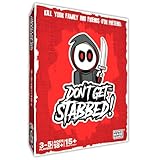
- ADULT CARD GAME FOR GAME NIGHT - Don’t Get Stabbed! is an adult party game where you get to kill your family and friends! ... for pretend of course. It’s inspired by horror movies of the 70’s, 80’s and 90’s, but is light-hearted enough for everyone to enjoy. The ultimate Halloween game!
- COMPETITIVE & EASY TO LEARN - This entertaining game is playable for 3 to 5 players. One person is elected as the killer (whoever is the most evil in your group) and the rest are victims. The killer wins by killing all the victims. The victims win by escaping.
- HILARIOUS & REPLAYABLE- The average player will love this game for its gameplay! The horror fan will love the art on many of these cards which features classic horror movie tropes. There is tons of fun in playing this game and in its artwork.
- ADULT PARTY GAME – It may look cute, but like most horror movies it has topics you probably don’t want your children knowing about. For ages 18+.
- WHAT’S IN THE BOX?! – Included in the box are 64 Main Deck Cards and 13 Car Deck Cards printed on premium glossy playing cards (2.5 x 3.5 inches), for a grand total of 77 cards. Also included is one instruction booklet.
Product prices and availability are accurate as of the date/time indicated and are subject to change. Any price and availability information displayed on Amazon at the time of purchase will apply.

