
There is no single official “20% rule” for solar panels. People use the phrase for different ideas—including producing 20% more electricity than a household uses, allowing for system losses, or sizing panels relative to an inverter. It is also sometimes confused with a separate U.S. electrical-panel interconnection rule. These are not interchangeable formulas.
What people mean by the “20% rule”
The phrase is ambiguous. It may refer to a suggested production buffer above annual electricity use, a claim that a solar system should cover only 80% of consumption, an assumed allowance for losses, or the U.S. National Electrical Code (NEC) 120% busbar concept. A UK explainer published September 16, 2026, documents these competing uses, but does not establish any one as a universal standard: Midland Solar Team’s explanation of the term.


A 20% buffer over a household’s annual use can be a rough starting point for a discussion, but it is not a universal engineering constant or a law. The right system estimate depends on the home, its electricity use, and the system design.
How to estimate whether a system can meet your electricity use
Annual production cannot be calculated from a panel’s rated efficiency or wattage alone. The U.S. Department of Energy (DOE) explains that a complete photovoltaic (PV) system’s design depends on the roof’s shape, size, slope, orientation and mounting, as well as whether storage is included. Production and potential savings also depend on household electricity use, system size and available sunlight.
The Tool Desk
Outbyte Driver Updater FREEScan for outdated or missing drivers - takes under a minuteDriver Scan →Outbyte PC Repair FREEClear out junk files and repair common Windows errorsFree Scan →#1 Best Overall
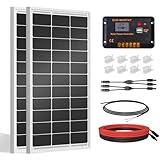
- [Wide Application]: Daily Output 800wh/day under 4 hours full sunshine condition. Perfect for RV, Caravan, Marine, Camper, Electric scooter, Golf Carts, Power wheels, Trolling motor, Tool trailer, Backup power supply for cabin shed home etc.
- [Excellent Performance]: ECO-WORTHY solar panels use high-performance monocrystalline solar cells, which can provide up to 21.5% higher efficiency sufficient light conditions.size:35.2*23.1.37in
- [Durable]: Corrosion-resistant aluminum alloy frame, so that the panel can be used for decades, and can withstand strong wind (2400Pa) and snow load (5400Pa), with a long service life. Ip65 rated junction box provides complete protection.:
- [Complete and Easy]: The back of the pre-drilled and plug-and-play cables allow quick installation, the kit can be connected in series (24V) or parallel (12V) if you need. What you will get: 2 pcs 100W mono solar panel + 2 set of Z mounting brackets + 30A solar controller + 1 pair of 16.4ft 10 awg solar cables + 1 pair of 2-in-1 connectors + 1 pair of 4.92ft tray cable.
- [Support]: 1 year with 24/7 tech support, if any problems or questions about the product,please do not hesitate to let us know through Amazon or call ECO-WORHTY hotline for solution.
- Start with your electricity use. Use your bills or utility records to understand how much electricity your home consumes over a year and, where relevant, when it uses it.
- Assess the roof and site. Roof direction and slope, shade, and local sunlight affect how much energy an array can produce.
- Make an initial estimate. The DOE recommends NREL’s PVWatts calculator as a starting point.
- Request a project-specific estimate. The DOE advises homeowners to obtain a custom estimate from a solar installer for likely production. Compare estimates using the same address and electricity-use profile.
For context, the DOE distinguishes a panel’s laboratory efficiency from its actual energy yield, which is affected by external conditions such as heat, dirt and shade. A rated panel figure by itself cannot tell you how much electricity a household system will produce each year. See the DOE’s discussion of PV system design and energy yield.
Does “20%” mean an allowance for solar losses?
Solar production models account for losses from factors such as soiling, shade, snow, wiring, mismatch and equipment availability. NREL’s PVWatts Version 5 Manual lists a 14% default total system loss under that version’s stated assumptions. That is a model default—not a universal measured loss rate, a guarantee for a particular installation, or a recommendation to add exactly 20% to a system size. The manual combines loss categories by multiplying the remaining fraction for each one.
Rank #2

- 【Efficient Performance】This Starter Kit can generate an average of 500Wh of electricity per day (varies with sunlight). The solar panel boasts a 22.5% cell efficiency, 1.3% higher than other counterparts. Each panel dispatched from our facility undergoes 100% EL testing, ensuring that your panel is completely free from any hidden cracks.
- 【Market-Leading Service Plan】Enjoy worry-free usage with our market-leading service plan, providing 10 years of coverage for solar panel material and workmanship, along with a 2-year plan for the charge controller. Additionally, benefit from a 25-year service plan for the power output of the panel.
- 【Exceptional Safety】Certified by UL 61730, CSA C22.2#61730, IEC 61730/IEC 61215, our solar panel withstands 2400Pa wind and 5400Pa snow loads. Featuring IP65-rated J-box and IP67-rated solar connectors, rest assured, it can tackle any weather challenge.
- 【Remote Monitoring】The Wanderer PWM Charge Controller features an RS232 Bluetooth port. By adding a Renogy BT-1 Bluetooth Module, you can remotely monitor your solar system on the Renogy DC Home app. Keep track of voltage and current at any time, and receive timely warnings for over-voltage, under-voltage, and over-discharge.
- 【Excellent Compatibility】The solar kit with the Wanderer 30A PWM Charge Controller, supports expansion up to 400W with additional solar panels and is compatible with AGM, Gel, Flooded, and Lithium batteries.
When reviewing a production estimate, check which loss assumptions it uses and how they are applied. Different assumptions can change the modeled annual output, so a single generic percentage cannot stand in for a site-specific estimate.
Is it the 120% busbar rule?
The NEC 120% busbar concept concerns connecting equipment to an electrical panel; it is not a rule about producing 20% more electricity than a household consumes. The detailed current code requirements and their local interpretation are not established here, so do not use the phrase alone to determine whether a particular installation complies. Ask the local authority having jurisdiction and a qualified solar electrician about the requirements that apply to your project.
Rank #3
Could it refer to panel-to-inverter sizing?
A solar array’s DC capacity and an inverter’s AC capacity are another possible source of percentage claims. NREL’s System Advisor Model (SAM) documentation explains that increasing the DC-to-AC size ratio can increase modeled annual output and array cost, while a high ratio can cause the inverter to limit output—known as clipping—when the array produces more power than the inverter can handle. The appropriate ratio depends on the location, array orientation and module cost; SAM does not set a universal 20% target. See NREL’s SAM photovoltaic system documentation.
Independent reader supportYour contribution helps us test, update, and keep practical guides available for everyone.What to compare in solar estimates
Rather than choosing a system based on a headline percentage, compare estimates on assumptions that affect the result:
- Annual AC electricity production for the same address and consumption profile.
- Roof orientation, tilt and shade assumptions.
- Loss inputs and how the estimator applies them.
- Array DC size, inverter AC rating and potential clipping.
- Project cost and the compensation available for electricity exported to the grid.
- Electrical-panel and code requirements confirmed for the project’s jurisdiction.
Costs, export compensation and local permitting depend on location and project details. A production estimate alone cannot resolve those questions.
Quick Recap
Best Value

- Portable Generator with 60W Solar Panel Included: with a big battery pack, ZeroKor 300W solar powered generator are powerful enough to charge smartphones,tablets,laptops,headphones or other outdoor small camping supplies(Tips:Using electrical appliances over 300W may damage the portable solar generator, especially some devices that are prone to heat or built-in air compressor such as coffee maker,Hair dryer, water pump etc )
- Multiple Charging outlets for camping gear with SOS Flashlight: with 2* 300W Max wall AC outlets, 1* DC port (9V-12.6V/10A max ), 3* 5V/3A Max USB ports, 1*quick charge USB port (5V/3A 9V/2A Max), Flashlight with reading mode and SOS mode for your outdoor Adventures, our portable solar power station offers a versatile charging solution,allowing you to charge your outdoor smart devices directly from a wall AC outlet
- Multiple Charging Optional, Solar Panel Charger 60W Included: ZeroKor portable power bank generator can be recharged by Home AC outlet, DC5521 13V-23V Solar Panel (Portable Power Station built-in MPPT), 12V Carport. Take the portable solar power bank generator with you on-the-go and never worry about power shortage,the portable AC outlet design makes it more suitable for Tent camping OFF-Grid
- Built in BMS(Battery Management System) : ZeroKor portable power station features short circuit protection, over-current protection, over-voltage protection, overload protection and overheating protection. The built-in cooling fan system will automatically start and stop according to the portable battery pack internal temperature during use. Acting as a portable solar power bank, it accommodates multiple devices simultaneously, making it perfect for indoor and outdoor use
- HIGH CONVERSION EFFICIENCY: ZeroKor solar panels 60W monocrystalline solar cell have a high conversion efficiency of 20.5%, and its performance is better than that of polycrystalline solar panels under the condition of insufficient light
Product prices and availability are accurate as of the date/time indicated and are subject to change. Any price and availability information displayed on Amazon at the time of purchase will apply.
Quick wins for a faster PC:
Fix the driver behind crashes, sound loss and screen glitchesFind Drivers →Repair Windows errors before they cause bigger problemsFix Now →Scan for outdated or missing drivers - takes under a minuteDriver Scan →
