
Countryside internet access means the ability to connect to the internet in rural or less densely settled places. In the United States, there is no single rural boundary used for every statistic or government program, so the practical question is whether service is available at a particular address—and what that service actually offers.
What does countryside internet access mean?
“Countryside internet access” is an informal way to describe internet connectivity in rural or less densely populated places. Official discussions more often distinguish between broadband availability (whether service is offered), subscription (whether someone buys it), and adoption (whether people use it). Those are related but different measures.
In the United States, “rural” does not have one universal definition. The U.S. Census Bureau’s 2020 statistical delineation defines urban areas using population and housing density, including areas with at least 2,000 housing units or 5,000 residents; areas outside those urban areas are rural under that classification. Federal programs may set their own eligibility definitions. USDA Economic Research Service explains why rural classifications vary.
How to check internet availability at a rural address
- Open the FCC National Broadband Map and search for the precise location or address.
- Review the fixed providers, technologies, and advertised download and upload speeds reported for that location.
- Contact providers to confirm serviceability, installation details, monthly price, fees, data limits, and any conditions that apply to your address.
- Ask local users about typical performance, or otherwise verify performance independently; advertised speeds and map entries do not guarantee what a connection will deliver in practice.
The map’s fixed-service layer covers fiber, cable, DSL, satellite, and fixed wireless. Which options appear—and whether they are actually suitable—depends on the location. The FCC says its map shows availability, not performance, affordability, or adoption; it is a starting point, not a complete comparison of service quality. FCC guidance on what the map does and does not show.
#1 Best Overall

- 【Lightning-fast Qualcomm SDX62 5G Modem inside】The RM520N 5G NR SA NSA AX3000 WiFi 6 CPE Router delivers 5G cellular speeds up to 3.4 Gbps (5G SIM), bringing reliable, high-speed internet to rural/remote locations where wired broadband isn’t available or as an alternative to urban broadband.
- 【Fast Wi-Fi 6 Cellular Router】The RM520N 5G NR router provides reliable high-speed internet with up to 574Mbps (2.4GHz) + 2402Mbps (5GHz) Wi-Fi speeds. Support 128 WiFi users connect simultaneously!
- 【9 Detachable High Gain Antennas】The RM520N 5G Sim Card router provides 4 x 5dBi cellular antennas and 5x5dBi WiFi antennas to improve the signal quality of 5G NR and Wi-Fi in different place. If you want to use an outdoor cellular antenna, the SMA connector also provides the possibility of an external cellular antenna.
- 【Multiple VPN Clients】With built-in PPTP/ L2TP / GRE/WireGuard / Zerotier VPN, this 5G Sim card router can easily establish a connection to the VPN server to transport all your online data and traffic, securing it with its encryption at the same time. Compatible with 20 more DDNS providers, convenient to manage your remote cameras.
- 【Reliable & Uninterrupted Internet】The RM520N 5G Cellular Router with multi-WAN technology lets users utilize multiple connection methods, including Ethernet, Repeater, Cellular, and Tethering; Load-balancing capabilities let users distribute bandwidth by custom proportion among multiple connection methods; Supports Network Failover and the option to configure Failover priorities among multiple connection methods.
How to interpret U.S. broadband speed benchmarks
In its 2024 Section 706 report, the FCC set 100 Mbps download and 20 Mbps upload as the fixed broadband benchmark for advanced telecommunications capability, replacing the former 25/3 Mbps benchmark. The report also describes 1,000/500 Mbps as a long-term goal—not the current benchmark. These figures are policy assessment thresholds, not a definition that applies worldwide or a promise of the speed available at an individual address. Read the FCC’s 2024 Section 706 report.
Some broadband programs use separate eligibility rules or speed thresholds. A threshold from an older program rule should not be mistaken for the FCC’s current 2024 benchmark.
Rank #2

- DUAL-BAND WIFI 6 ROUTER: Wi-Fi 6(802.11ax) technology achieves faster speeds, greater capacity and reduced network congestion compared to the previous gen. All WiFi routers require a separate modem. Dual-Band WiFi routers do not support the 6 GHz band.
- AX1800: Enjoy smoother and more stable streaming, gaming, downloading with 1.8 Gbps total bandwidth (up to 1200 Mbps on 5 GHz and up to 574 Mbps on 2.4 GHz). Performance varies by conditions, distance to devices, and obstacles such as walls.
- CONNECT MORE DEVICES: Wi-Fi 6 technology communicates more data to more devices simultaneously using revolutionary OFDMA technology
- EXTENSIVE COVERAGE: Achieve the strong, reliable WiFi coverage with Archer AX1800 as it focuses signal strength to your devices far away using Beamforming technology, 4 high-gain antennas and an advanced front-end module (FEM) chipset
- OUR CYBERSECURITY COMMITMENT: TP-Link is a signatory of the U.S. Cybersecurity and Infrastructure Security Agency’s (CISA) Secure-by-Design pledge. This device is designed, built, and maintained, with advanced security as a core requirement.
What to compare when choosing a connection
| Factor | What to check |
|---|---|
| Address-level availability | Whether the provider will serve your exact location, not just the surrounding town or county. |
| Technology | Whether service is fiber, cable, DSL, satellite, or fixed wireless, and what installation or equipment it requires. |
| Advertised speeds | Both download and upload speeds, plus any conditions attached to the advertised figures. |
| Cost and limits | Monthly charges, installation or equipment fees, contract terms, and data limits. The FCC map does not establish affordability. |
| Actual performance | Whether service performs reliably at the address during ordinary use. An availability listing alone does not establish real-world performance. |
National coverage statistics need similar care. The FCC’s Internet Access Services report for data through December 31, 2024, reported terrestrial service at 100/20 Mbps for 95.0% of broadband-serviceable locations nationally. That is not a rural-only statistic or an estimate of an individual household’s chance of service; the report also notes that block-level aggregation can count locations as served when location-level results do not. FCC broadband deployment and Internet Access Services reporting.
Independent reader supportYour contribution helps us test, update, and keep practical guides available for everyone.U.S. policy context
U.S. law states that consumers in rural, insular, and high-cost areas should have access to telecommunications and information services reasonably comparable to those in urban areas, at reasonably comparable rates. That policy goal does not by itself determine which providers serve a specific address or what plans they offer. 47 U.S.C. § 254(b)(3).
Do these 3 things before closing this tab:
1Scan for outdated or missing drivers - takes under a minute2Repair Windows errors before they cause bigger problems3Fix the driver behind crashes, sound loss and screen glitchesRank #3

- Tri-Band WiFi 6E Router - Up to 5400 Mbps WiFi for faster browsing, streaming, gaming and downloading, all at the same time(6 GHz: 2402 Mbps;5 GHz: 2402 Mbps;2.4 GHz: 574 Mbps)
- WiFi 6E Unleashed – The 6 GHz band brings more bandwidth, faster speeds, and near-zero latency; Enables more responsive gaming and video chatting
- Connect More Devices—True Tri-Band and OFDMA technology increase capacity by 4 times to enable simultaneous transmission to more devices
- Unique Design, More RAM, Better Processing - A unique housing design provides optimal heat dissipation, combined with a 1.0 GHz dual-core CPU and 512 MB High-Speed Memory, the AXE75 is designed for long-term reliability and performance.
- EasyMesh-compatible - Extend network range even more by adding EasyMesh-compatible routers, extenders, or wireless powerline adapters for a seamless, whole-home connection. Eliminate dead zones, drops, and lag as you move across your home.
These definitions and benchmarks are U.S.-specific. They should not be treated as a universal definition of rural internet access or applied to other countries without checking their own classifications and standards.
Quick Recap
Best Value

- 𝐍𝐞𝐱𝐭-𝐆𝐞𝐧 𝐖𝐢-𝐅𝐢 𝟕 - Optimize performance on latest WiFi 7 laptops and devices, like the iPhone 16 Pro, Samsung Galaxy S24 Ultra, and PS5 Pro with the latest WiFi 7 technology with Multi-Link Operation, Multi-RUs, 4K-QAM, and up to 320 MHz channels.◇△
- 𝟕-𝐒𝐭𝐫𝐞𝐚𝐦, 𝐁𝐄𝟗𝟕𝟎𝟎 𝐓𝐫𝐢-𝐁𝐚𝐧𝐝 𝐖𝐢-𝐅𝐢 𝟕 𝐒𝐩𝐞𝐞𝐝𝐬 - Delivers smooth 4K/8K streaming, immersive AR/VR gaming, and blazing-fast downloads with speeds up to 5,765 Mbps on the 6 GHz band, 2,882 Mbps on the 5 GHz band, and 1,032 Mbps on the 2.4 GHz band.⌂
- 𝐌𝐚𝐱𝐢𝐦𝐢𝐳𝐞𝐝 𝐂𝐨𝐯𝐞𝐫𝐚𝐠𝐞 - Up to 2,600 sq. ft. coverage for up to 120 devices at a time. 6 optimally positioned antennas and Beamforming technology focus Wi-Fi signals toward hard-to-cover areas for stronger coverage-—ideal for those seeking the best WiFi router for large homes.
- 𝟏𝟎 𝐆𝐛𝐩𝐬 𝐏𝐨𝐫𝐭 𝐟𝐨𝐫 𝐌𝐮𝐥𝐭𝐢-𝐆𝐢𝐠𝐚𝐛𝐢𝐭 𝐂𝐨𝐧𝐧𝐞𝐜𝐭𝐢𝐯𝐢𝐭𝐲 - Features 1x 10 Gbps WAN/LAN port, 1x 2.5 Gbps WAN/LAN port, and 3x 2.5 Gbps LAN ports. Integrate with a multi-gig modem for fast, wired gig+ internet.
- 𝐎𝐮𝐫 𝐂𝐲𝐛𝐞𝐫𝐬𝐞𝐜𝐮𝐫𝐢𝐭𝐲 𝐂𝐨𝐦𝐦𝐢𝐭𝐦𝐞𝐧𝐭 - TP-Link is a signatory of the U.S. Cybersecurity and Infrastructure Security Agency’s (CISA) Secure-by-Design pledge. This device is designed, built, and maintained, with advanced security as a core requirement.
Rank #4
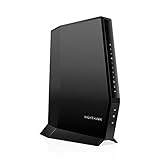
- MAXIMIZE YOUR CABLE INTERNET AND WHOLE-HOME WIFI: A cable modem and WiFi router in one device unlocks the full potential of your home internet with faster downloads, smoother WiFi for gaming and video calls, and reliable coverage in every room.
- APPROVED FOR YOUR PROVIDER AND PLAN: Works with Xfinity internet plans up to 800Mbps, Spectrum up to 1Gbps, and Cox up to 1Gbps. Not compatible with Verizon, AT&T, CenturyLink, DirecTV, DISH, or bundled voice plans. ISP activation required after setup.
- MULTI-GIG DOCSIS 3.1 SPEEDS: Get Gigabit+ cable download speeds on today's fastest plans, with headroom for the upgrades ahead. Real-world speeds depend on your plan and ISP network.
- WIFI 6 COVERAGE FOR THE WHOLE HOME: Stay connected in every room with dual-band AX2700 WiFi 6 covering up to 2,000 sq ft and capacity for 25+ connected devices. Real-world coverage depends on home size, layout, and building materials.
- WIRED CONNECTIONS FOR YOUR FASTEST DEVICES: Four Gigabit Ethernet ports keep gaming consoles, desktops, and streaming devices hardwired for the lowest latency and the most stable connection in your home.
Product prices and availability are accurate as of the date/time indicated and are subject to change. Any price and availability information displayed on Amazon at the time of purchase will apply.

