
An ambient light sensor (ALS) detects the amount of light around a device, usually as illuminance measured in lux (lx). Phones commonly use its reading to adjust screen brightness automatically. The value is specific to the sensor and how the device is built, so different devices can report different readings in the same room.
What does an ambient light sensor measure?
An ALS measures ambient light as illuminance—the amount of light falling on a surface. Its readings are commonly expressed in lux. The W3C Ambient Light Sensor Working Draft dated 14 May 2026 defines a device interface for monitoring the illuminance of its environment and reporting it in lux.
Lux is useful for describing lighting conditions, but a reading from a phone is not a universal reference measurement. The W3C notes that different devices can report different lux values in the same light because their detection methods and sensor construction vary. Placement, materials over the sensor, and calibration also affect the value.
What does an ambient light sensor do?
Adjusts screen brightness
A common use is automatic or adaptive display brightness. A phone can use its ALS reading to make the screen brighter in a bright environment and dimmer in a darker one. The sensor supplies light information; the device’s software determines how to respond to it.
The Tool Desk
Outbyte PC Repair FREERepair Windows errors before they cause bigger problemsFix Now →Outbyte Driver Updater FREEScan for outdated or missing drivers - takes under a minuteDriver Scan →#1 Best Overall

- Module based on a VEML7700 sensor for measuring ambient light.
- Connectivity: The use of this module requires soldering of the included 5-pin connector depending on the use.
- Power supply: 3.3 or 5 Vdc
- Interface: I2C I2C address: 0x10 (not modifiable) Measuring range: 0 to 120,000 lux on 16 bits
Supports light-aware interfaces
Ambient-light data can also be used by light-aware user interfaces. Microsoft’s hardware guidance for ambient light sensors discusses using ALS data for adaptive brightness and related interface behavior. The W3C document defines a web interface; it does not mean every phone or computer exposes that API.
What affects an ALS reading?
The reading reflects the whole sensing and processing path, not just the light in the room. Microsoft’s integration guidance identifies several factors that matter when selecting and installing a sensor:
Rank #2

- High sensitivity TEMT6000 ambient light sensor module for Arduino, accurately detects light intensity for smart home applications
- Mimics human eye's response to visible light, providing linear output and eliminating the need for additional filtering
- Wide operating voltage range of DC3.3-5.5V and temperature range of -40-85°C, suitable for various environmental conditions
- Detects light intensity in the range of 1-1000Lux, allowing for precise control of lighting and screen backlight
- Analog voltage output within 0-5V range enables seamless integration with different systems for light intensity detection
- Accuracy and resolution: how close measurements are to actual lighting conditions, and how finely changes can be distinguished.
- Field of view and placement: which directions the sensor sees and whether the device’s position or housing blocks incoming light.
- Dynamic range and spectral response: the lighting levels the sensor can handle and how it responds to different wavelengths, including infrared rejection.
- Optics and calibration: glass, coatings, and other materials can reduce the light reaching the sensing element, so an integrated device may need compensation and calibration.
- Sampling and power use: how frequently the sensor updates and the effect of sensing on device power.
Microsoft says a goal for calibrated ALS values is accuracy within 4 percent of actual lighting conditions. That is a target in its hardware guidance, not a guarantee for every device. The same guidance describes sunlight as ranging from 0 to 10,000 lux or more and typical indoor light as 0 to 1,000 lux. Its illustrative examples include 1 lux for pitch black, 300 lux for normal indoor light, 15,000 lux for sunlight outdoors, and 100,000 lux for direct sunlight. These are reference examples, not universal thresholds. The publication date is not stated on the Microsoft page.
How is an ambient light sensor different from a proximity sensor?
An ambient light sensor detects surrounding light. A proximity sensor detects whether an object is close to the device. For example, a phone may use proximity sensing to turn off its screen when held near the user’s ear during a call. The two sensors serve different purposes even if they are located near one another.
Recommended Free Tools
Rank #3
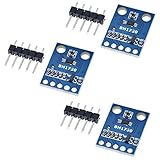
- HiLetgo 3pcs GY-302 BH1750 Light Intensity Illumination Module
- Model: GY-302
- Dimensions: 13.9mm X 18.5mm
- Original BH1750FVI chip using ROHM
- Power supply :3-5v
Does an ambient light sensor measure color?
Not necessarily. Microsoft states that color detection is not required for an ALS. A sensor may provide a light-level reading without identifying the color of the light.
Can a case or screen protector affect the sensor?
Yes. If a case or protective film covers or obstructs the sensor, it can interfere with how much light reaches it. Huawei Support warns that a non-official case or mismatched protective film may affect ambient-light sensor function. If automatic brightness behaves unexpectedly, check whether the sensor area is covered or dirty before assuming the sensor is faulty.
Rank #4

- photosensitive resistance module's most sensitive to ambient light, commonly used to detect environment around the brightness of the light, or MCU trigger relay module, etc.;
- module in the environment light intensity than set threshold, output high level DO end, when the environment light intensity more than set threshold, the DO output low level;
- the DO output can be directly connected to microcontroller, through single chip microcomputer to detect the high and low level, thus to detect the environment light intensity change;
- the DO output can be directly driven our relay module, which can form a light-operated switch.
What should you compare when choosing an ALS component?
For an electronics project or hardware design, match the sensor to the expected environment and device layout. An indoor-only design does not necessarily need the same light range as a device expected to operate outdoors. Compare accuracy, resolution, field of view, dynamic range, spectral response, sampling behavior, power consumption, placement, optical materials, and calibration requirements.
One component example is Texas Instruments’ OPT3001 digital ambient light sensor, which TI describes as having filtering designed to match human-eye response. It is an example part, not a recommendation for a particular repair or a claim of compatibility with any specific device.
Do these 3 things before closing this tab:
1Fix the driver behind crashes, sound loss and screen glitches2Repair Windows errors before they cause bigger problems3Scan for outdated or missing drivers - takes under a minuteQuick Recap
Best Value

- 5PCS TEMT6000 Light Sensor Professional TEMT6000 Light Sensor Module For Arduino Ambient Light Sensor
- TEMT6000 Light Sensor
- For Ambient light sensor for control of display backlight dimming in LCD displays and keypad backlighting of mobile devices and in industrial on/off-lighting operation
Product prices and availability are accurate as of the date/time indicated and are subject to change. Any price and availability information displayed on Amazon at the time of purchase will apply.

