
Crashes, No Sound, or Screen Glitches?
Random freezes, missing sound and display glitches usually trace back to one bad driver. Find and replace yours safely.Free scan · under a minuteWindows Errors? Fix Them Before They Spread
Repair common Windows errors and clear accumulated junk for a smoother, more stable PC - no reinstall needed.Free scan · no reinstallA baseboard management controller (BMC) is a small embedded computer that lets administrators monitor and manage supported server hardware through an out-of-band connection—often even when the host operating system is unavailable. It is the controller, not a protocol: IPMI and Redfish are separate interfaces a server may use to communicate with it. The exact functions available depend on the server model and its firmware.
What a BMC is
The DMTF, which develops the Redfish standard, defines a BMC as “typically an independent microprocessor or system-on-chip with associated firmware in a computer system that completes out-of-band systems monitoring and management-related tasks.” In practical terms, it is a management computer built into a server or its motherboard, separate from the main host operating system.
That separation enables out-of-band management: an administrator can use supported management functions without relying solely on the host OS. Depending on the platform, these functions can include checking hardware status and controlling host power. A BMC is not necessarily reachable whenever the server is switched off; that depends on the system design and whether auxiliary power is available. DMTF Redfish Specification
How a BMC works
A BMC gathers information from platform sensors and management interfaces, makes supported status and control operations available, and receives requests from an administrator or automation client through an available management interface. The specific sensors, operations, and access methods differ by implementation.
Do these 3 things before closing this tab:
1Repair Windows errors before they cause bigger problems2Scan for outdated or missing drivers - takes under a minute3Clear out junk files and repair common Windows errors#1 Best Overall

- AMD socket sTR5 supports up to 96-core CPUs: Ready for AMD Ryzen Threadripper PRO 7000 WX-Series Processors.
- Ultrafast connectivity:Seven PCIe 5.0 x16 slots, dual 10 Gb LAN ports, four M.2 slots, two rear USB4 40Gbps Type-C and SlimSAS NVMe support.
- CPU and memory overclocking: Support for up to 2TB ECC R-DIMM DDR5 memory modules (1DPC)
- Robust power and thermal design: 32 power stages with two 8-pin power connectors for the CPU, massive VRM cooling, chipset and M.2 heatsinks with active fans, and M.2 thermal pad.
- PCIe Q-release Slim: Remove the graphics card by directly pulling it up, instead of pressing a PCIe latch.
- Collect status: Platform sensors and interfaces supply information the BMC can expose, such as supported hardware readings and system state.
- Expose management functions: The BMC provides the monitoring and control operations implemented for that system. These may include host power operations, event or inventory data, and console access, but no single feature set is universal.
- Receive a request: An administrator, management application, or automation client connects using an interface supported by the server, such as IPMI or Redfish.
- Carry out the operation: The BMC processes the request and, where supported, reports information or asks the platform to perform an action. OpenBMC documents one example in which an authenticated REST request asks its host-state service to transition the host on or off. That is an OpenBMC implementation example, not a guarantee about every BMC. OpenBMC host management documentation
The IPMI specification describes a BMC system interface and message handler, including how messages can be routed among interfaces. A BMC’s hardware and firmware are not prescribed by the management standards, and Redfish implementations can include required elements, optional elements, and vendor-specific extensions. IPMI Specification, Second Generation v2.0
BMC, IPMI, and Redfish: what is the difference?
The BMC is the management controller. IPMI and Redfish are interfaces for communicating with management functions; they are not names for the controller itself. A system may support one interface or both.
| Term | What it refers to | What to check |
|---|---|---|
| BMC | The embedded controller and firmware that perform supported out-of-band management tasks. | Which monitoring, control, networking, and console features the specific system implements. |
| IPMI | A platform-management specification defining messaging and functions. | Whether the system supports IPMI, which functions it exposes, and which tools or access methods are available. |
| Redfish | A RESTful, HTTP-based management interface with a schema-based data model. | Which Redfish resources and operations the implementation supports, and how authentication and encryption are configured. |
Redfish is designed to expose management data and operations through a standard model, but support for a particular feature is not automatic just because a server supports Redfish. For example, the data model includes connection types such as IPMI Serial over LAN and KVM over IP, while their availability depends on the controller. DMTF Redfish Manager schema
Rank #2
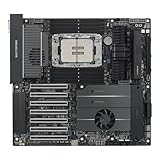
- Ready for Advanced AI PC: Designed for the future of AI computing, with the power and connectivity needed for demanding AI applications
- Intel LGA 4710-2 socket: Ready for Intel Xeon? 600 Processors for Workstation
- CPU and memory overclocking: The performance of ECC R-DIMM DDR5 memory (1DPC) is further enhanced by the exclusive NitroPath DRAM technology
- Ultrafast connectivity: 7 PCIe 5.0 x16 slots, Dual Intel E610-XAT2 10Gb LAN, 4 M.2, MCIO, 2 SlimSAS, and USB4? and USB 20Gbps Type-C
- Server-grade IPMI remote management: Hardware and software-level with a dedicated LAN port link to AST2600 BMC controller, plus a real-time monitoring and management software – ASUS Control Center Express
What you can—and cannot—assume a BMC can do
Common management capabilities include hardware monitoring and host power control, but the exact set varies. One server may provide sensor readings and power operations without remote KVM, virtual media, or a particular API. Optional features, vendor extensions, firmware versions, and licenses can all affect what is available.
Quick wins for a faster PC:
Fix the driver behind crashes, sound loss and screen glitchesFind Drivers →Repair Windows errors before they cause bigger problemsFix Now →Scan for outdated or missing drivers - takes under a minuteDriver Scan →- Monitoring: Check which sensors, event logs, and inventory information the implementation exposes.
- Power control: Confirm the supported operations and whether the BMC remains accessible when the host is powered down.
- Console access: Verify whether serial-over-LAN or KVM over IP is provided; do not infer it from the presence of a BMC.
- Virtual media: Confirm availability for the exact system and whether any license or configuration is required.
- Interfaces and network: Check support for IPMI, Redfish, or both, as well as whether management networking is dedicated or shared. Port arrangements and restrictions are product-specific.
Consult the documentation for the exact server or motherboard and firmware rather than relying on a general BMC feature list. The standards define interfaces and data models; they do not require every vendor to implement every possible function. DMTF Redfish Specification
How to evaluate BMC support when choosing server hardware
If you are selecting a server system or server motherboard, look for an integrated BMC and verify the management functions that matter for your use. A category description such as “server motherboard with integrated BMC and IPMI management” is only a starting point, not proof that a particular console, API, network arrangement, or license is included.
Rank #3

- Intel Xeon 6300-series/E-2400 Series Processor, Pentium Processor, Single Socket LGA-1700 (Socket
- Intel C262 controller for 6 SATA3 (6 Gbps) ports ; RAID 0,1,5,10
- Up to 64GB ECC Unbuffered DIMM, DDR5-4800MHz, in 2 DIMM slots
- 1 PCIe 5.0 x16
- 2 SlimSAS (2 PCIe 4.0x4 or 1 PCIe 4.0x4 & 4 SATA)
- Confirm the exact product model and supported firmware.
- Check whether IPMI, Redfish, or both are implemented, along with the available web, command-line, and automation interfaces.
- Verify required remote access features, such as serial console, KVM over IP, or virtual media.
- Review management-network options, authentication and encryption support, and any vendor restrictions.
- Check whether desired functions are optional or require a model-specific license.
How to secure a BMC
A BMC is a privileged management endpoint because it can expose hardware status and host-control operations independently of the operating system. Treat it as part of the server’s security boundary.
- Place management access on a restricted management network and limit it to authorized administrators and systems.
- Use unique credentials rather than shared or default passwords.
- Use encrypted management access where supported, and configure authentication according to the server’s documentation.
- Keep BMC firmware current and follow the vendor’s security and configuration guidance for the specific platform.
Redfish specifies authentication and encryption requirements for its interface. Intel also publishes BMC and BIOS security guidance for Intel platforms; those recommendations should be applied in the context of the relevant Intel system, not treated as a universal recipe for all vendors. DMTF Redfish Specification IPMI Specification, Second Generation v2.0 Intel BMC and BIOS security guidance
Quick Recap
Product prices and availability are accurate as of the date/time indicated and are subject to change. Any price and availability information displayed on Amazon at the time of purchase will apply.

