
The U.S.-China Economic and Security Review Commission’s September 22, 2026 assessment is not about one newly announced Chinese cable. It examines risks to the broader trans-Pacific undersea-cable network. For U.S. network architects, the practical takeaway is to plan for cable disruption: assess whether alternate routes are truly independent, whether they have capacity for rerouted traffic, and how quickly service could be restored.
What the USCC assessment says—and does not say
The U.S.-China Economic and Security Review Commission (USCC) describes Chinese capabilities that could threaten existing and planned trans-Pacific cable systems. Its report frames these as gray-zone risks to the network; it does not identify a single “major submarine cable” as the sole subject, nor does it establish that a named system has been compromised.


The risks are potential consequences, not a forecast of a particular outage. The report’s public summary does not provide route-level engineering parameters, outage-duration estimates, route-specific risk rankings, or quantified financial losses. Architects should use its findings to inform resilience planning, not treat them as a vendor specification or a prediction that an incident will occur.
Which U.S. connections does the report flag as exposed?
The USCC identifies cables linking the United States with Taiwan, Japan, and the Philippines as especially exposed. It points to shallow waters, busy shipping, and contested areas as factors that can increase vulnerability. It also flags U.S. links to Hawaii and Guam, where the report says redundancy options are few.
Quick wins for a faster PC:
Repair Windows errors before they cause bigger problemsFix Now →Scan for outdated or missing drivers - takes under a minuteDriver Scan →#1 Best Overall
These findings describe exposure at a regional level. They do not establish that every cable on those routes has the same risk, or that a particular landing point or system is most vulnerable. For an architecture review, the relevant question is where paths actually travel and which physical facilities, sea areas, and landing locations they share.
How could a cable disruption affect network services?
A single disruption could strain available capacity on direct routes to Taiwan, Japan, and the Philippines, according to the USCC. If multiple cables were disrupted, remaining trans-Pacific headroom could be overwhelmed, forcing traffic onto longer routes. Those reroutes can increase latency and reduce the capacity available for services that depend on the affected paths.
Rank #2

- Plastic model kit
- Paints sold separately unless stated
The report identifies internet communications and cloud services as potentially affected, along with latency-sensitive financial trading and AI services. The practical impact would depend on the routes involved, the traffic shifted, remaining capacity, and each application’s tolerance for delay or congestion. The report does not quantify those effects for specific services or incidents.
What capabilities does the report describe?
The USCC describes China’s operational Striver as a 10,000-meter-class submersible capability and discusses linked uncrewed systems such as Haiyi. It characterizes these technologies as dual-use: their existence is relevant to underwater operations, but does not by itself establish hostile activity against a cable.
What’s actually slowing this PC down?
Pick the symptom - the matching free tool is one click away.
The report also discusses “hibernating” cable cutters as a future technology under development. It does not present them as an established, deployed capability. Keeping that distinction clear matters: current architecture decisions should account for the broader disruption and repair risks without treating an emerging concept as a confirmed operational threat.
How should architects evaluate cable resilience?
Translate the regional threat picture into a route-and-service review. The USCC calls for redundancy and resilience; the dimensions below are practical ways to apply those recommendations, not a scoring system or risk ranking supplied by the commission.
Rank #4

- 【Exquisite Design & High Restoration】The Reobrix U-boat submarine building block set is a highly accurate replica of the original ww2 military submarine, with intricate exterior details including the navigation compass, telescope, gun barrel, steel cable design, and ice-breaking saw. These features create a realistic military atmosphere. Every design element showcases superb craftsmanship, making it a valuable submarine collectible.
- 【Detachable Structure & Detailed Display】The submarine's deck structure is easily removable, clearly revealing realistic details of the missile compartment, kitchen, cockpit, and more. This increases the model's realism, interactivity, and playability, allowing you to explore each detail and appreciate the charm of this military model kit. This set is the ideal choice for boys and adults who love military toys.
- 【Perfect Military Model Addition】This ww2 adult submarine set comes with exquisite stickers and a base stand, making it perfect for display in rooms, offices, or display cabinets. It is a must-have for every military collector. The independent nameplate adds a unique artistic touch to the submarine model, enhancing your space with a decorative and collectible piece, showcasing your distinct artistic taste.
- 【High-Quality Bricks & Challenging Project】The Reobrix submarine set includes 3,624 high-quality bricks, offering a challenging assembly process that provides hours of building fun for you and your family. Upon completion, you'll experience unparalleled achievement and satisfaction. This submarine model kit for adults is perfect for model enthusiasts who like challenges, helping you improve your hands-on skills while enjoying the building experience.
- 【Perfect Gift for Any Occasion】Our U-boat battleship set is a must-have army building toy for military enthusiasts. This model kit makes an ideal gift for birthdays, Father's Day, Christmas, and other special occasions. It's a creative gift for boys, girls, and adults, and the perfect addition to any military model collector's collection. While satisfying the pursuit of design, you can also get a submarine building model built by yourself.
| Review dimension | Questions for the architecture team | Why it matters |
|---|---|---|
| Geographic exposure | Do primary and alternate paths cross the same shallow waters, busy shipping areas, contested zones, or concentrated landing locations? | Routes can be separate on a diagram while sharing relevant physical exposure. |
| Route diversity | Are alternate paths geographically and operationally independent, or do they rely on shared vulnerable infrastructure? | Logical path diversity alone may not provide resilience to a physical cable or landing-area disruption. |
| Capacity headroom | How much traffic can remaining direct routes absorb, and which services would compete for that capacity? | The USCC warns that one disruption could strain direct routes and multiple disruptions could overwhelm trans-Pacific headroom; it gives no capacity figures. |
| Latency tolerance | Which applications can tolerate a longer reroute, and which are sensitive to added delay or slowdown? | Financial trading and AI services are among the latency-sensitive examples raised by the report. |
| Repair readiness | What repair resources and critical equipment are available, and what dependencies could delay restoration? | The USCC recommends strengthening repair capacity, replenishing aging repair fleets, and pre-positioning equipment. |
| Monitoring and response | Can operators coordinate maritime awareness, monitoring, patrols, and incident response with regional allies? | The report calls for allied coordination and improved monitoring and patrols. |
What resilience actions does the USCC recommend?
The commission’s recommendations point to coordinated preparation rather than reliance on a single technical fix. For network architects, they can be translated into a practical sequence:
- Map physical dependencies. Document cable routes, landing locations, shared infrastructure, and the services that depend on each path. Include the U.S. connections to Taiwan, Japan, the Philippines, Hawaii, and Guam in the regional review.
- Test credible reroute scenarios. Model loss of one route and multiple routes. Check whether alternatives are physically distinct and whether their capacity and latency characteristics meet service requirements under load.
- Set service priorities. Identify which communications, cloud workloads, and latency-sensitive applications need scarce surviving capacity first, and define how traffic would be managed during disruption.
- Review restoration dependencies. Assess repair-fleet availability, access to critical equipment, and the arrangements needed to mobilize repairs. The USCC specifically recommends cable repair capacity and pre-positioned equipment.
- Coordinate monitoring and response. Establish how operators, relevant authorities, and regional allies would share maritime awareness and coordinate monitoring, patrols, and incident response.
- Revisit the plan as conditions change. Update route assumptions, capacity plans, and response arrangements as infrastructure, operational capabilities, and allied coordination evolve.
What the report means for procurement and design
The report supports treating resilience as a system property spanning route selection, capacity planning, monitoring, and repair readiness. It does not specify a preferred vendor, system design, capacity target, or procurement standard. Any design or procurement decision should therefore be grounded in the operator’s own route data, service requirements, and recovery arrangements rather than attributed to the USCC as a prescribed solution.
Quick Recap
Best Value
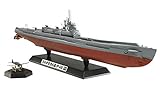
- The leader in hobby products around the world
- Made using the highest quality components and materials
- Test for durabitlity and safety
- Hangar features realistic interior details and can store 3 Seiran aircraft.
- Hangar door can be posed in both opened and closed positions.
Product prices and availability are accurate as of the date/time indicated and are subject to change. Any price and availability information displayed on Amazon at the time of purchase will apply.

