
Recommended Free Tools
Waste heat is energy left over from useful work—but it becomes a resource only when a facility can capture it at a useful temperature, deliver it to a nearby user, and match it to demand. Industrial heat recovery can reduce the need for purchased fuel or heat, but the share of energy lost as heat is not the same as the share a project can recover profitably.
What is waste heat recovery?
Waste heat recovery means capturing heat that would otherwise be rejected and putting it to use. Sources include hot exhaust gases, cooling water, hot equipment surfaces, heated products, and—in data centers—heat removed by cooling systems.

The U.S. Department of Energy (DOE) estimated in 2023 that 20–50% of industrial energy input is lost as waste heat. That estimate describes energy lost as heat; it does not mean that 20–50% can be recovered technically or economically. The useful portion depends on the source temperature, the equipment and connections needed, and whether a heat user needs that energy when it is available.
How does a recovery project work?
Project design starts with a source and a heat sink: the stream that has excess heat and the process, building, or other user that can use it. The closer their temperatures, locations, and operating schedules match, the less upgrading and delivery infrastructure may be needed.
#1 Best Overall

- Used Book in Good Condition
- Characterize the source. Identify where heat is rejected, its temperature and flow, and when it is available. A hot exhaust stream, warm cooling water, and a heated product are not interchangeable sources.
- Find a compatible heat user. Potential sinks include another process, hot-water demand, building heating, a district heating loop, a greenhouse, or a nearby facility. The user must need heat at a suitable temperature and at times that align with supply.
- Choose direct transfer or temperature upgrading. If the source is already hot enough for the user, a heat exchanger may transfer it directly. If not, an industrial heat pump can raise the temperature, using energy to make the recovered heat more useful.
- Design the connection and backup plan. Account for distance, piping or other connections, process integration, maintenance, and what happens when the heat user or source is unavailable. Recovery equipment must fit the site’s operating and safety requirements.
- Compare the full costs with displaced energy. Evaluate installation and integration, operating energy, maintenance, financing, and any grid connection against the fuel or heat the project would actually displace.
What are the main ways to use recovered heat?
| Route | How it works | Key fit question |
|---|---|---|
| Direct heat exchange | Transfers heat from a source to a user without first raising its temperature. | Is the source hot enough for the process or heating demand? |
| Industrial heat pump | Uses energy to raise a waste-heat stream to a more useful temperature. DOE describes industrial heat pumps as active heat-recovery equipment. | Can the upgraded heat displace enough purchased energy to justify the pump’s operating and project costs? |
| Reuse elsewhere on site | Routes heat to another process or use within the same facility. | Are source and demand close enough, and do their schedules and temperature needs align? |
| Transfer to another user | Supplies heat to another industry, a cluster of users, a district heating network, or a low-temperature use such as a greenhouse. | Is there a nearby heat host and a practical, financeable connection? |
The International Energy Agency’s 2019 IETS topic sheet identifies these kinds of uses, including heat used as a source in refrigeration plants. No route is universally best: the appropriate choice depends on the source, the user, and the site’s conditions.
When do industrial heat pumps help?
An industrial heat pump is useful when waste heat is available but too cool for the intended use. It raises the stream’s temperature so it can serve process heating, hot water, or space heating. The DOE describes this as reusing process energy by increasing a waste-heat stream to a higher, more useful temperature.
The economic test is whether the useful heat displaces purchased energy worth more than the energy required to run the pump, while also covering installation, integration, and maintenance costs. In its 2025 Renewables for Industry executive summary, the IEA says industrial heat pumps are established to deliver heat up to 150 °C. In that same technology comparison, electric boilers can generate steam up to 350 °C and pressure around 70 bar; those figures describe different equipment and should not be read as a project-specific comparison of cost or efficiency.
What makes data-center heat reusable?
Data centers provide a clear example of why having waste heat is not enough. A heat host must be nearby, need heat at a temperature the data center can supply, and be able to use it when the heat is available.
Rank #3

- 【Premium Quality】Our plate heat exchanger is made of high quality 316L stainless steel which are brazed together by 99.9% copper at the edges for a reliable and rugged part to form a durable, integral piece that can resist leakage and withstand high pressure and temperature.
- 【Convenient For Use And Energy Saving】Smooth Thread makes a easy, quick, flexible hookup. Highly conductive and super-thin stainless steel plates make good performance and economy for heating transfer and cooling without electricity consumption and oxygen consumption.
- 【Product Parameter】250,000 - 330,000 BTU CAPACITY: Depending on the application, this product can produce 250kBtu to 330kBtu per hour. 30 PLATES; 4"x 12", 1" MPT: 30 brazed plates work to efficiently heat water for your application.
- 【Multiple Applications】AB water heat exchanger offers the highest level of thermal efficiency and durability in a compact & lightweight unit, perfect for domestic water heating, Floor Heating, Snow Melting, District or Zone Heating Systems, Outdoor Wood Furnaces, Hydraulic and Lube Oil Coolers, Radiator Heating, Hydronic Heating, Solar Heating, Wood Boiler.
- 【Product Support】 Quality-focused manufacturing backed by responsive support for product questions, selection and installation guidance.
A 2024 DOE guide says direct use in low-temperature applications, such as ventilation-air preheating or water heating, can provide the greatest energy savings; it describes direct use without a heat pump as optimal. If a potential host needs hotter heat, upgrading may be necessary, adding equipment and operating energy. Most sites also retain redundant cooling so heat can still be removed when the host is unavailable. The DOE guide identifies potential water savings when heat reuse reduces or eliminates chillers or cooling towers, but it does not establish a general amount of water saved.
What can prevent a project from paying off?
A large waste-heat estimate does not predict a project’s savings or payback. The DOE identifies material constraints and higher maintenance costs as recovery barriers. The IEA’s 2026 discussion of industrial heat-pump projects also names customized engineering, site coordination, grid connections, large capital commitments, and long planning horizons.
Rank #4

- High-Quality Materials: The entire unit is copper brazed at edges and contact points, forming a durable and leak-resistant piece that withstands high pressure and temperature.
- Durable and Corrosion-Resistant: Features epoxy-coated fins, providing high hardness, wear resistance, and corrosion protection. This reduces internal water vapor scaling, promoting maximum heat exchange between air and fins. Suitable for operating temperatures of -40-356℉ / -40-180°C.
- Efficient Heat Transfer: The heat exchanger generates up to 160kBtu per hour, with 12 aluminum fins per inch and 3 rows of 3/8" seamless copper tubes. The threaded copper tubes increase the contact area and capacity of the fluid medium, significantly enhancing the heat exchanger's performance.
- Large Heat Exchange Area: With an effective heat exchange area of 18”x20” and 242 fins, this heat exchanger provides excellent heat transfer performance to meet various needs.
- Tight and Leak-Proof: To eliminate the possibility of micro-leaks, the heat exchanger uses high-pressure vacuum brazing and undergoes rigorous leak testing, ensuring long life and high reliability.
- Temperature mismatch: The source may be too cool for the intended use, so direct transfer is insufficient.
- Distance or infrastructure: Connecting a remote heat host can require costly piping and coordination.
- Timing mismatch: Heat may be available when the user does not need it, or demand may exceed supply.
- Operating and financing costs: Electricity or other pump energy, maintenance, capital, and financing can weaken the case.
- Integration constraints: Existing processes, site ownership, grid capacity, and the need for backup heating or cooling can complicate delivery.
There is no universal payback period established for waste-heat recovery. The DOE’s industrial-loss estimate cannot be used as a project savings figure; each case needs site-specific temperatures, demand profiles, energy prices, engineering, and costs.
Independent reader supportYour contribution helps us test, update, and keep practical guides available for everyone.Why consider recovery as part of a wider efficiency plan?
Waste-heat recovery is one measure among several, not a substitute for reducing avoidable energy use. The IEA’s 2025 Renewables for Industry executive summary groups recovery with insulation, process control, and plant-level thermal optimisation as basic measures that can reduce fuel use at comparatively low cost. Assessing these measures together helps facilities consider recovery in the context of overall plant efficiency.
Free tools Windows power users keep installed
One-click scans. No signup required.
Quick Recap
Best Value
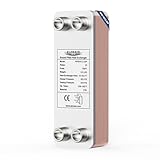
- Excellent Quality: This brazed plate heat exchanger is made of high-quality SS316L stainless steel, brazed with copper in a vacuum environment, ensuring a reliable and robust component. It offers superior resistance to high temperatures, high pressures, corrosion, and leaks, playing an excellent role in supporting various refrigeration, heating, high-temperature, and high-pressure industrial fields.
- Heat-transfer Efficiency increased by 99%: The heat exchanger adopts a fishbone corrugated design, which increases the intensity of the turbulence and creates various support points that reduce the secondary side pressure, resulting in a rapid increase in channel heat transfer efficiency by 99%.
- Convenient to Use and Energy Saving: The smooth threads allow for quick and flexible disassembly and installation. Ultra-thin stainless steel plates provide excellent performance and economy in heating and cooling, improving energy efficiency and reducing operating expenses.
- Product Parameter:Mode WHE4X12-20P can produce up to 275000 btu per hour depending on different applications, 5.6 sq.ft heat transfer area,4"x12"-20 plates with 1"MPT.
- One-year limited warranty: The stainless steel heat exchanger provides exceptional thermal efficiency and durability in a compact, lightweight design and ALORAIR offers a one-year limited warranty covering manufacturing defects.
Product prices and availability are accurate as of the date/time indicated and are subject to change. Any price and availability information displayed on Amazon at the time of purchase will apply.

