
What’s actually slowing this PC down?
Pick the symptom - the matching free tool is one click away.
Venus is the hottest planet in the Solar System, even though Mercury is closer to the Sun. Its dense, carbon-dioxide-rich atmosphere traps heat so effectively that the average surface temperature is about 867°F (464°C), according to NASA’s 2022 comparison. Venus is similar to Earth in size, but its crushing pressure, acidic clouds, slow retrograde rotation, and intensely hot surface make it a very different world.
Venus at a glance
Venus is the second planet from the Sun and, in NASA’s description, Earth’s closest planetary neighbor. It is a rocky planet with a mean radius about 5% smaller than Earth’s. Yet the resemblance in size conceals a stark contrast: Venus has a dense atmosphere and a surface environment hostile to humans and familiar Earth life.
| Measure | Venus | Earth |
|---|---|---|
| Mean radius | 6,051.8 km | 6,371.0 km |
| Mean surface temperature | 464°C (867°F) | 15°C |
| Surface pressure | 92 bars | About 1 bar at sea level |
| Sidereal rotation | −5,832.6 hours, retrograde | 23.9345 hours |
| Sidereal orbit period | 224.701 Earth days | 365.256 Earth days |
Planetary comparison values are from the NASA Goddard Space Flight Center/NSSDC Venus Fact Sheet. NASA’s temperature resource gives mean surface temperatures; the negative rotation value uses the fact sheet’s convention to indicate retrograde spin.
Why is Venus hotter than Mercury?
Mercury is closer to the Sun, but proximity alone does not determine a planet’s surface temperature. Venus’s thick atmosphere, composed mostly of carbon dioxide, absorbs and retains heat through an extreme greenhouse effect. The heat that reaches the surface has difficulty escaping back into space, keeping Venus hotter than Mercury.
#1 Best Overall

- Stunning Solar System Crystal Model: This stunning model of the solar system features eight planets, each made from carefully selected natural crystal gems that represent the unique colors and energies of the planets, capturing the essence of their corresponding celestial bodies.
- Authentic Gemstone Representation: Each planet is crafted from a specific gemstone, Pluto (amethyst), Earth (blue aventurine), Neptune (blue turquoise), Saturn (yellow jade), Venus (tiger's eye), Mercury ( clear quartz), Uranus (green aventurine), Jupiter (picture stone), Mars (red agate).
- Cosmic & Inspirational Decor: This solar system ornament is not only an elegant home and office decor piece, but also a captivating celestial display. Ideal for astronomy enthusiasts, it delivers a unique, tactile way to admire the charm of the planetary system and appreciate cosmic beauty.
- Versatile Display Piece: With its elegant design and vibrant gemstone planets, this model serves as a striking decorative piece for any room. Whether on a desk, shelf, or in a study area, it adds a cosmic touch to your space and sparks curiosity about the universe.
- Thoughtful Gift for Space Lovers: This solar system crystal model makes an excellent gift for astronomy enthusiasts, science lovers, or anyone fascinated by space. It's perfect for birthdays, educational milestones, or as a thoughtful gift for someone who loves the mysteries of the universe.
NASA’s mean-temperature comparison lists Venus at 867°F (464°C) and Mercury at 333°F (167°C). Venus’s surface temperature is hot enough to melt lead. The figures are from NASA’s Solar System Temperatures, published February 15, 2022.
What are Venus’s atmosphere and surface like?
A dense, hot atmosphere
Carbon dioxide is the main component of Venus’s atmosphere, with nitrogen the next major component in NASA’s planetary fact sheet. At the surface, pressure is about 92 bars—roughly 92 times Earth’s sea-level pressure. NASA also describes it in rounded terms as about 93 times Earth’s sea-level pressure.
Rank #2
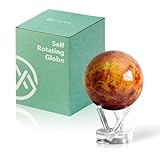
- NASA-Inspired Planet Design - A vivid depiction of Venus based on actual satellite imagery, featuring fiery swirls of red, orange, and gold to showcase its harsh, volcanic surface.
- No Batteries or Wires — Just Light - The MOVA Globe turns silently on its own using ambient indoor light or indirect sunlight, powered by patented solar cell technology.
- Premium Build with Seamless Movement - A fluid-suspended inner globe rotates within a clear acrylic outer shell, offering a smooth, almost magical visual experience.
- Compact and Versatile Size - Measuring 4.5 inches in diameter, it fits neatly on desks, bookshelves, or display stands. Small enough to gift, striking enough to admire.
- A Smart Gift That’s Out of This World - Ideal for astronomy lovers, science teachers, space enthusiasts, or anyone drawn to beautiful objects with purpose. A captivating kinetic sculpture.
High in the atmosphere, clouds made of sulfuric acid obscure the surface from ordinary visible-light views. Those clouds are not a cool, breathable refuge: Venus remains an extreme environment, and the cloud layer’s existence is distinct from the question of whether any life could persist there.
A rocky landscape mapped by radar
Because clouds block a clear optical view of the ground, spacecraft radar has been essential for studying Venus’s terrain. NASA’s Magellan spacecraft mapped the surface and revealed volcanoes, mountains, and terrain altered by extensive geological activity. NASA describes evidence of widespread volcanism and relatively recent resurfacing in geological terms; that does not establish that every volcano is active today.
Free tools Windows power users keep installed
One-click scans. No signup required.
Rank #3

- 【Multipurpose】: toy can be used not only as a throw pillow, but also as a decoration for kids room, living room, bedroom, sofa, office.
- 【Stuffed Toy】: Simulated toy, which can let children know about planets and cultivate children's interest in science.
- 【Great Gift】: Solar system stuffed toy is a gift for kids, friends, family.
- 【Soft Material】: Stuffed toy is made of , the inner filling is flat, soft to the touch and comfortable.
- 【Portable and Lightweight】: The soft doll pillow is small 17cm/6.69inch in size, for cuddling, playing with, or as a car cushion.
How long is a day on Venus?
The answer depends on what “day” means. Venus turns once relative to the distant stars in about 243.69 Earth days. That is its sidereal rotation period, and the spin is retrograde—opposite the direction of most planets’ rotation. As a result, the Sun appears to rise in the west and set in the east.
A solar day, measured from one sunrise to the next at a given location, is about 117 Earth days. Venus’s year—the time it takes to orbit the Sun—is about 224.70 Earth days. The sidereal rotation is longer than the year, while the solar day is shorter because Venus rotates backward as it moves around the Sun.
Rank #4
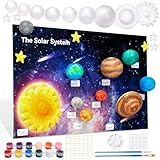
- Large-size solar system model kit display board: The oversized display board of 17.32 x 11.02in perfectly reproduces the 3D three-dimensional solar system toys for kids 8+, making it easy to create an exclusive mini universe
- Complete solar system kit: Display board, 17 high-quality foam craft balls (planets and stars), 12 vibrant paints, brushes, Dot stickers and label stickers. Each planetary foam craft balls is reduced according to the proportion, so that children can intuitively feel the volume difference between the planet balls and easily build a complete cognitive framework of the solar system for kids
- Both educational and fun: It is the enlightening key for children to explore the universe. In the process of drawing planets for kids, it can stimulate children's strong interest in astronomical knowledge, exercise hands-on ability, and the printed introduction of the eight planet toys helps children learn the mysteries of the universe in practice
- Easy assembly, exclusive for children: No need for complex tools and techniques, the assembly steps are simple and easy to understand, and children can complete it independently. Safe small foam balls material, light and easy to take, is an excellent choice for parent-child interaction and children's handicraft classes
- Versatile Usage Scenarios: Perfect for DIY decoration, school project, and science project. This kit is an excellent choice for solar system modeling craft supplies and makes a great art project or outer space room decoration
Could there be life in Venus’s clouds?
Some conditions around 50 km above Venus’s surface are less extreme than those on the ground: NASA gives temperatures of roughly 30°C to 70°C there, with pressure similar to Earth’s surface pressure. Such conditions could be compatible with some Earthly extremophiles, but compatibility is not evidence. No claim that life exists in Venus’s clouds follows from those measurements.
Independent reader supportYour contribution helps us test, update, and keep practical guides available for everyone.How do scientists study Venus?
Scientists combine spacecraft observations with measurements of the planet’s atmosphere and surface. Radar can map terrain beneath the clouds, while missions designed to sample or analyze the atmosphere can investigate how Venus formed and changed.
Best Value

- BUILD & DISPLAY A MOVING, GLOWING SOLAR SYSTEM – With this kit, kids can customize all 8 planets and the sun, creating a stunning 3D solar system model that glows in the dark! It’s an awesome addition to any space-themed room.
- ALL-INCLUSIVE KIT – Everything needed to build a glowing solar system is included: 6 vibrant paint colors, glow-in-the-dark accent paint, brush, palette, fun decals, and a poster with solar system facts! Kid-friendly instructions make assembly easy!
- MOVABLE ARMS FOR EASY ADJUSTMENTS – Adjust the position of the planets with ease! The model’s movable arms allow kids to set up and rearrange their solar system display to match their imagination.
- LEARN HANDS-ON FUN FACTS ABOUT OUR SOLAR SYSTEM – Dive into the wonders of space with this engaging model kit! Kids will learn fascinating facts about each planet as they build and explore their own glow-in-the-dark solar system.
- AWARD-WINNING PRODUCTS - Blue Marble, winner of the Toy Association's prestigious Toy of the Year Award, proudly develops products that foster education, imagination, and creativity, with a U.S. support team to ensure a stellar experience!
NASA’s DAVINCI mission is designed to study Venus from above the clouds down to the surface, examining the planet’s formation and evolution and its massive atmosphere. Its stated objectives are described on NASA’s DAVINCI Science page; this description does not specify an operational date.
Can you see Venus from Earth?
Venus can show phases like the Moon as it moves around the Sun relative to Earth. Observers can follow those changing phases with binoculars or a telescope. A beginner telescope or binoculars can help if you want to observe the change over time, but equipment is not needed to understand why Venus is so hot or how its orbit and rotation differ from Earth’s.
For additional basic facts about the planet, see NASA Space Place’s All About Venus.
Quick Recap
Product prices and availability are accurate as of the date/time indicated and are subject to change. Any price and availability information displayed on Amazon at the time of purchase will apply.
The Tool Desk
Outbyte Driver Updater FREEScan for outdated or missing drivers - takes under a minuteDriver Scan →Outbyte PC Repair FREERepair Windows errors before they cause bigger problemsFix Now →
