
A maker’s ESP32-S3 project can make calls, send texts, use mobile data and take pictures, according to a March 4, 2026 Hackster.io report. It is best understood as a proof-of-concept 4G featurephone, not a finished smartphone: the maker describes it as thick and awkward, and says you must remove the display to insert a SIM.
What the ESP32 4G phone prototype can do
Maker LuckyBor’s prototype combines an Espressif ESP32-S3 N16R8 microcontroller with a SIMCom A7682E 4G modem. The project is reported to support voice calls, SMS, mobile data and camera use. It is programmed using the Arduino IDE.
Those functions make it phone-like, but the report does not establish that it can run smartphone apps or provide the broader experience of a commercial smartphone. The most accurate description is a DIY 4G featurephone proof of concept.
Reported hardware specifications
| Component | What the report says |
|---|---|
| Microcontroller | Espressif ESP32-S3 N16R8 |
| Cellular modem | SIMCom A7682E 4G modem |
| Camera | 2MP Omnivision OV2640 |
| Battery | 3,000mAh, as reported by the maker; runtime is not stated |
| Touchscreen | 3.5 inches, 480×320 resolution |
| Audio and alerts | Headphone jack and notification buzzer |
| Software workflow | Arduino IDE |
These are specifications attributed to the maker in Gareth Halfacree’s Hackster.io account, rather than independently measured results. The report does not identify the exact development board, camera module variant, display part, or battery model.
Quick wins for a faster PC:
Fix the driver behind crashes, sound loss and screen glitchesFind Drivers →Repair Windows errors before they cause bigger problemsFix Now →#1 Best Overall

- 🔥【Dual Mode & High Performance】 The ESP32-S3 development board features integrated dual-core xtensa 32-bit LX7 microprocessor, clock speed up to 240 MHz, with 16MB Flash and 8 MB PSRAM. Perfect for Arduino IoT projects requiring stable wireless communication with ultra-low power consumption.
- 🔧【Easy Programming & Debugging】 Equipped with dual USB Type-C ports, this ESP32-S3 board supports both USB and UART modes for effortless programming, firmware flashing, and debugging.
- 🌐【Versatile Wireless Connectivity】 Built-in Wi-Fi (2.4GHz) and Bluetooth 5.0 (LE) dual-mode ensure seamless connectivity with a wide range of smart devices, making it ideal for IoT, smart homes projects.
- 🚀【Flexible Download Options】 Supports dual download methods — USB direct download or USB-to-serial download — offering flexibility and convenience for different development needs.Ideal for beginners and developers working with ESP32-S3.
- 🔋【Advanced Power-Saving Modes】 Designed for energy-efficient applications, with 3.3V SPI voltage, the ESP32-S3 board supports multiple low-power modes, allowing you to extend battery life based on different usage scenarios.
Why it is not ready to use as an everyday phone
The maker describes the current unit as very thick and awkward for general-purpose use. A particularly practical limitation is SIM access: inserting or replacing the SIM requires removing the display. The maker says the prototype is not really ready for use as a phone.
Important details for judging real-world usability are not established in the report. It does not provide LTE bands, named carriers or countries tested, antenna details, call or audio quality, power consumption, measured battery life, safety certification or carrier approval. As a result, the project’s reported 4G capability should not be read as a promise that it will work on a particular network or with a particular SIM.
Rank #2

- ESP32-S3-DevKitC-1-N16R8 SPI voltage: 3.3v, ESP32-S3-DevKitC-1 is an entry-level development board equipped with Wi-Fi + Bluetooth module ESP32-S3
- Most of the I/O pins on the module are broken out to the pin headers on both sides of this board for easy interfacing. Developers can either connect peripherals with jumper wires or mount ESP32-S3-DevKitC on a breadboard.
- The ESP32-S3-DevKitC development board equipped with ESP32-S3-DevKitC-1-N16R8, a general-purpose Wi-Fi + Bluetooth LE MCU module that integrates complete Wi-Fi and Bluetooth LE functions.
- ESP32-S3-N16R8 cable can be used: USB Type A to Type-C cable or CC cable Note the distinction between the commonly used USB A port to Type-C cable that can only be charged, which cannot be used for communication between YD-ESP32-S3 and the host.
- USB-to-UART Port and ESP32-S3 USB Port (either one or both), default power supply (recommended)
What the maker plans to change
The report describes possible changes for a later version, not features confirmed in a completed design. Those plans include a custom PCB, microSD storage and replacing the A7682E modem with a SIMCom A7670G, which the report describes as a global alternative. The existing prototype is described as using the A7682E, characterized in the account as European-exclusive; that description alone does not establish compatibility with any specific carrier or region.
The maker reportedly pledged to publish the design and source code on GitHub once the design is finished. The report does not provide a verified repository or establish that the design has since been completed, so availability of downloadable files remains unconfirmed.
Crashes, No Sound, or Screen Glitches?
Random freezes, missing sound and display glitches usually trace back to one bad driver. Find and replace yours safely.Free scan · under a minutePC Slower Than It Used to Be?
A free scan shows the junk files, broken settings and background clutter dragging Windows down - then fixes them in one click.Free scan · Windows 10 & 11Rank #3

- 【Low-power performance】: The AYWHP ESP32-S3 Core development board integrates a 2.4 GHz Wi-Fi and Bluetooth 5 (LE) dual-mode communication module, perfect for Arduino Internet of Things (IoT) projects.
- 【Simple programming and debugging】: The ESP32-S3 module makes it easy to program and burn in your ESP32-S3 board via dual USB Type-C ports, with a choice of USB or UART modes.
- 【Multiple Power Saving Modes】: The ESP S3 development board supports multiple low-power modes, which can be configured according to different application scenarios to provide longer battery life.
- 【Dual download modes】: The ESP S3-1 module supports both USB direct connection download and USB to serial port download, providing more flexibility and convenience.
- 【Diverse connectivity options】: The ESP32-S3-1 supports dual-mode Wi-Fi and Bluetooth 5.0 (LE) connectivity for a wide range of smart devices, making it ideal for Internet of Things (IoT) applications.
What this project shows—and what it does not
The build demonstrates a reported combination of an ESP32-S3, a cellular modem and phone-oriented peripherals capable of basic calling and messaging functions. For makers, it is an example of how a microcontroller project can reach beyond Wi-Fi or Bluetooth into cellular voice, SMS and data.
It is not enough information to reproduce the device reliably: the report does not include a complete bill of materials, published build instructions, source repository, network compatibility details or independent test results. Anyone considering a similar build would need to verify the modem’s bands and carrier support, the exact module interfaces and the hardware design before choosing parts.
Quick Recap
Best Value
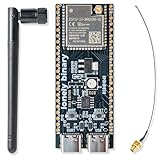
- 【GOLD EDITION — IMMERSION GOLD PCB】The Lonely Binary Gold Edition features a black PCB with lead-free immersion gold (ENIG) plating and clear silkscreen — the signature finish of the Lonely Binary Gold Edition line. RoHS-compliant.
- 【16MB FLASH + 8MB PSRAM】Large memory capacity for OTA updates, large programs, and AI/ML tasks — more headroom than 4MB boards for data-intensive IoT and automation projects.
- 【EXTERNAL IPEX ANTENNA】External IPEX antenna can be positioned for extended WiFi and Bluetooth signal coverage — for remote applications like weather stations, robots, or enclosed builds.
- 【DUAL USB TYPE-C PORTS】Separate power and data ports for macOS, Windows, and Linux. Power via USB-C (5V) or VIN pin (5–12V); do not exceed 5V on the USB-C ports.
- 【FLEXIBLE PROTOTYPING PINS】2x40-pin GPIO headers compatible with breadboards and sensors. Supports external ToF sensors via I2C for distance sensing.
Rank #4
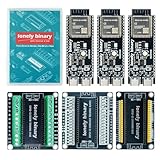
- 【ESP32-S3 PERFORMANCE】Dual-core 240MHz processor with 16MB Flash and 8MB PSRAM for IoT, AI, and machine learning projects.
- 【WIRELESS CONNECTIVITY】Onboard antenna for 2.4GHz WiFi and Bluetooth 5.0 LE — for smart home devices, no external antenna needed.
- 【LEAD-FREE GOLD EDITION DESIGN】Immersion gold (ENIG) plating for durability and conductivity. Lead-free, RoHS-compliant — for long-term prototyping.
- 【PRE-SOLDERED, PLUG-IN DESIGN】ESP32-S3 boards come with pre-soldered headers and plug directly into the included expansion and terminal boards — no soldering required.
- 【MULTI-PLATFORM COMPATIBILITY】Works with C++, MicroPython, ESP-IDF, Raspberry Pi, and STM32 — with online tutorials for quick start. Power via USB-C (5V) or VIN pin (5–12V); do not exceed 5V on the USB-C ports.
Product prices and availability are accurate as of the date/time indicated and are subject to change. Any price and availability information displayed on Amazon at the time of purchase will apply.

