
Some cookie notices make accepting everything obvious and quick while making refusal faint, buried or unreliable. Those are among the worst designs—not because there is a verified ranking of today’s banners, but because they make it harder for people to understand and act on their choices. Reports and studies document examples from Prada and La-Z-Boy, as well as controls that did not behave as their labels suggested. The examples below are historical observations, not claims about what those companies’ sites show today.
Why is it so hard to reject cookies?
A banner can include a way to refuse and still make that choice difficult to find or use. The problem is often an imbalance: accepting is prominent and takes one click, while refusing requires searching, opening extra menus or interpreting unclear labels. Defaults can add another obstacle if a privacy-intrusive option is already selected.
These are design criticisms, not a universal legal verdict. The cited material includes U.S. government guidance, a Canadian regulator’s sweep and academic discussions of consent rules. Whether a particular design violates a law depends on the jurisdiction and applicable rules.
Acceptance gets the visual advantage
A large, high-contrast “Accept all” button beside faint or small refusal text makes one action easier to notice. A 2020 academic analysis describes patterns such as a prominent “OK” beside a small “Configure” control, or acceptance presented as a button while refusal is plain text. The presence of both options does not make them equally usable.
The Tool Desk
Outbyte PC Repair FREEClear out junk files and repair common Windows errorsFree Scan →Outbyte Driver Updater FREEFix the driver behind crashes, sound loss and screen glitchesFind Drivers →

Refusal takes extra steps—or starts from the wrong default
A refusal route may sit behind “More information” or several submenus. Separately, a preselected setting can make inattention or a routine click produce a choice the visitor did not intend. The Office of the Privacy Commissioner of Canada (OPC) advised in its 2024 sweep report: “Even where the law allows opt-out consent, organizations should consider preselecting the most privacy protective options by default or requiring users to make an active choice as to whether they want to consent.”
The controls are confusing or do not work as labeled
Labels such as “Options” and “Confirm My Choices” should lead to a meaningful choice and accurately describe what a control does. Researchers in the 2022 study Okay, whatever recorded an “Options” button that appeared only to dismiss the interface, and a “Confirm My Choices” button on a page that offered no choices. A control that misleads or does nothing useful undermines the point of asking for consent.
#1 Best Overall
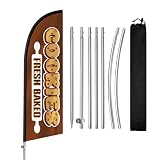
- Attract More Customers Fast: Bold “COOKIES” design grabs attention and helps bring more walk-in customers to your bakery, dessert shop, or coffee cafe
- 8FT Height for Easy Visibility: Visible from a distance, helping customers quickly notice your storefront from sidewalks, shopping streets, and outdoor markets
- Perfect for Bakery Commercial Display: Great for cookie shops, bakeries, dessert stores, cafes, and pastry businesses needing outdoor visibility
- Quick Setup & Easy to Move: Set up in minutes and reposition easily for better visibility near storefronts, sidewalks, and outdoor seating areas
- Reusable & Cost-Effective: Durable polyester flag and stainless steel pole kit built for repeated outdoor advertising and long-term bakery business visibility
The purpose is vague or refusal feels socially undesirable
In a 2022 study of sampled U.S. e-commerce notices, Danyang Li reported examples of notices that described a “better” or “personalized” experience instead of clearly explaining the data use. That is a finding about the study’s sample, not every cookie banner. Emotional or guilt-inducing wording is another concern: the Federal Trade Commission (FTC) describes dark patterns broadly as practices that may trick or manipulate people, including in cookie-consent contexts.
Documented examples of bad cookie-consent design
Prada: refusal faded into the background
The OPC’s 2024 sweep report described a Prada cookie notice with large “COOKIE SETTING” and “ACCEPT ALL” boxes. “Continue without accepting” appeared in a less obvious area, in light gray against white. The refusal option existed, but its treatment made it harder to notice than acceptance. This is the report’s documented example; it does not establish that Prada’s current notice uses the same design.
What’s actually slowing this PC down?
Pick the symptom - the matching free tool is one click away.
La-Z-Boy: a preselected setting and a prominent “Allow All”
The same report described a La-Z-Boy privacy-settings interface—not necessarily a standard cookie banner—in which a preselected option could allow personal information to be sold unless the user acted. The report also says that after a user deselected “Sale of Personal Data,” a large “Allow All” control appeared more prominently than “Confirm My Choices.” The OPC’s qualified concern was that this combination could lead someone to accept all cookies contrary to their intended choice. It is a documented example, not evidence of the company’s current interface.
Study examples: a button that dismisses, and a page with nothing to choose
In Okay, whatever, researchers recorded an “Options” control on a cookie-options screen that appeared only to dismiss the interface, and a “Confirm My Choices” control on a page with no choices. These historical observations illustrate a basic test: a button’s effect should match what its label leads a person to expect. They do not show what those sites do today.
Rank #2

- Great for roll-out cookie dough, fondant and crafts too!
- Easy Release Edges: The cutters feature smooth edges to cleanly cut through dough and release baked treats effortlessly.
- CARE INSTRUCTIONS: Gently wash by hand with warm soapy water, avoid using anything abrasive to scrub, and dry with a cloth promptly. With proper care, your R&M cookie cutters should last a lifetime.
- PRODUCT FEATURES: 1" deep steel sides for crisp defined cuts and unique shape.
- IDEAS FOR USE: Great for cutting cookie dough, cake decorations, pastries, desserts, pancakes, fondant, soft fruits, biscuits, brownies, bread, sandwiches, cheese, vegetables, English muffins, pet treats or craft clay.
What the reported numbers do—and do not—show
Studies and regulator sweeps offer evidence that these patterns have been observed, but their figures describe particular samples and methods. They are not a current count of bad banners across the web.
| Finding | What was measured | What it does not mean |
|---|---|---|
| 88.0% exhibited a dark-pattern heuristic | Habib, Li, Young and Cranor’s 2022 study classified the consent interfaces they reviewed using heuristics. | It is not the share of all websites or banners that use dark patterns. |
| 1,109 participants; 12 designs | In the same 2022 study, participants were randomly assigned to interact with one of 12 cookie-consent designs on a fictitious e-commerce website. | This describes a controlled experiment, not the prevalence of a design in real-world browsing. |
| 38% of 100 sampled notices; 80.9% of binary-option notices | Li’s 2022 article reported nudging in 38% of its sample of 100 U.S. e-commerce cookie notices and in 80.9% of the notices in its binary-option subset. | The percentages apply to that sample and coding method, not all U.S. notices or current websites. |
| 24% during account registration or deletion; 65% during privacy-settings reviews | The OPC’s 2024 sweep found false hierarchy at these rates among websites and apps reviewed in those respective contexts. | Neither figure is a cookie-banner-specific rate. |
The FTC’s 2022 report release said its report found dark patterns in a range of contexts, “including e-commerce, cookie consent banners, children’s apps, and subscription sales.” That establishes cookie banners as one setting in which the agency examined the issue; it is not a site-by-site ranking.
How to judge whether a banner gives you a real choice
When comparing consent interfaces, look at the whole route to a decision—not just whether a refusal option technically exists. The OPC’s 2024 report puts the visibility principle plainly: “Websites and apps should be designed to ensure that privacy-protective choices related to privacy are, at least, equally visible; no one should have to squint to find out how to protect their personal information.”
Quick Recap
Rank #3

- Cookie Booth Decor: Use this Girls Cookie Banner at your cookie booth to create a festive and inviting atmosphere that will attract customers and boost sales. Display this Fundraising Booth Display Decorations at your school or community event to draw attention to your cause and encourage donations.
- Eye-catching design: This Cookie Booth Bunting Banner features a sparkling green glitter design that will attract attention and make your booth stand out at any fundraising event.
- Size: The size of banner is 3.3 ft and the letters are about 4.2"-5.7" tall. This banner is perfect for girls' cookie booths, fundraising events, or any occasion where you want to add a touch of sparkle and fun.
- Durable quality: Made of premium cardstock material, this banner is designed to last through multiple events without losing its sparkle.
- Easy to use: The banner comes pre-strung, so you can easily hang it up and start decorating your booth in minutes.
- Visibility: Can you see both acceptance and refusal without hunting through the page?
- Steps: Is the refusal route clear and reasonably direct, or hidden behind extra menus?
- Defaults: Are optional, privacy-intrusive purposes already selected before you act?
- Purpose: Does the notice explain what data use a choice permits, rather than relying on vague benefits?
- Function: Do the controls do what their labels promise?
- Revisiting: Is there a persistent route to change preferences later?
These are practical design-review questions, not a legal scorecard. A banner can fail users through low visibility or friction even when the evidence here is not enough to determine whether it breaks a particular jurisdiction’s law.
Product prices and availability are accurate as of the date/time indicated and are subject to change. Any price and availability information displayed on Amazon at the time of purchase will apply.

