
Old bricks are most useful in the yard as bed edging, raised-bed walls, or paving for a garden path or small patio. Choose a project that suits their condition and quantity, and plan for access and drainage before building. If the bricks’ previous use is unknown, don’t assume they are suitable near food crops or for a fire feature.
Choose a project that fits your bricks
Start by sorting bricks by size, condition, and how much mortar remains. Sound bricks of similar dimensions are easier to lay evenly for paving. Mixed sizes or bricks with mortar still attached may work better for a low, informal border, provided they fit securely. Broken or badly spalled bricks are poor choices where stability matters.
| Project | Best suited to | Key consideration |
|---|---|---|
| Bed edging | Small or mixed quantities, including bricks with some mortar | Keep the line stable and avoid projecting edges that could catch feet or tools. |
| Raised-bed walls | A larger quantity of sound bricks | Plan reach, wall height, and drainage before laying the walls. |
| Path or small patio | Cleaned, similarly sized bricks | Use a suitable base for the site and expected foot traffic; there is no single foundation recipe established for every soil and climate. |
| Pot-standing pad | A compact group of sound bricks | This is a practical adaptation of brick-walk or patio paving, not a separately tested design in the cited guidance. |
Use old bricks for borders and edging
Brick is a straightforward way to define the edge of a planting bed, and University of Delaware Cooperative Extension specifically suggests using old bricks, stones, or pavers to line a bed. A short border can make use of a modest or irregular supply without requiring every brick to match. Dry-lay the pieces first and check that they sit firmly; mortar remnants can stay if they do not interfere with fit or stability.
Build a raised bed with access and drainage in mind
Make the bed reachable
Iowa State University Extension and Outreach lists brick among suitable materials for permanent raised-bed walls. It recommends a maximum width of about 1.5–2 feet for a bed reachable from one side, or 3–4 feet when it can be reached from both sides. The aim is to tend the bed without stepping on its soil.
Free tools Windows power users keep installed
One-click scans. No signup required.
#1 Best Overall

- STAYS IN PLACE - Our edging stays securely in place, keeping mulch and other materials from migrating into other areas of your landscape for a pollished look
- PROTECTS FLOWER BEDS - Say goodbye to messy flower beds, our edging will protect your garden from weed eater damage and it looking neat and tidy
- MADE IN THE USA, each 6-brick sections is 47.5" L x 2.25" H x 3.75" W and holds its integrity all year in all seasons
- FORMS A BOUNDARY - Perfect for creating any boundry shape you need, just add Function Bricks for creative shapes, SOLD SEPARATELY
- EASY TO INSTALL - Our interlocking design, lightweight material and securing spikes make installation a breeze, saving you time and hassle
Account for the surface beneath it
A bed on soil can drain into the ground; one on paving or another hard surface needs a way for excess water to escape. The Royal Horticultural Society recommends drainage gaps in masonry beds on hard surfaces: leave gaps at 45 cm (18 in) intervals between joints in the first two courses, and cover the openings on the inside with fine wire mesh so soil does not block them.
For masonry walls higher than 20 cm (8 in), RHS guidance calls for mortar bonding and concrete footings approximately 15 cm (6 in) deep and 30 cm (1 ft) wide, over 15 cm (6 in) of hardcore. These are RHS recommendations, not a substitute for checking local requirements or site conditions.
Rank #2
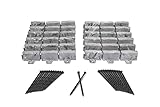
- EASYFLEX DECORATIVE NO-DIG LANDSCAPE EDGING: Get a beautifully landscaped yard without all the work of a dig-in lawn edging; simple installation without trenches or shovels; color may vary due to the unique manufacturing process.
- DO-IT-YOURSELF: Place the edging around raised flower beds, trees, and gardens and use a rubber mallet to drive the spikes into the tabs for a secure, long-lasting border
- FIT ANY SHAPE GARDEN DESIGN: EasyFlex garden edging is rigid enough to make straight sections, and has built-in spines that can bend to make curves and tree rings, or cut to make corners
- DURABLE & LOW MAINTENANCE: the strong plastic lawn edging can withstand string trimmers, temperature fluctuations and seasonal ground movement; requires minimal annual maintenance
- KIT INCLUDES: (12) 2.5-inch-tall x 15-inch-wide Stone-Look edging pieces and (24) 8-inch spiral anchoring spikes to complete a 15-foot installation
Match bed depth to the crops
Raised beds may dry faster than ground-level beds because drainage is improved. Beds on hard surfaces dry especially quickly because roots cannot draw on soil below. University of Maryland Extension recommends at least 8 inches of soil depth for leafy greens, beans, and cucumbers in beds on hard surfaces, and 12–24 inches for peppers, tomatoes, and squash. Check moisture and water as needed.
Lay a path or small patio
University of Missouri Extension describes using cleaned old bricks for a brick walk or patio laid in sand. This makes paving a sensible reuse for a batch of sound, similarly sized bricks. Before committing, consider how much foot traffic the surface will take and whether the location drains well. The source does not establish one universal base or installation method for every site, so adapt construction to local soil, climate, and use rather than assuming sand alone suits all conditions.
Rank #3

- Realistic Faux Stone Texture: Our landscape edging boasts a lifelike stone texture with detailed surface patterns that add depth and a polished look to your outdoor space. It beautifully enhances garden beds, lawns, pathways and flower beds, bringing a natural, decorative touch to any yard.
- Generous 15.5FT Complete Kit: This set includes 12 interlocking edging pieces for a total length of 15.5 feet. Each piece measures 16.3" L x 3.5" W x 2" H, providing ample coverage to outline and define your entire landscape with a clean, professional border.
- No-Dig DIY Easy Installation: Designed for hassle-free DIY setup with no digging or trenching required. The interlocking structure allows quick assembly, and the kit includes 12 heavy-duty 7.8-inch metal stakes to anchor the edging firmly in place for long-lasting stability.
- Durable All-Weather & Low-Maintenance: Made of high-quality durable plastic, this edging is fade-resistant, weather-resistant and built to withstand sunlight, rain and seasonal changes.
- Flexible & Multi-Scene Application: The rigid yet flexible design lets you create straight lines, smooth curves or right angle to fit any garden layout. It effectively separates lawns and flower beds, keeps your outdoor space neat and tidy.
A small, level paved patch beside a wall or potting area can serve as a place to stand pots; treat it as a compact version of a paved area, not as a design specifically tested by the cited guidance.
Remove mortar carefully when the project requires it
You do not need to strip every brick bare. For low edging or informal landscape use, leave mortar in place if it does not prevent a secure fit. Paving is different: the Missouri guide refers to cleaned old brick.
Rank #4

- STAYS IN PLACE - Our edging stays securely in place, keeping mulch and other materials from migrating into other areas of your landscape for a pollished look
- PROTECTS FLOWER BEDS - Say goodbye to messy flower beds, our edging will protect your garden from weed eater damage and it looking neat and tidy
- MADE IN THE USA, each 6-brick sections is 48" L x 4" W x 2.25" H and holds its integrity all year in all seasons
- FORMS A BOUNDARY - Perfect for creating any boundry shape you need, just add Function Bricks for creative shapes, SOLD SEPARATELY
- EASY TO INSTALL - Our interlocking design, lightweight material and securing spikes make installation a breeze, saving you time and hassle
For stubborn mortar, the Brick Development Association’s 2023 guide describes using a heavy hammer and broad cold chisel for larger lumps, followed by a brick hammer for smaller pieces. It urges extreme caution, appropriate protective equipment, and a chisel hand guard. Grinding wheels, discs, and wire brushes can be difficult to control and may score or polish the brick. The guide does not recommend chemical cleaners as the initial method for removing solid mortar.
Independent reader supportYour contribution helps us test, update, and keep practical guides available for everyone.Be cautious with bricks of unknown history
Near edible crops
Appearance alone cannot establish what reclaimed bricks were exposed to. In a response dated January 11, 2024, an Ask Extension expert said they could not assure the safety of the particular bricks in the question or identify a way to test those bricks. The response noted less concern for ordinary backyard-use bricks without creosote exposure; it was not a universal safety certification.
Recommended Free Tools
Best Value

- STAYS IN PLACE - Our edging stays securely in place, keeping mulch and other materials from migrating into other areas of your landscape for a pollished look
- PROTECTS FLOWER BEDS - Say goodbye to messy flower beds, our edging will protect your garden from weed eater damage and it looking neat and tidy
- MADE IN THE USA, each 6-brick sections is 48" L x 4" W x 2.25" H and holds its integrity all year in all seasons
- FORMS A BOUNDARY - Perfect for creating any boundry shape you need, just add Function Bricks for creative shapes, SOLD SEPARATELY
- EASY TO INSTALL - Our interlocking design, lightweight material and securing spikes make installation a breeze, saving you time and hassle
If you plan to grow food and the site’s history is uncertain, University of Maryland Extension advises having a soil sample tested, including for lead. A soil test assesses the soil; it does not chemically certify the bricks.
In a fire feature
Do not assume an unspecified salvaged brick is fire-rated. A Washington State University Extension response about cinder blocks advises against using them for the fire-exposed liner and identifies firebrick, sheet iron, or steel as preferred inner materials, with concrete materials potentially used as a second protective layer. That advice addresses cinder block; it does not prove that every reclaimed clay brick is unsafe or suitable for fire.
Quick Recap
A practical decision checklist
- For a path or patio, set aside sound, similarly sized bricks and plan around site drainage and expected foot traffic.
- For edging, mixed bricks can be useful if they sit securely; mortar need not be removed when it does not affect fit.
- For a raised bed, check that the width is reachable, the wall construction suits its height, and water can drain—especially over a hard surface.
- For food-growing beds, consider the history of both the bricks and the soil; seek soil testing when site history is uncertain.
- For a fire feature, use materials appropriate to the heat exposure rather than assuming salvaged masonry will work.
Product prices and availability are accurate as of the date/time indicated and are subject to change. Any price and availability information displayed on Amazon at the time of purchase will apply.

