
To measure low resistance accurately, force a known current through the device under test (DUT) and measure the voltage across it with a separate pair of sense leads. This four-wire, or Kelvin, method keeps most lead and contact resistance out of the voltage reading. It is especially useful when those unwanted resistances are not small compared with the DUT.
Why two-wire measurements can mislead
In a two-wire measurement, the meter sends current and reads voltage through the same leads. The reading therefore includes voltage drops across the leads and their contacts as well as the DUT. If those added resistances are significant relative to the DUT, the meter reports too much resistance. The actual error depends on the leads, connections, DUT, and instrument—not on a universal correction factor. The Keithley Low Level Measurements Handbook explains why two-wire measurement becomes unreliable when lead resistance is not small compared with the resistance being measured.
Tektronix/Keithley gives an illustrative example: 100 mΩ of combined test-lead resistance when measuring a 500 mΩ resistor produces 20% measurement error in two-wire mode, in addition to instrument error. That is a worked example for those stated values, not a general error rate. Tektronix/Keithley’s four-wire measurement guide describes the example.
How four-wire Kelvin measurement works
A Kelvin setup separates the current path from the voltage-sensing path. One pair of leads carries the test current through the DUT; another pair measures the voltage at the DUT. Because the sense leads carry very little current, their own resistance usually contributes negligible voltage drop. The measured voltage is therefore much closer to the voltage across the DUT itself. Divide that voltage by the test current to calculate resistance: R = V / I. See the Keithley handbook, Tektronix/Keithley’s guide, and Keysight’s low-resistance measurement application note.
Quick wins for a faster PC:
Clear out junk files and repair common Windows errorsFree Scan →Fix the driver behind crashes, sound loss and screen glitchesFind Drivers →Repair Windows errors before they cause bigger problemsFix Now →#1 Best Overall
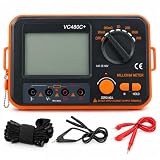
- 【HIGH‑ACCURACY 4‑WIRE KELVIN TEST】 Equipped with advanced 4‑wire Kelvin test technology, the VC480C digital milliohm meter delivers precise low‑resistance testing starting from 0.01mΩ with ±0.5% reading accuracy. It works great for lithium‑battery internal resistance measurement, motor winding resistance verification, PCB trace testing, cable resistance inspection and micro‑ohm analysis for industrial laboratory applications.
- 【RELIABLE PROTECTION & STEADY READINGS】 Built‑in full circuit protection together with advanced anti‑magnetic and anti‑electromagnetic interference (EMI) technology ensures stable and accurate measurement even under harsh industrial conditions. Suitable for production‑line quality control, electrical equipment maintenance, cabinet‑based device inspection and routine resistance verification on workshop‑based jobs.
- 【LARGE BACKLIT LCD DISPLAY】 This milliohm meter adopts a large backlit LCD screen with distinct test symbols and high‑contrast resistance readouts. The user‑friendly interface supports fast low‑resistance measurement, which simplifies on‑site data logging and analysis for electronics repair workshops and technical testing work.
- 【COMPACT & PORTABLE DESIGN】 Featuring a compact 75 × 52 mm lightweight body, the 4‑wire Kelvin digital milliohm meter is easy to transport for on‑site troubleshooting. The matched wrist strap offers secure handling during outdoor field inspections and on‑site commissioning of electrical machinery.
- 【VERSATILE POWER OPTIONS】 Powered by 6 AA batteries or an external 9V DC power adapter (adapter NOT included). Low‑power consumption plus integrated battery‑level indicator supports long‑hour continuous measurement. Perfect for mobile service work, automotive electrical repair shops and prolonged diagnostic testing sessions.
Place the voltage-sense contacts as close to the DUT terminals as practical. Any conductor between a sense contact and the DUT terminal can still be included in the sensed voltage. Make stable contacts and keep their placement consistent when comparing readings.
Control thermal offsets and test current
Reduce thermoelectric voltage errors
At low resistance, the voltage signal can be small enough that thermoelectric voltages from dissimilar-material junctions or temperature gradients distort it. Depending on their direction and stability, these offsets can make a reading high, low, or unstable. The Keithley handbook discusses thermal EMF and offset compensation. Keysight’s application note describes reversing current direction to reduce thermal EMF effects and notes that measurement timing must account for source settling.
Rank #2

- Large LCD display for easy reading - High accuracy and performance for low resistance measurements
- 4-wire cables with Kelvin clip connectors, capable of testing extreme low resistance - Accurate measurement of conductor, electric heating elements and solder point
- HOLD key for data hold - Backlit LCD for easy reading under dark light
- Connection for external power supply - Strong anti-magnetic and anti-jamming functions
- Full function protection - Manual zero display adjust
Where the instrument and application support it, use offset compensation or current reversal, allow the source and measurement to settle, and reduce temperature gradients around the connections. These techniques address offsets; they do not eliminate every source of measurement uncertainty.
Balance signal size against heating
More test current produces a larger voltage signal, which can make it easier to measure. But current also dissipates power in the DUT, potentially changing its temperature or damaging it. Choose current based on the instrument’s range and resolution, the DUT’s electrical and thermal limits, and the uncertainty you need. There is no single correct test current for every device.
Free tools Windows power users keep installed
One-click scans. No signup required.
Rank #3

- Using the four‑wire measurement method, it can measure very low while maintaining
- Full function, strong anti‑magnetic and anti‑interference ability, to ensure the accuracy of measurement results.
- Large‑screen LCD display with clear handwriting makes it easier to measure and record data.
- Function display, detailed data display, convenient and simple
- Small size, portable and light weight, it can be easily handheld to measure in various situations.
If self-heating is a concern, reduce the current or use pulsed current when the instrument and measurement permit it. Keysight emphasizes balancing measurable voltage against heating or damage; the Keithley handbook also discusses reducing or pulsing current when heating matters.
Choose a measurement setup that fits the DUT
Several kinds of equipment can perform a four-wire measurement. The right choice depends on resistance range, accuracy and resolution, current control, voltage compliance, speed, thermal behavior, and contact geometry.
Rank #4

- Using the four line measurement method to make the measurement data more accurate and convenient. This DC low resistance tester can measure resistance from 1μΩ~300kΩ, Resistance accuracy: 0.1%; Minimum resolution 1μΩ.
- This milliohm meter features a large LCD display and a backlight function that can be freely opened and closed. Turning on the backlight in low light or dark environments can provide clear visibility, while turning off the backlight can achieve energy savings, balancing adaptability to usage scenarios and environmental protection requirements.
- Data storage: Supports up to 99 sets of measurement data storage, without real-time recording, making it convenient to trace historical data.
- Intelligent numerical judgment: can preset comparison values, automatically compare and judge measurement results, and quickly screen qualified/unqualified data.
- Designed specifically for professionals, this micro-ohmmeter covers a wide range of resistance measurement scenarios — it can accurately measure cable conductor resistance, switch/relay contact resistance, winding resistance of coils, motors and transformers, resistance between metal riveted parts and components, as well as conductor resistance of connections between ground grids and ground electrodes. It not only fulfills cable performance testing requirements but also ensures the reliability of electrical connections, fully meeting the needs of professional use.
| Setup | What it offers | What to check |
|---|---|---|
| Four-wire-capable digital multimeter | Measures resistance with separate current and sense leads. | Confirm four-wire capability, appropriate range and resolution, lead compatibility, and available offset-compensation features. |
| Micro-ohmmeter | Typically uses four-wire measurement; some models include offset compensation or dry-circuit testing. | Check the specific instrument’s current, range, accuracy, and whether its dry-circuit method meets the contact-test requirement. |
| Separate current source and sensitive voltmeter, or an SMU | Allows current to be sourced and DUT voltage to be measured using separate connections. | Verify current control, voltage compliance, measurement resolution, settling behavior, and suitability for the DUT. |
The equipment categories and feature considerations are described in the Keithley handbook, Keysight’s application note, and Tektronix/Keithley’s guide. These sources do not establish one instrument model as best for every application.
When dry-circuit testing matters
For some contacts, connectors, or switches, a dry-circuit test limits the test voltage so the measurement does not disturb oxide films. Do not assume every meter or micro-ohmmeter offers this feature, or that its limit is appropriate for your application. Check the specific instrument documentation and the requirements for the contact being tested. The Keithley handbook discusses dry-circuit testing.
Do these 3 things before closing this tab:
1Fix the driver behind crashes, sound loss and screen glitches2Repair Windows errors before they cause bigger problems3Scan for outdated or missing drivers - takes under a minuteBest Value

- 4-wire low resistance measurement with 0.1mOhm resolution for precise testing.
- Digital milliohm meter suitable for measuring contact resistance and wire resistance.
- Battery powered with portable design for field and laboratory use.
- Multiple measurement ranges from 0.1mOhm to 20kOhm for versatile applications.
- Includes test leads and power adapter for immediate use out of the box.
Set up and take a reading
- Select a suitable instrument and range. Confirm it can make a four-wire measurement over the expected resistance range, and check current, voltage compliance, resolution, and relevant DUT limits.
- Connect the current leads. Attach the source pair so current flows through the DUT.
- Connect the sense leads at the DUT. Attach the voltage-sensing pair as close to the DUT terminals as practical, separate from the current connections.
- Make stable, consistent contacts. Use a lead set or fixture that suits the instrument terminals and DUT geometry. Keep contact placement consistent when comparing measurements.
- Choose a safe, measurable test current. Ensure it produces adequate voltage for the instrument without exceeding the DUT’s thermal or electrical limits.
- Allow the measurement to settle and address offsets. Use the instrument’s offset-compensation or current-reversal function where appropriate, following its instructions for timing and setup.
- Calculate resistance if needed. Use the sensed voltage and sourced current: R = V / I. For example, if the measured DUT voltage is 10 mV at 100 mA, the calculated resistance is 0.1 Ω; this arithmetic example does not specify a recommended test current.
What determines the accuracy you can achieve
Four-wire wiring removes a major source of error, but it does not by itself guarantee an accurate result. The final measurement depends on the instrument, test current, connections, DUT behavior, settling, and environment. Relevant checks include:
- Whether the instrument’s accuracy and resolution suit the expected resistance and sensed voltage.
- Whether the current is controlled and appropriate for the DUT, including any self-heating or damage risk.
- Whether sense contacts are close enough to the DUT terminals and remain stable.
- Whether thermal EMFs or temperature gradients could be comparable to the signal.
- Whether the source and measurement have settled before the reading is taken.
- Whether the instrument supports the offset-compensation, current-reversal, or dry-circuit method the application needs.
A defensible uncertainty budget requires the actual DUT, fixture, instrument specifications, and measurement environment. The cited guidance does not provide one universal budget or accuracy figure for all low-resistance measurements.
Quick Recap
Product prices and availability are accurate as of the date/time indicated and are subject to change. Any price and availability information displayed on Amazon at the time of purchase will apply.

