
What’s actually slowing this PC down?
Pick the symptom - the matching free tool is one click away.
The TECHWAY PFP-KX7+ is a Kintex-7 FPGA PCIe platform with up to 12 high-speed serial (HSS) links rated at 10 Gbps each. Those are manufacturer-stated link rates, not a guarantee of sustained application throughput: the board also uses PCIe x4 Gen2, and actual performance depends on the FPGA design, memory, host path and connected I/O.
What is the TECHWAY PFP-KX7+?
The PFP-KX7+ is a modular FPGA board from TECHWAY, based on AMD (Xilinx) Kintex-7. It is designed for installation in a standard PC or use as a stand-alone board in an enclosure. TECHWAY lists Windows and Linux drivers and describes the board as PCIe x4 Gen2. TECHWAY’s product page
The product family includes configurations using Kintex-7 KX325 or KX410 FPGAs. Do not assume the two variants have identical resources or deliver identical results for a given design; confirm the exact board configuration when evaluating it.
How fast are the 12 HSS links?
TECHWAY specifies up to 12 HSS links, each rated at up to 10 Gbps. The technical sheet is identified as version V08-23; the publication year is not independently established. TECHWAY PFP-KX7+ technical sheet
#1 Best Overall
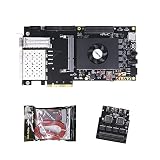
- FL9134 Package: AX7325B+USB downloader+FL9134
- FPGA Chip: XC7K325T-2FFG900I
The rate describes the stated capability of each link. It does not establish that all 12 can operate at their maximum in every configuration, nor does it prove sustained application-level throughput. No independently measured throughput benchmark is reported in the cited product materials. Performance in a real system depends on the FPGA design, data handling, memory access, PCIe transfer path, host software and connected hardware.
What other performance specifications matter?
| Specification | TECHWAY-stated value | How to interpret it |
|---|---|---|
| PCIe interface | x4 Gen2; the product page expresses this as 16 Gbps | This is the board’s stated host interface, not an application throughput benchmark. The cited page does not explain the basis or overhead assumptions behind its 16 Gbps wording. |
| DDR3 memory | Two 512 MB banks at 1600 Mbps | TECHWAY lists these memory specifications; they do not by themselves establish end-to-end data throughput. |
| HSS links | Up to 12 links, up to 10 Gbps per link | Manufacturer-stated link capability; usable aggregate performance depends on configuration and design. |
| Power | Below 15 W without an FMC board | TECHWAY’s technical sheet qualification excludes the expansion board; it is not a complete system power figure. |
Specifications above are from TECHWAY’s product page and its technical sheet. Values should be checked against the exact variant and intended operating configuration.
Rank #2

- Dual Kintex-7 Core Models:Available in PZ-K7325T-FH-KFB (XC7K325T) and PZ-K7410T-FH-KFB (XC7K410T), offering up to 406K logic cells, 1540 DSP slices, and robust industrial temperature support (-40°C to +85°C).
- Comprehensive High-Speed Interfaces:Supports PCIe 2.0 x2, dual SFP optical ports, HDMI 4K IN/OUT, FMC HPC (8 GT pairs, 168 IOs), Gigabit Ethernet, USB to UART & JTAG, SD Card, and 40-pin user expansion.
- Stable Boot and Memory Configuration:Equipped with 2GB DDR4 (64-bit), 256Mb QSPI Flash, and startup options via JTAG or QSPI (default), providing reliable configuration and efficient data throughput.
- Industrial-Grade Hardware Design:Features a 12V/3A power input, black matte PCB with immersion gold finish, 5 user keys, and 5 LEDs. Built for rugged use in laboratories, field environments, and embedded applications.
- Expansion-Ready Architecture:40-pin expansion port enables integration with Puzhi peripheral modules including AD/DA converters, cameras, and LCDs. Ideal for prototyping in communication, imaging, and control fields.
What can you connect to the FMC+ slot?
TECHWAY lists an FMC HPC or FMC+ HSPC connector and VITA 57.4 compliance. An appropriate FMC or FMC+ mezzanine may provide analog or digital I/O, but that does not mean every card is compatible. Before selecting a mezzanine, verify the exact connector variant and pin mapping, electrical standards, required transceivers and clocking, and whether the selected FPGA variant has the resources your design needs.
TECHWAY also lists user I/O. The applicable signal details and compatibility should be checked against the chosen board configuration and the intended design rather than inferred from the connector name alone.
Do these 3 things before closing this tab:
1Repair Windows errors before they cause bigger problems2Scan for outdated or missing drivers - takes under a minute3Clear out junk files and repair common Windows errorsRank #3

- AX7325B Board: AX7325B+USB downloader
- FPGA Chip: XC7K325T-2FFG900I
What applications does TECHWAY identify?
TECHWAY lists radar, co-processing, prototyping, medical imaging, data recording and high-speed data switching as application categories. These are manufacturer-stated use cases, not independently verified deployment examples. The fit for any particular system depends on its I/O, data-rate, FPGA-resource and software requirements.
Independent reader supportYour contribution helps us test, update, and keep practical guides available for everyone.What should you verify before choosing the board?
- Exact FPGA variant: Establish whether the offered configuration uses KX325 or KX410 and confirm the resources your design requires.
- End-to-end data path: Check how HSS traffic will be buffered and processed, and how it will move through DDR3, PCIe and the host application.
- Mezzanine fit: Confirm FMC connector type, VITA 57.4 details, signal mapping, electrical compatibility, clocks and transceiver needs for the specific card.
- Deployment and software: Confirm the board’s suitability for the intended PC or stand-alone setup and validate driver and design support for your operating system and application.
- System power: Account for the FMC card and other system components; the below-15-W figure excludes an FMC board.
- Commercial terms: Request a quote from TECHWAY and verify current stock and lead time directly; the available product information does not establish current pricing or availability.
For context, a 2019 Embedded article discusses the product historically, but that date should not be treated as the origin date of today’s published specifications. Embedded
Quick Recap
Best Value

- Luxury Package: AX7325B+USB downloader+FL9134+AN831+Fiber Module+AN9767+AN706+AN9238+Binocular Camera+7 inch LCD
- FPGA Chip: XC7K325T-2FFG900I
Rank #4

- Arty A7 comes in two FPGA variants: Arty A7-35T features Xilinx XC7A35TICSG324-1L. Arty A7-100T features the larger Xilinx XC7A100TCSG324-1.
- Internal clock speeds exceeding 450MHz, On-chip analog-to-digital converter (XADC), Programmable over JTAG and Quad-SPI Flash
- 256MB DDR3L with a 16-bit bus @ 667MHz, 16MB Quad-SPI Flash, USB-JTAG Programming circuitry, Powered from USB or any 7V-15V source
- 10/100 Mbps Ethernet, USB-UART Bridge
- 4 Switches, 4 Buttons, 1 Reset Button, 4 LEDs, 4 RGB LEDs, 4 Pmod connectors, shield connector
Product prices and availability are accurate as of the date/time indicated and are subject to change. Any price and availability information displayed on Amazon at the time of purchase will apply.

