
Terrestrial renewables have the stronger evidence-based case for supplying electricity in the foreseeable future. NASA’s 2024 assessment found its conceptual space-based solar power designs substantially more expensive than terrestrial alternatives in baseline scenarios. Space solar could eventually benefit from more consistent sunlight, but lower launch and manufacturing costs, improved performance, and a working delivery system would all be needed to make it competitive.
What counts as space solar power?
Space-based solar power (SBSP) is a complete electricity system: solar collectors in orbit capture sunlight, transmit energy wirelessly to Earth, and a receiving station converts it into electricity for a grid or storage. A satellite that uses solar panels only to power its own onboard systems is not a terrestrial SBSP power plant. NASA’s assessment evaluates conceptual systems rather than commercially operating plants on Earth (NASA Technical Reports Server presentation record; NASA public summary).

“Traditional renewables” is not one technology. Utility-scale solar photovoltaics (PV), wind, and solar thermal with storage have different output profiles and infrastructure needs. Comparisons are most useful when they name the specific option and use consistent measures for cost, availability, emissions, and system boundaries.
How do the costs compare?
NASA’s 2024 baseline assessment estimated that the lifecycle cost per unit of electricity from its conceptual SBSP systems could be 12 to 80 times higher than terrestrial alternatives. Its 2050-projection chart puts two representative SBSP designs at approximately $0.61/kWh and $1.60/kWh, compared with roughly $0.02–$0.05/kWh for the terrestrial alternatives shown. These are modeled scenario estimates—not measured operating costs, retail electricity prices, or bids for real projects—and depend on the study’s assumptions and system boundaries (NASA presentation, acquired July 10, 2024; NASA summary, January 11, 2024).
Outdated Drivers Are Slowing You Down
One free scan finds every outdated or missing driver and matches the right update for your exact hardware.Free scan · exact hardware matchPC Slower Than It Used to Be?
A free scan shows the junk files, broken settings and background clutter dragging Windows down - then fixes them in one click.Free scan · Windows 10 & 11#1 Best Overall
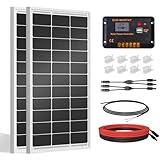
- [Wide Application]: Daily Output 800wh/day under 4 hours full sunshine condition. Perfect for RV, Caravan, Marine, Camper, Electric scooter, Golf Carts, Power wheels, Trolling motor, Tool trailer, Backup power supply for cabin shed home etc.
- [Excellent Performance]: ECO-WORTHY solar panels use high-performance monocrystalline solar cells, which can provide up to 21.5% higher efficiency sufficient light conditions.size:35.2*23.1.37in
- [Durable]: Corrosion-resistant aluminum alloy frame, so that the panel can be used for decades, and can withstand strong wind (2400Pa) and snow load (5400Pa), with a long service life. Ip65 rated junction box provides complete protection.:
- [Complete and Easy]: The back of the pre-drilled and plug-and-play cables allow quick installation, the kit can be connected in series (24V) or parallel (12V) if you need. What you will get: 2 pcs 100W mono solar panel + 2 set of Z mounting brackets + 30A solar controller + 1 pair of 16.4ft 10 awg solar cables + 1 pair of 2-in-1 connectors + 1 pair of 4.92ft tray cable.
- [Support]: 1 year with 24/7 tech support, if any problems or questions about the product,please do not hesitate to let us know through Amazon or call ECO-WORHTY hotline for solution.
NASA also examined favorable sensitivity cases in which SBSP might become competitive if launch, manufacturing, and system performance improve beyond baseline assumptions. Those cases are conditional possibilities, not a forecast that the improvements will occur.
A separate terrestrial benchmark illustrates why cost units matter. For 100 MWdc utility PV, the U.S. Department of Energy’s 2025Q1 benchmark reports a minimum sustainable price (MSP) of $1.07/Wdc and a modeled market price (MMP) of $1.12/Wdc, in 2024 U.S. dollars. These are installed-capacity costs, not electricity costs per kilowatt-hour, so they cannot be directly compared with NASA’s SBSP figures (DOE Solar Photovoltaic System Cost Benchmarks).
Rank #2

- Portable Generator with 60W Solar Panel Included: with a big battery pack, ZeroKor 300W solar powered generator are powerful enough to charge smartphones,tablets,laptops,headphones or other outdoor small camping supplies(Tips:Using electrical appliances over 300W may damage the portable solar generator, especially some devices that are prone to heat or built-in air compressor such as coffee maker,Hair dryer, water pump etc )
- Multiple Charging outlets for camping gear with SOS Flashlight: with 2* 300W Max wall AC outlets, 1* DC port (9V-12.6V/10A max ), 3* 5V/3A Max USB ports, 1*quick charge USB port (5V/3A 9V/2A Max), Flashlight with reading mode and SOS mode for your outdoor Adventures, our portable solar power station offers a versatile charging solution,allowing you to charge your outdoor smart devices directly from a wall AC outlet
- Multiple Charging Optional, Solar Panel Charger 60W Included: ZeroKor portable power bank generator can be recharged by Home AC outlet, DC5521 13V-23V Solar Panel (Portable Power Station built-in MPPT), 12V Carport. Take the portable solar power bank generator with you on-the-go and never worry about power shortage,the portable AC outlet design makes it more suitable for Tent camping OFF-Grid
- Built in BMS(Battery Management System) : ZeroKor portable power station features short circuit protection, over-current protection, over-voltage protection, overload protection and overheating protection. The built-in cooling fan system will automatically start and stop according to the portable battery pack internal temperature during use. Acting as a portable solar power bank, it accommodates multiple devices simultaneously, making it perfect for indoor and outdoor use
- HIGH CONVERSION EFFICIENCY: ZeroKor solar panels 60W monocrystalline solar cell have a high conversion efficiency of 20.5%, and its performance is better than that of polycrystalline solar panels under the condition of insufficient light
What could make orbital solar useful?
Solar collectors in orbit may have fewer interruptions from night, clouds, atmospheric effects, or seasonal variation than ground-based solar. That resource advantage is real in principle, but it does not by itself establish continuous, affordable electricity delivered to a grid. The system must also launch and assemble large structures, operate and service them in space, transmit power wirelessly, receive and convert it on Earth, and integrate the output with storage or the grid. DOE’s explainer describes the theoretical attraction of orbital sunlight, while NASA’s assessment makes clear that the full system chain drives the comparison (DOE space-solar explainer; NASA assessment).
Any future cost improvement would depend on several linked variables, not just the price of solar cells:
What’s actually slowing this PC down?
Pick the symptom - the matching free tool is one click away.
Rank #3
- Launch cost and the cadence at which launches can deliver equipment.
- Mass, manufacturing scale, and the ability to assemble and service systems in orbit.
- Spacecraft operating life, solar-cell efficiency, and end-of-life performance.
- Wireless transmission efficiency and the size and requirements of receiving sites.
- Grid connection, storage, and the cost of delivering power when and where it is needed.
How certain are the emissions claims?
NASA’s study says SBSP lifecycle greenhouse-gas intensity may be comparable to terrestrial options in its modeled cases, but it also calls for more study, including the effects of launch emissions on the upper atmosphere. That supports “potentially comparable in modeled lifecycle emissions, with important uncertainties”—not a claim that space solar is emissions-free or proven cleaner. A fair lifecycle comparison needs to account for manufacturing, launches, operations, and end of life under clearly stated boundaries (NASA assessment; NASA summary).
Independent reader supportYour contribution helps us test, update, and keep practical guides available for everyone.How mature is the technology?
NASA’s cost analysis concerns conceptual systems, not commercial SBSP plants delivering electricity to terrestrial grids. Space photovoltaics are an active development area: DOE describes work to improve performance, durability, manufacturability, and affordability, including multijunction III-V cells valued for efficiency, reliability, and radiation resistance on long-duration missions (DOE Space Photovoltaics).
Rank #4
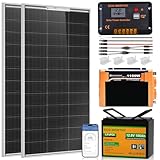
- One-Stop Solar Solution: This complete 200W solar complete system generates 800Wh of power daily and stores 1.28Kwh of power, making it the essential kit for your RV trip. This system comes with everything you need to build an off-grid solar system, no additional purchases required. It includes 2pcs 100W solar panel, 12.8V 100Ah lithium battery, 1100W inverter, a 30A PWM charge controller, and all necessary cables.
- Say Bye To DIY:To Save You The Trouble Of Diy, Our 200w Complete System Can Bring You Fully Compatible, Novice-Friendly 4-Step Quick Installation, Long-Term Benefits, Damaged Replacement, Technical Support, Empowering Your Rv Life Anytime, Anywhere
- 4 Step To Hassle-Free Solar:①Connecting Two solar panel②Connect Battery To Controller,Secure Them To Positive And Negative Screws and Connect Battery To Inverter ③Connect Solar Panel To Controller④Connecting the load
- 7/24 Service:We Provide 7/24 Customer Service And Give You The Most Professional Service. When You Receive It, If There Is Any Problem, You Can Tell Us And We Will Give You A Reasonable Reply
At a DOE workshop held June 2, 2026, 78 participants proposed cross-cutting 2035 targets for space photovoltaic arrays: at least 200 W/kg specific power, at least 70% of beginning-of-life power at end of life under a defined mission profile, and under $10/W at a defined array boundary. These were proposed targets, not demonstrated commercial performance. Participants also identified cost and specialized-material supply as concerns (DOE 2026 Space Photovoltaics Workshop).
How to compare the options fairly
For a meaningful comparison, use the same system boundary and keep unlike measures separate. Consider:
Do these 3 things before closing this tab:
1Repair Windows errors before they cause bigger problems2Fix the driver behind crashes, sound loss and screen glitches3Clear out junk files and repair common Windows errors- Delivered cost: Compare electricity-cost measures such as levelized cost of energy (LCOE) with other LCOE estimates; do not treat a $/W installed-capacity benchmark as a $/kWh electricity price.
- Availability: Account for actual sunlight profiles, storage, transmission, and grid integration—not resource consistency alone.
- Lifecycle emissions: Include manufacturing, launches where relevant, operations, and end of life when the evidence allows.
- Maturity and timing: Distinguish technologies operating on Earth today from orbital systems modeled for a 2050 scenario.
- Infrastructure and scale: Include land, grid, and storage needs for terrestrial systems, and launch, assembly, servicing, and receiving infrastructure for SBSP.
Which is more likely to power the future?
For the foreseeable build-out, terrestrial renewables are the practical choice supported by the stronger current evidence. NASA’s baseline scenarios put conceptual SBSP well above terrestrial alternatives in modeled electricity cost, while the path to lower orbital costs depends on improvements that remain uncertain. Space solar is worth continued research as a possible longer-term option, especially if its full delivery chain becomes affordable and performs as required; it is not currently established as a replacement for terrestrial renewable power.
Quick Recap
Product prices and availability are accurate as of the date/time indicated and are subject to change. Any price and availability information displayed on Amazon at the time of purchase will apply.

