
Free tools Windows power users keep installed
One-click scans. No signup required.
Skipper CCDs help astronomers detect very faint signals by measuring the charge in each pixel repeatedly without removing it. Averaging those nondestructive readings reduces electronic readout noise, so a small signal is less likely to be hidden by the detector itself. The first reported on-sky astronomy demonstration used the SOAR Telescope’s Integral Field Spectrograph in Chile.
What is a Skipper CCD?
A charge-coupled device (CCD) turns incoming photons into electrons that accumulate in pixels. When the image is read, electronics measure each pixel’s stored charge. With a faint source, the signal may be only a few electrons, and readout noise can make it difficult to distinguish that signal from measurement noise.

A Skipper CCD changes the readout stage: it can sample the same stored charge packet more than once without destroying it. The detector averages those readings to reduce readout noise. It does not collect extra photons; it measures the charge already produced by the photons more precisely.
How repeated sampling reduces noise
If the repeated readings have independent white noise, averaging N samples reduces that noise approximately in proportion to 1/√N. For example, taking more samples can make a single-electron signal easier to resolve, but the improvement is not free: each additional measurement takes time.
#1 Best Overall
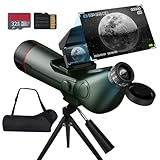
- Exceptional Optical Performance:Equipped with a powerful 80mm aperture and 300mm focal length (f/8.89), this telescope for adults delivers crystal-clear, bright views. The starlight-grade sensor supports up to 350X magnification for long-distance viewing and captures stunning 4K high-resolution images. even in low-light or moon-viewing conditions.
- Dual-Screen Display for Real-Time Viewing: This scope is equipped with not only an eyepiece with adjustable vision compensation (diopter adjustment range +/-4), but also a foldable external screen allows for direct, vivid observation. The built-in sunshade ensures clear visibility even under strong daylight, offering an intuitive viewing experience.
- One-Touch Switch Photo & Video Modes: Capture breathtaking photos or videos at the touch of a button—no external devices needed. Supports up to 512GB external storage, so you can save and share your favorite celestial moments anytime.
- Extended Battery Life & Auto Power-Off: Features a built-in 4500mAh high-capacity battery offering up to 6 hours of operation on a full charge. With customizable auto shut-off options (1/3/5/10 minutes), you can preserve battery life effortlessly.
- Versatile Use & Perfect Gift: Spotting Scope with Tripod for Target Shooting. Ideal for moon observation, stargazing, long-distance photography, and birdwatching. A perfect gift for astronomy enthusiasts and nature lovers alike.
That makes the useful setting a balance between read noise and readout time. An observation that needs the lowest possible noise may benefit from more samples, while another observation may favor faster readout. More samples are not automatically better for every target or observing configuration.
What the SOAR astronomy demonstration showed
Fermilab reports that its CCD Group led the first on-sky astronomy demonstration of a Skipper CCD using the SOAR Telescope’s Integral Field Spectrograph (SIFS) in Chile. The collaboration included Fermilab, the University of Chicago, NOIRLab, Lawrence Berkeley National Laboratory and Brazil’s National Astrophysical Laboratory. Fermilab’s account of the demonstration describes it as helping retire perceived risks for future cosmology experiments.
Rank #2

- 1080P 30fps Lunar & Planetary Imaging: FIBONAX Nova200 is a beginner-friendly telescope camera with a 2MP CMOS sensor supporting 19201080 video up to 30fps. Capture the Moon, Jupiter, Saturn and bright terrestrial targets, or enjoy real-time telescope views on your computer
- UVC Plug and Play + ASCOM Upgrade Path: Connect by USB for standard UVC live viewing on compatible Windows, macOS and Linux systems. Windows users can also install the optional FIBONAX ASCOM driver for more astronomy-focused imaging workflows with compatible software
- Removable UV IR Cut Filter Included: Unlike a fixed-filter electronic eyepiece, Nova200 includes a removable UV IR cut filter to reduce unwanted ultraviolet and infrared light for more natural lunar and planetary color. Remove or replace the filter when your imaging setup requires greater flexibility
- Standard 1.25 Inch Electronic Telescope Eyepiece: Insert Nova200 directly into many standard 1.25 inch telescope focusers in place of a traditional eyepiece. The M28.5x0.6 thread also supports compatible 1.25 inch astronomy filters and accessories
- Lightweight CNC Aluminum Camera Body: The compact 110g aluminum housing keeps the telescope setup lightweight while providing a durable metal body and effective heat dissipation for longer observation and video capture sessions
The on-sky use shows that the technology has been operated as part of an astronomy instrument, rather than remaining only a laboratory concept. It does not show that every observatory should replace conventional CCDs: whether repeated sampling is worthwhile depends on the needs and configuration of a particular observation.
What the published measurements mean
Two reported noise figures illustrate the technology’s potential, but they come from different studies and detector configurations. They are measurements of particular devices, not universal specifications for all Skipper CCDs.
The Tool Desk
Outbyte PC Repair FREERepair Windows errors before they cause bigger problemsFix Now →Outbyte Driver Updater FREEFix the driver behind crashes, sound loss and screen glitchesFind Drivers →Rank #3
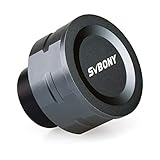
- SV105 telescope camera is the basic method for starting astronomical imaging; you can use the SV105 electronic telescope eyepiece to image it; which is more suitable for beginners who like to do astrophotography
- SV105 astrophotography camera is suitable for lunar and planetary photography; share the view of bright planets; moon and terrestrial targets; just point the telescope at the moon or planet and record a quick video; you can transfer the real-time view of the telescope to your laptop or PC
- Plug and play; no driver required; real-time dynamic observation; clear images; SV105 astronomy camera compatible with Windows system needs to download Sharpcap Capture; Linux system needs to download AstroDMx Capture; Android system needs to download USB Camera
- The image processor adopts dark light compensation technology; SV105 svbony camera can greatly improve the image clarity of the astronomy camera under low light conditions
- Interesting and useful USB planetary camera; standard 1.25 inches; threaded M28.5x0.6; can be used with telescope filters; directly connected to the telescope
| Measurement | Reported result | What it applies to |
|---|---|---|
| Readout noise | 0.18 electron rms per pixel after 400 nondestructive samples | The SOAR SIFS detector characterization reported in a 2024 paper. The sample count is part of the result. 2024 detector characterization |
| Quantum efficiency | At least 80% from 450 to 980 nm; at least 90% from 600 to 900 nm | The characterized SOAR SIFS detector. These wavelength ranges describe that detector, not every Skipper CCD. 2024 detector characterization |
| Readout noise | 0.068 electron rms per pixel | A separate 2017 Skipper CCD study, which reproduced the result over millions of pixels on a stable large-area detector. It is not the SOAR result. 2017 Skipper CCD study |
When comparing detectors, read noise is only one consideration. Relevant factors also include readout time, wavelength-dependent quantum efficiency, dark current, charge transfer, full-well capacity and dynamic range. The SOAR characterization reports detector properties, but the cited material does not establish a complete product-to-product comparison.
Independent reader supportYour contribution helps us test, update, and keep practical guides available for everyone.Why Skipper CCDs matter beyond astronomy
Fermilab also describes Skipper CCDs as promising for low-mass dark-matter searches. Such experiments look for very low-energy electron-recoil signals, where being able to measure charge below the usual one-electron noise scale may be valuable. Fermilab’s overview of the dark-matter application explains how repeated measurements can push readout noise below one electron.
Rank #4

- 【Dual-Screen Display for Real-Time Viewing】This smart telescope is equipped with a foldable external screen (3 inch) allows for direct, vivid observation. It can be enjoyed with family and friends. The built-in sunshade ensures clear visibility even under strong daylight, offering an intuitive viewing experience.
- 【Superior Optics】300mm(f/8.89) focal length and 78mm aperture, fully coated optics glass lens with high transmission coatings creates stunning images and protect your eyes. Perfect full positive telescope for astronomers to explore stars and moon.
- 【Magnification】The starlight-grade sensor supports up to 350X magnification for long-distance viewing and captures stunning 4K high-resolution images. even in low-light or moon-viewing conditions. Come with an eyepiece with adjustable vision compensation (diopter adjustment range +/-6).
- 【One-Touch Switch Photo & Video Modes】Capture breathtaking photos or videos at the touch of a button—no external devices needed. Supports up to 512GB external storage, so you can save and share your favorite celestial moments anytime. (Equipped with a 64GB memory card)
- 【Great Gift Ideas】The telescope is a perfect gift or birthday gift for kids or beginner astronomers. Smart telescope helps them build interest in astronomy ,exploring the world , enjoy life and away from the screen! The kids' astronomical journey starts from here.
OSCURA is a research effort aimed at scaling this detector approach for a much larger dark-matter experiment. That is a project goal, not evidence that a large-scale detector has already been deployed. Other forms of sensitive imaging and particle detection may also benefit, but those are potential applications unless a specific use is documented.
Quick Recap
Best Value
What to keep in mind when comparing detector claims
- Check the reported sample count alongside a noise figure; repeated sampling is central to how a Skipper CCD reaches low read noise.
- Confirm which detector and configuration produced the measurement. The SOAR result and the 2017 large-area study are distinct experiments.
- Look at wavelength range and quantum efficiency as well as noise when judging suitability for a particular astronomical observation.
- Weigh lower read noise against the time required to acquire repeated samples.
- Do not assume that a generic astronomy CCD camera is a Skipper CCD or that a published research detector is a drop-in commercial replacement.
Product prices and availability are accurate as of the date/time indicated and are subject to change. Any price and availability information displayed on Amazon at the time of purchase will apply.
What’s actually slowing this PC down?
Pick the symptom - the matching free tool is one click away.

