
What’s actually slowing this PC down?
Pick the symptom - the matching free tool is one click away.
Scientists at Japan’s National Institutes for Quantum Science and Technology (QST) and Doshisha University demonstrated a way to combine laser beams that reached 1.2 terawatts of peak power. That is a notable result for the combining method—not an announcement of a new laser facility that is the world’s most powerful. QST says the technique could eventually scale toward exawatt-class output, but the experiment did not reach that level.
What the researchers achieved
In an announcement published September 1, 2026, QST reported a proof-of-principle demonstration reaching 1.2 terawatts (1.2 × 10¹² watts) of peak power. QST described that result as about 1,000 times the peak power achieved by prior beam-combining methods. The number refers to peak power—the pulse’s power at its maximum—not average power delivered continuously. QST’s announcement describes the experiment and its comparison.



The result is a method for combining beams, not a newly unveiled, world-leading laser facility. QST separately notes that the highest peak power among laser systems worldwide is in the petawatt range. Its “world’s highest peak power” framing applies to the team’s beam-combining-method result. The available sources do not establish a comprehensive global ranking of every laser facility.
How the beam-combining method works
Instead of relying only on ever-larger optical components and beam apertures to raise output, the researchers combined multiple beams while aligning their phases. QST says their approach places a high-power solid-state amplifier inside a Sagnac interferometer. The split pulses travel equal optical path lengths, which passively aligns their phases when they recombine.
Do these 3 things before closing this tab:
1Fix the driver behind crashes, sound loss and screen glitches2Repair Windows errors before they cause bigger problems3Scan for outdated or missing drivers - takes under a minute#1 Best Overall
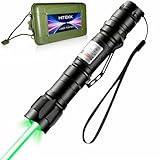
- LONG RANGE VISIBILITY: HiTekk's high-intensity green laser beam is visible across the night sky, making it ideal for stargazing, astronomy, outdoor activities, nighttime use, presentations, and pointing at distant objects. Designed for clarity and precision, the powerful beam helps you communicate, guide, and highlight with confidence
- RECHARGEABLE BATTERY: Enjoy reliable, long-lasting performance with a rechargeable battery that eliminates the need for constant battery replacements. Quickly recharge using the included USB charger to ensure your laser pointer is always powered for travel, professional use, outdoor adventures, and extended sessions without interruption or added expense
- PORTABLE CARRYING CASE: Transport and store your laser pointer securely with the included protective carrying case designed for convenience and durability. Perfect for travel, hiking, camping, work, and everyday carry, the compact case keeps your device protected from scratches, dust, and accidental damage while keeping accessories organized
- DURABLE: Built with a rugged cemented carbide body for enhanced strength, impact resistance, and long-term reliability. Engineered for frequent use and demanding environments, this laser pointer withstands daily handling, outdoor conditions, and extended operation while maintaining a premium feel and consistent performance.
- WATER RESISTANT: Designed for dependable outdoor use, the water-resistant construction helps protect internal components from light moisture and environmental exposure. Ideal for camping, hiking, stargazing, and unpredictable weather conditions, allowing you to use your laser pointer with greater confidence in various settings.
That passive alignment is important for very short pulses: QST says the method avoids active phase-control feedback, which is particularly challenging to maintain for such pulses. The reported 1.2-terawatt result demonstrates the approach at proof-of-principle scale; it does not by itself establish the performance of a larger system built from many more beams.
How it compares with higher-power lasers
“Most powerful” depends on what is being compared. The QST result concerns a beam-combining technique demonstration; other figures describe laser facilities or broader field status. The units also differ: a petawatt is 1,000 times a terawatt, and an exawatt is 1,000 times a petawatt.
Rank #2
| Figure | What it describes | Status and scope |
|---|---|---|
| 1.2 terawatts | Peak power in QST’s coherent beam-combining proof of principle | Demonstrated by QST and Doshisha University; announced September 1, 2026. QST compares it with prior beam-combining results, not with every laser facility worldwide. QST |
| 2 petawatts | Peak power in a ZEUS user experiment | Reported by the U.S. National Science Foundation (NSF) in June 2025; NSF then described ZEUS as the most powerful laser in the United States. NSF, 2025 |
| 10 petawatts operational; 100 petawatts under construction | Field-level overview of high-power laser systems | Reported in a 2026 review abstract; it is not a direct comparison with the QST apparatus or an exhaustive live facility record. 2026 review abstract |
In September 2026, NSF said ZEUS had entered full-power operations and again described it as the highest-power laser in the United States. That is a facility-level U.S. ranking, distinct from QST’s claim about a combining-method result. NSF, 2026
ZEUS has also been associated with a zettawatt-equivalent experiment. That does not mean the laser delivered zettawatts of ordinary peak power: NSF explains that the equivalent refers to power in a moving electron’s frame of reference. NSF’s explanation distinguishes that frame-dependent comparison from the facility’s reported laser power.
Could the method reach exawatt power?
QST says adding more beams could make the output scale with beam count and provide a path toward exawatt-class systems. An exawatt is 1018 watts, far above the demonstrated 1.2 terawatts. This is a proposed future possibility, not an achieved result or a claim that an exawatt laser is now operating. A 2026 review abstract likewise treats exawatt lasers as a future frontier while describing 10-petawatt lasers as operational and a 100-petawatt facility as under construction. 2026 review abstract
Independent reader supportYour contribution helps us test, update, and keep practical guides available for everyone.What the technology could be used for
QST identifies extreme-matter science and smaller particle accelerators as potential applications. These are prospects for future systems, not outcomes demonstrated by this experiment. The research received support through Japan Society for the Promotion of Science Grant-in-Aid JP21K8149 and was published online in Optics Letters on September 1, 2026, U.S. time. QST
Quick Recap
Best Value
Rank #4
![MIPREZT [Professional] Rechargeable Green Laser Pointer High Power Green Beam Laser Light Long Distance Range for TV/LED/LCD Screens Tactical Flashlights Presentation Office/Outdoors/Astronomic [001]](https://m.media-amazon.com/images/I/41i-qPg8QGL._SL160_.jpg)
- [Good Quality & Long Distance] This flashlight is made of aluminum alloy, very strong and durable, good quality, and it has a non-slip design, long distance range.[001]
- [Rechargeable Design] The light flashes when the battery is low. Just rotate the lid off the bottom of the product and you can charge it, It is compatible with all USB-A chargers, Whether it's a computer, a laptop, a phone charger, a powerbank, or a plugboard, you can charge it with a USB port. Charge it for half an hour and you can use it for hours on end. The product uses a prismatic lithium-ion pouch battery, model 501240. The battery has passed UN38.3 and MSDS testing and complies with applicable safety standards. [001]
- [Starlight Pattern] Press down the star cap and rotate it to remove the star cap, then you can see a straight green light in the dark, and you can see different starlight patterns when you install the star cap. You can use it in many situations, such as construction sites, outdoor adventures, classrooms, meeting presentations, and other fun uses.[001]
- [Notice] Do not use the light directly at human's or animal's eyes, and keep it away from children.[001]
- [Our Services] Ourproduct comes with a 1-year warranty, if you have any questions or our flashlight have some defects, please contact us for further assistance.[001]
Product prices and availability are accurate as of the date/time indicated and are subject to change. Any price and availability information displayed on Amazon at the time of purchase will apply.

