
Do these 3 things before closing this tab:
1Scan for outdated or missing drivers - takes under a minute2Clear out junk files and repair common Windows errors3Fix the driver behind crashes, sound loss and screen glitchesRoomie-Pi lets a child choose Spotify music by placing a physical NFC-tagged wooden chip on a Raspberry Pi player, rather than navigating a phone or screen. A PN532 reader identifies the chip, local software maps it to a Spotify URI, and the Pi streams the selection to its audio system. Rotating the chip can trigger next- or previous-song controls.
What Roomie-Pi does
Maxi Lacher published Roomie-Pi on Hackster.io on May 21, 2025, describing a player built so his four-year-old daughter could start songs independently. The child’s interface is a set of physical music chips: place one on the player to select music, then rotate it to change tracks. The project description sums up the idea as “no screen, no phone, just place a chip to play music.” That describes the child-facing interaction, not necessarily the setup or maintenance of the system.
Roomie-Pi is a maker project rather than a finished, certified consumer product. Its design combines NFC for selection with a separate rotation-sensing mechanism and Spotify streaming software.
How a music chip selects Spotify music
The tag identifies a selection
Each reference-build chip is a 35 mm wooden sandwich made from two discs, with an NTAG215 NFC tag embedded between them. When the chip is placed on the PN532 reader, the player reads the tag’s unique ID. Roomie’s local MariaDB database maps that ID to a Spotify URI, which identifies the selected music. In this design, the local mapping is the important link between a physical chip and its Spotify selection; the project does not require the child to search through Spotify menus.
#1 Best Overall

- This is PN532 NFC HAT based on PN532 operating in the 13.56MHz frequency range. NFC (Near Field Communication) is a wire-less technology that allows contactless point-to-point data communication between devices within a short distance of 10 cm. It is widely used in applications such as access control systems, smart tickets, meal cards, etc. Based on the popular NFC controller PN532 with multi-interface options, this HAT will easily enable NFC function for RPi.
- Standard Pi 40PIN GPIO extension header, Compatible with Raspberry Pi series boards ( like Pi 5/ 4B/3B+/3B/2B/A+/Zero W/WH/Zero 2 W/ Pico/Pico 2W, etc.)
- Onboard PN532 chip, supports various NFC/RFID cards like MIFARE/NTAG2xx, etc. Breakout control pins, for easily connecting with host boards like STM32/Ardu.
- Three interface options: I2C, SPI, and UART, configured via jumpers and switches.
- Operating voltage: 3.3V/5V. Factory communication baud rate: 115200 bps. The NFC module operates in the 13.56 MHz band.
A Spotify URI can refer to a track, album, or playlist. The reference project’s description establishes the tag-ID-to-URI mapping, but does not specify that Spotify URI data is written directly onto the tag.
Rotation controls playback
Two small magnets are built into each chip. Two Hall-effect sensors in the player detect the magnets as the chip turns, allowing the system to determine rotation direction and trigger previous- or next-song behavior. This is distinct from NFC: the PN532 reads the chip’s identity, while the magnets and Hall sensors provide the rotation input.
Rank #2
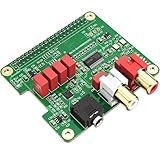
- 【Direct-Connect HiFi DAC Expansion Board】Seamlessly integrates with Raspberry Pi 5, 4, 3B+, Zero & Zero W via 40-pin GPIO. No soldering or external wiring needed – unlock studio-grade audio at 10% of traditional cost. Features 384kHz/32bit PCM5122 DAC with dual ultra-low jitter oscillators (45.158MHz/49.152MHz).
- 【Reference-Class Audio Engineering】TI PCM5122 reference DAC delivers 112dB SNR and -78dB THD+N, coupled with film capacitors for pristine RCA/3.5mm outputs. Master-clock mode eliminates Raspberry Pi jitter, supporting DSD over PCM (DOP) and 8kHz-384kHz sampling.
- 【Universal OS & Software Support】Tested with Volumio, Moode, RuneAudio, LibreELEC, and Raspberry Pi OS. Stream high-res audio via network/NAS/USB storage. Onboard EEPROM enables plug-and-play configuration.
- 【Professional Dual-Output Interface】Gold-plated RCA line-level outputs (2.1Vrms) + dedicated headphone amp (138mW@32Ω via TPA6133). Independent grounding eliminates crosstalk for studio monitors or high-impedance headphones.
- 【Developer-Optimized Design & Support】Features ultra-low-noise power regulation + reserved IR port (GPIO26). Compliant with Raspberry Pi HAT specs, with open-source SDK, documented API, and technical support via InnoMaker Wiki (link in manual).
The Pi streams the selected music
The documented Roomie-Pi implementation uses Raspotify on a Raspberry Pi 4 Model B. A HiFi HAT with a TAS5713 audio amplifier and two small 3 W speakers provide the audio path. Raspotify handles Spotify playback; the NFC reader, database mapping, and sensors make that playback accessible through physical controls.
Reference-build components
| Part or tool | Role in the project |
|---|---|
| Raspberry Pi 4 Model B | Runs the player software and coordinates the hardware. |
| PN532 NFC reader | Reads the identifier of a music chip placed on the player. |
| NTAG215 tags | Embedded in the wooden chips and used to identify selections. |
| RPI HiFi HAT TAS5713 and two LuluDa 3 W speakers | Provide the reference build’s amplified audio output. |
| Two Hall-effect sensors and two magnets per chip | Detect chip rotation for previous- and next-song controls. |
| 3D-printed enclosure parts and 35 mm wooden discs | Form the player housing and physical music chips. |
| Raspbian, a 3D printer, and a hobbyist soldering station | Listed software and build equipment for the reference project. |
Spotify software options: the original build and Soloist
Raspotify is the documented Roomie-Pi implementation
The project’s reference design uses Raspotify together with its local MariaDB mapping. That is the implementation described for Roomie-Pi; it should not be treated as evidence that other Spotify clients work with the project unchanged.
Rank #3

- 【Perfect Fit for Compact Boards】Specifically designed to fit perfectly onto the Raspberry Pi Zero, Zero W, Zero 2, and Zero 2W without overhanging. Maintains full compatibility with all 40-pin Raspberry Pi models, including the Pi 5, Pi 4, and 3B+.
- 【Extensive Software Compatibility】Ready to work with all popular Raspberry Pi music player systems such as Volumio, Moode, RuneAudio, OSMC, PiCorePlayer, and Max2Play, as well as standard operating systems including Raspberry Pi OS, Debian, and Ubuntu.
- 【High-Performance DAC & Amp Combo】Equipped with the PCM5122 32-bit/384kHz high-resolution DAC for exceptional audio clarity, paired with the TPA6133 headphone amplifier that delivers 2.1Vrms output for driving headphones powerfully and cleanly.
- 【Dual Gold-Plated Outputs】Features both RCA left/right jacks and a 3.5mm headphone output, allowing high-quality connection to speakers, amplifiers, or headphones directly from your Raspberry Pi.
- 【Superb Sound, Unbeatable Value】Delivers a remarkably low noise floor and audiophile-grade sound quality that challenges expensive standalone DACs, offering incredible performance and value for DIY audio enthusiasts.
Spotify Soloist is a newer headless Linux option
Spotify announced Soloist on August 13, 2026, and its documentation describes it as a headless Linux Spotify client for Raspberry Pi-class devices. It can output to a local amplifier or DAC, use a Bluetooth speaker, accept command-line controls, and optionally expose a WebSocket interface. Its single-track mode can be used with a Spotify URI. Spotify says Soloist supports Free and Premium accounts after setup, but it requires a Spotify API key; each user must generate their own key, and builds expire after 90 days.
Soloist may be a platform option for a new build or an adaptation, but the available Roomie-Pi project description does not establish that its code has been tested with Soloist. A builder should plan to adapt and verify the software integration rather than assume the original Raspotify setup can simply be swapped out.
Rank #4

- This is a USB sound card/USB audio module with 8Ω 5W Speaker that supports recording and playback, a stereo codec, a built-in microphone, and a speaker. It is suitable for Raspberry Pi/Jetson Nano, driver-free, plug-and-play
- "Listening / Speaking" Two-In-One-- onboard microphone, and speaker header, easy audio input / output. Plug and Play, easy to use--standard USB 2.0 port, driver-free, portable size
- Multiple sampling rates support--supported sampling rates including 8K, 11.025K, 12K, 16K, 22.05K, 24K, 32K, 44.1K, and default 48K (Hz)
- Support Multiple systems--Compatible with mac/Win7/8/8.1/10, Linux, Android, WinCE
How Roomie-Pi compares with other Raspberry Pi music-player designs
Other open-source projects use physical media controls to make Spotify easier to operate, but they make different hardware and interaction choices.
| Design | Board and audio | Reader and selection | Controls and build trade-offs |
|---|---|---|---|
| Roomie-Pi | Raspberry Pi 4 Model B with a HiFi HAT and two speakers. | PN532 reader identifies NTAG215-tagged wooden chips. | Chip rotation is sensed by magnets and Hall sensors; the enclosure and chips involve 3D-printed and handcrafted parts. |
| Spotbox | Raspberry Pi Zero 2 W with Bluetooth audio and a power bank. | RC522 RFID scanner reads programmable RFID cards. | Physical buttons provide play/pause, next, and previous controls. The Zero 2 W has no audio jack, so wired analog output requires a different Pi model or an external audio interface. |
| NFC Jukebox | Raspberry Pi 5 and a speaker. | USB NFC/PCSC reader with NTAG215 tags; tags are associated with Spotify track, album, or playlist URIs. | A Flask application works with a Spotify Connect speaker service; the described design does not use Roomie-Pi’s rotating-chip controls. |
These reader types are not interchangeable names for the same part. NTAG215 is the tag embedded in a chip; PN532, RC522, and USB PCSC devices are readers that detect tags or cards. The designs also differ in output and controls: Roomie-Pi pairs a Pi 4 with a DAC/amplifier HAT and rotation sensing, while Spotbox prioritizes a compact Pi Zero 2 W, Bluetooth audio, battery power, and buttons.
Best Value

- S/PDIF(IEC60958-3) interface with 32 to 192kHz sampling rate.
- Optical TOSLINK electric RCA bitperfect output.
- With two low jitter external crystal oscillator and I2S master mode design, the DIGI ONE achieves more accurate audio clocking across different frequency ranges.
- The board adopts a 150M industrial-grade digital signal isolator and a automotive-grade 1W power isolator, providing complete galvanic isolation of DIGI ONE‘s power and digital signals from the Raspberry Pi, thereby ensuring better output signal quality.
- Absolutely support all Raspberry Pi music player system ,such as OSMC, Max2Play, RuneAudio, Volumio, Moode, Pi CorePlayer, Pi MusicBox, OpenELEC, Debian,Raspberry Pi Os, Ubuntu etc.
What to plan for when building a similar player
- Choose the interaction first. Decide whether the player should select music by NFC chip alone, add rotation sensing like Roomie-Pi, or use physical buttons like Spotbox. Rotation adds magnets, Hall sensors, mechanical alignment, and control logic beyond the NFC selection function.
- Match the reader to the tags. Roomie-Pi specifies NTAG215 tags and a PN532 reader. The reader detects the tag; it is not itself the tag. If using another reader type, confirm that the intended tags and software interface are supported by that reader and implementation.
- Choose the audio path and board together. Roomie-Pi uses a Pi 4 and audio HAT. Spotbox uses a Pi Zero 2 W and Bluetooth; because that board has no audio jack, wired analog sound needs another model or an external interface. A Pi 5/USB-reader arrangement is another documented design pattern, but it is not the Roomie-Pi hardware recipe.
- Define how selections map to Spotify. In Roomie-Pi, the software reads a tag ID and looks up the corresponding Spotify URI in MariaDB. Decide what each chip should play and maintain the mapping in the player’s software. Do not assume the tag itself contains the Spotify URI unless the implementation is deliberately designed that way.
- Select and verify the playback client. The reference build uses Raspotify. Soloist is a newer official headless option with different setup requirements, including an API key and expiring builds. Treat moving to it as a software adaptation that needs testing.
- Budget for enclosure and power complexity. Roomie-Pi’s wooden chips and 3D-printed enclosure, and Spotbox’s battery-oriented design, represent different build priorities. Choose materials and a power arrangement appropriate to the intended placement and supervision.
Limits to know before treating it as a product
The published Roomie-Pi project is a hobby build, and no independent child-safety certification or laboratory test result is established for it. That matters when evaluating the enclosure, embedded tags, magnets, wiring, power, and intended use: the project description is not a product-safety assessment.
Spotify’s Embedded SDK documentation describes a commercial route for compatible speakers and other hardware using Spotify Connect. Spotify currently accepts applications only from organizations. The documented route includes a hardware-partner application, agreements, implementation, certification through Certomato, and submission of test devices before launch. It is therefore a company-oriented process, not an individual-maker signup path or evidence that Roomie-Pi itself is certified.
Quick Recap
Product prices and availability are accurate as of the date/time indicated and are subject to change. Any price and availability information displayed on Amazon at the time of purchase will apply.

