
Crashes, No Sound, or Screen Glitches?
Random freezes, missing sound and display glitches usually trace back to one bad driver. Find and replace yours safely.Free scan · under a minutePC Slower Than It Used to Be?
A free scan shows the junk files, broken settings and background clutter dragging Windows down - then fixes them in one click.Free scan · Windows 10 & 11A filament extruder can turn suitable plastic feedstock into 3D-printer filament, but it is not a plug-and-play way to turn any failed print into a usable spool. You must match the machine to your materials, prepare and often tune the process, and account for cooling, pulling, diameter measurement, and winding. No controlled, like-for-like tests establish a best performer among the Filabot EX3, Felfil, Damao Tech, FIXstruder, and DIY options covered here, so the right choice depends on your feedstock and willingness to manage the workflow.
What a filament extruder does—and what it does not guarantee
A filament extruder heats plastic feedstock and forms it into a continuous strand. Depending on the machine, that feedstock may be pellets, regrind, or clean, sorted recycled plastic. A machine’s broad description is not proof that it accepts every polymer, mixed scraps, or unprepared failed prints. Confirm support and preparation requirements for the exact model before buying.
Making filament is a workflow, not simply a heated barrel. Feedstock preparation, cooling, pull speed, diameter measurement, and winding can all affect the result. Filabot’s EX3 system is presented as a sequence from raw material to spool, while a published sensor study illustrates that diameter sensing is a distinct engineering problem; neither establishes consistent printer-ready output from a particular commercial machine. Filabot EX3 system; sensor paper.
How the main options compare
The available descriptions distinguish product approaches, not independently measured performance. Use this table to narrow the candidates, then verify the details that matter for your material and setup.
Do these 3 things before closing this tab:
1Clear out junk files and repair common Windows errors2Scan for outdated or missing drivers - takes under a minute3Repair Windows errors before they cause bigger problems#1 Best Overall

- This is a single-shaft extruder accessory with a single-shaft screw, 2 heating coils and a hopper
- 2 pieces 200W ceramic heating coils, fast heating and easy wiring for diy plastic extruder machine
- 45# steel screw, high temperature resistant, can be used within 572℉. Applicable to extrusion of PE PP PS PVC POM PA PC ABS PET and other materials
- This is the main accessory of the extruder. You need to prepare a K-type temperature controller and a motor with a speed greater than 50rpm, a power greater than 100W and a torque greater than 10 Nm. You can easily assemble your own 3D filament extruder
- The equipment is compact and designed for experimental research, small batch testing, 3D consumables extrusion molding, etc.
| Option | What its source describes | What to verify |
|---|---|---|
| Filabot EX3 / EX3 System | Filabot describes the EX3 as a compact extruder for pellets, regrind, and recycled plastic. The system page presents a workflow with separate extrusion, airpath, winding, and measurement components. | Which components are included in the configuration you are considering, supported polymers, preparation needs, and current total cost. These are manufacturer descriptions, not independent performance findings. Filabot; EX3 System. |
| Felfil | The manufacturer describes a desktop recycler/extruder for waste plastic, failed prints, and pellets, for home or lab use. Independent coverage describes a modular setup and notes hands-on calibration and material preparation as practical considerations. | Exact polymer compatibility, preparation, included modules, and the calibration effort for your intended feedstock. Felfil; Tom’s Hardware overview. |
| Damao Tech desktop extruder | The vendor describes use with pellets, custom compounds, or clean recycled material and lists technical specifications. | Ask which specifications are vendor claims and seek independent output evidence; confirm materials and preparation requirements. Product page. |
| FIXstruder | The manufacturer describes a desktop machine for recycling failed prints and supports. | Independent tests and comparable specifications were not established in the available coverage; verify materials, preparation, system contents, and support directly. Manufacturer site. |
| DIY or open-source projects | Coverage discusses the 3D-printable ExtrudeX project and DIY kits such as ARTME 3D. This route exchanges convenience for building, sourcing, and tuning work. | Check project status, price, licensing, files, and parts availability at the time you plan to build. ExtrudeX coverage; desktop recycling overview. |
Choose by feedstock and preparation workload
Start with the plastic you can reliably supply, not with a machine’s broad recycling label. If you expect to use pellets, check whether the model names the polymers you intend to extrude. If you plan to reuse prints or supports, determine whether they must be sorted by polymer, cleaned, shredded into regrind, dried, or blended, and whether the manufacturer explicitly supports that material.
- Mostly pellets: Compare the supported polymers and the complete workflow required to turn pellets into a measured, wound strand.
- Clean, sorted scrap: Confirm how the machine handles that specific material and what size or condition it must be in before feeding.
- Mixed or unidentified waste: Do not assume compatibility. The product descriptions do not establish that arbitrary mixed waste can be processed successfully.
Material preparation and hands-on calibration are practical considerations in desktop recycling, as noted in Tom’s Hardware’s overview. If you want the convenience of feeding unsorted failed prints and receiving consistent filament without supervision, the evidence here does not establish that any listed option will provide it.
Rank #2

- 【Innovative & Environmentally Friendly Design】: 3D printer extruders visually showcases the innovative combination of plastic recycling and 3D printing technology for home DIY creation, environmental education, and 3D printing teaching experiments
- 【Turn Trash Into Trend】: Our 3D printer filament maker machine can directly convert discarded bottles into consumables needed for 3D printing. Standard cola bottles can produce about 10m of environmentally friendly filament, greatly reducing the cost of consumables while being environmentally friendly
- 【Integrated Smart Filament Making Machine】: Our 3D recycled PET consumables machine Integrating heating, temperature control, traction, and winding, the real-time LCD screen displays temperature and speed, making it very suitable for beginners and professionals.
- 【Adjustable Temperature / Speed】: The 3D recycled pet filament maker adopts a speed and temperature adjustable design, with a maximum temperature of 240℃. The cutting table can also be adjusted to ensure suitability for plastic bottles of various thicknesses, meeting your different needs for multifunctional filament production.
- 【Desktop Compact Design】: Desktop filament maker adopts a compact design, weighing only 3.75lb, with a size of 13.78(L)*5.9(W) inch, easy to carry, operating at less than 45 dB. It is an ideal choice for small spaces such as homes, classrooms, and dormitories
Compare the complete workflow, not just the extruder
Check whether a quoted configuration includes only the extrusion unit or also the components for cooling or airpath management, pulling, spooling, and diameter measurement. A system may be modular, so a product family’s description does not mean every component is included in the unit or package you are pricing.
Diameter monitoring deserves separate scrutiny. The sensor paper reports a sensor designed, built, tested, and validated for recycling and winding machines. That is evidence that measurement is a real process concern, not a benchmark of any named product. Ask how the machine measures diameter, whether readings are displayed or used for feedback, and what adjustment is available when the strand varies.
Rank #3
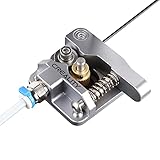
- 【Quality Assurance】100% official all-metal 3D printer extruder. High quality aluminum alloy material and sandblast to surface oxidization, ensuring this gray extruder is last for long term use. Works better than original plastic stock extruder. Original Creality 3D printers accessories for Ender-3/Ender-3 Pro/Ender-3S/Ender-3 V2/Ender-3 Max/CR-10/CR-10S
- 【Work Better】Our 3d printer extruder kits have an adjustable bolt so that you can adjust the pressure of the extruder gear as needed. The extruder drive has better stronger pressure pushing the filament into the printer nozzle and so will improve the printer's performance. 40 Teeth drive gear feeds the 1.75mm filament, compatible with PLA/ABS/Wood/TPU/PTEG
- 【Improved Performance】The optimized extruder with metal extrusion and original hotend kit pushes the filament into the printer nozzle, greatly making the metal extruder retain power in filament feed-in. And the beveled filament intake can prevent scraping the filament as it is pulled into the feeder
- 【Easy To Install】DIY kit and you need to assemble by yourself. The full necessary screws & parts kit for the extruder is included. Referring to instructions or our 5th picture to install, it is very easy and straightforward to switch to this upgraded part on your machine
How to judge the evidence and the effort
Manufacturer pages establish what their makers claim about intended feedstock and system design; they do not independently prove output quality. Editorial coverage offers practical context on preparation and calibration, but it is not a controlled comparison of the listed machines. The available sources do not establish which one produces the most consistent usable filament.
Before choosing a desktop or modular system, be realistic about the work beyond assembly:
Rank #4

- ✔️ INNOVATIVE RECYCLING DESIGN —— This machine creatively merges plastic recycling with 3D printing, enabling you to produce your own filament while reducing material consumption. Suitable for DIY projects, environmental education, and hands-on learning.
- ✔️ TRANSFORM BOTTLES INTO FILAMENT —— Convert used plastic bottles into ready-to-use 3D printing filament. A single standard soda bottle produces approximately 10m of filament, lowering your material costs and supporting sustainable making.
- ✔️ ALL-IN-ONE SMART DESIGN —— Integrates plastic cutting, heating, temperature control, traction, and winding into one compact unit. The real-time LCD display ensures easy monitoring and setting for both beginners and experienced users.
- ✔️ CUSTOMIZABLE PRODUCTION —— Fully adjustable temperature (up to 572℉) and speed settings allow you to match different plastics and bottle thicknesses. The customizable cutting bed supports versatile filament production for various project requirements.
- ✔️ SPACE-SAVING & LOW NOISE —— With a compact footprint of 13.78"L x 5.9"W and a weight of only 3.75 lbs, the machine operates below 50 dB. Its quiet and small design fits in homes, classrooms, and dorm rooms.
- Preparing and sorting feedstock, and any required drying, shredding, or blending.
- Setting up and calibrating the process for a material.
- Supervising extrusion and troubleshooting variation.
- Managing cooling, pull speed, measurement, and winding as parts of one process.
DIY projects add sourcing and build work to that list. Choose that route for the learning and control it offers, not on an assumption that a printable design is automatically the cheapest or easiest complete system.
Quick Recap
Best Value

- ①【SUNLU PLA 3D Printer Filament】PLA material is the perfect choice for 3D printing enthusiasts! SUNLU PLA filament is reliable, versatile, and easy to use. No clogs, bubbles, or tangles, its excellent layer adhesion ensures high-quality prints every time. Ideal for beginners and experienced users.
- ②【Neatly Wound 3D Filament Spool】SUNLU's self-developed neat winding device ensures that the filament is easy to use, with a 100% neat rate that reduces the risk of tangles and jams, and provides a smoother and more efficient 3D printing experience.
- ③【PLA Filament 1.75 mm】SUNLU 3D printer filament dimensional Accuracy +/- 0.02mm. SUNLU filament has wide compatibility due to the small diameter error, making it suitable for almost all 1.75mm FDM 3D printers.
- ④【Filament Spool Diameter】Spool Diameter: 8.00", Spool Width: 2.50", Spool Hub Hole Diameter: 2.20". The size of the SUNLU filament spool is suitable for hanging on a lot of FDM 3D printers.
- ⑤【PLA Recommend Settings】To achieve the best printing results with SUNLU PLA filament, we recommend printing at a nozzle temperature of 200-230°C, a bed temperature of 50-65°C, and a printing speed of 50-100mm/s.
What to verify before placing an order
- Supported materials: Get the exact polymers and feedstock forms the specific model accepts, plus any preparation requirements.
- Package contents: Confirm whether the price covers the extruder alone or includes airpath or cooling, a puller, a spooler, and measurement equipment.
- Diameter control: Ask how diameter is monitored and what controls or feedback help correct variation.
- Ownership costs: Check current machine price, shipping, required modules, spare parts, warranty, and support for your country. Comparable current totals were not established for these options.
- Independent output evidence: Look for tests using the same material and a clearly described method; do not treat vendor specifications or demonstrations as equivalent to a controlled comparison.
- Availability: Verify current stock, seller, and project status directly. The product descriptions alone do not establish availability in your region.
Which type of buyer is each option for?
- Consider Filabot EX3 if a defined, modular path from feedstock to spool suits you; verify exactly which system components and material support are included in your chosen configuration.
- Consider Felfil if a desktop recycling-oriented setup matches your plans and you accept preparation and calibration work.
- Investigate Damao Tech if its described feedstock options fit yours, but treat its listed specifications as vendor claims until independently verified.
- Investigate FIXstruder if its stated failed-print and support use case is relevant, while recognizing that comparable independent evidence was not established here.
- Choose DIY if building, sourcing, and tuning are part of the goal; verify the project’s current files, licensing, status, and parts before committing.
Product prices and availability are accurate as of the date/time indicated and are subject to change. Any price and availability information displayed on Amazon at the time of purchase will apply.
What’s actually slowing this PC down?
Pick the symptom - the matching free tool is one click away.

