
The Tool Desk
Outbyte Driver Updater FREEScan for outdated or missing drivers - takes under a minuteDriver Scan →Outbyte PC Repair FREEClear out junk files and repair common Windows errorsFree Scan →At Red Hat Summit on May 7, 2024, Red Hat positioned its enterprise software portfolio around building, serving, monitoring, and deploying AI workloads across datacenters, public clouds, and edge sites. The centerpiece was OpenShift AI 2.9, alongside announcements about AI assistance and automation across Red Hat tools. Some capabilities were previews or plans—not general-availability launches. OpenShift Lightspeed later reached general availability in May 2025, while Red Hat described a broader AI portfolio in February 2026.
What Red Hat announced at Summit 2024
Red Hat Summit took place in Denver on May 7, 2024. Data Center Knowledge counted 28 announcements, 16 with AI in the headline; that is a count of event announcements, not a measure of adoption, performance, or business results. Its report framed the releases as a push to help enterprises develop and manage AI applications across hybrid cloud, including generative AI.
The central product announcement was OpenShift AI 2.9. Red Hat described the release as expanding flexibility for predictive and generative AI workloads across hybrid cloud, while the event report highlighted adjacent moves in AI-assisted platform operations and automation.
What OpenShift AI 2.9 added
The announced capabilities addressed several stages of operating AI workloads, from serving models to observing them and distributing compute-intensive work.
Windows Errors? Fix Them Before They Spread
Repair common Windows errors and clear accumulated junk for a smoother, more stable PC - no reinstall needed.Free scan · no reinstallCrashes, No Sound, or Screen Glitches?
Random freezes, missing sound and display glitches usually trace back to one bad driver. Find and replace yours safely.Free scan · under a minute#1 Best Overall

- Built for Local AI Development: AMD Ryzen AI Halo is designed for local AI development and inference, featuring 128GB unified memory and support for up to 200B parameter models to build and run intensive AI workloads locally.
- 128GB Unified Memory: Features 128GB LPDDR5x unified memory at 8000 MT/s with 256 GB/s memory bandwidth, providing a shared memory pool across the CPU, GPU, and NPU to support larger AI models.
- AMD Ryzen AI Max+ 395 Processor: Features 16 cores, 32 threads, and Zen 5 architecture, paired with AMD Radeon 8060S integrated graphics featuring 40 RDNA 3.5 compute units and an AMD XDNA 2 NPU with up to 50 TOPS.
- Linux AI Developer Platform: Purpose-built for Linux-based AI development with full AMD ROCm software support and preloaded tools, models, and workflows optimized for local AI development.
- Compact, Connected Design: Includes a 2TB M.2 SSD, 10GbE LAN, Wi-Fi 7, Bluetooth 5.4, USB-C connectivity, and HDMI 2.1b.
- Model serving at the edge: Red Hat described serving models on single-node OpenShift for resource-constrained locations, including sites with intermittent or air-gapped connectivity. Red Hat classified this capability as a technology preview at launch, not a generally available feature.
- Serving for predictive and generative workloads: Data Center Knowledge named KServe, vLLM, and text generation inference server (TGIS) in its account of enhanced model serving. The announcement materials do not establish that every framework and configuration was supported in every environment.
- Distributed workloads with Ray: The release covered distributed workload support using Ray, for tasks that can be spread across resources rather than run as a single process.
- Model monitoring: Red Hat highlighted visualizations for monitoring models, adding an observability element to the platform’s AI workflow.
- Accelerator profiles: The announcement included profiles for accelerators, intended to help align workloads with available compute resources.
Red Hat’s official release described the platform as offering choice across underlying hardware, services, and tools. That positioning is not a complete compatibility matrix: organizations still need to verify support for their specific product versions, accelerators, serving stack, and deployment configuration.
Other products and plans announced at the event
Not every item discussed at Summit was a released feature. These statuses describe what Red Hat announced in May 2024.
- Red Hat Lightspeed: Red Hat said it planned to expand generative AI assistance to OpenShift and Red Hat Enterprise Linux (RHEL). At that point, OpenShift Lightspeed was slated for late 2024, while RHEL Lightspeed was described as being in planning.
- Ansible Automation Platform policy-as-code: Red Hat announced this as a coming technology preview, aimed at expressing and enforcing operational policies through automation.
- RHEL image mode: Red Hat announced image mode for RHEL as a technology preview.
- Podman AI Lab: This extension for Podman Desktop was presented as a way to build, test, and run generative AI applications in local containers.
What changed after the 2024 announcements
The Lightspeed timeline moved beyond the original plan. Red Hat announced general availability of OpenShift Lightspeed on May 20, 2025. The 2024 announcement’s proposed late-2024 timing is therefore historical; the later GA announcement is the relevant milestone for OpenShift Lightspeed. The cited materials do not establish the current availability of RHEL Lightspeed, so its 2024 planning status should not be treated as proof that it shipped.
On February 24, 2026, Red Hat announced Red Hat AI Enterprise and described a broader AI portfolio that included Red Hat AI Inference Server, OpenShift AI, and Red Hat Enterprise Linux AI. This later portfolio update provides context for Red Hat’s direction, but does not establish the present status of each feature introduced with OpenShift AI 2.9.
Recommended Free Tools
Rank #2

- EVOLUTION AMD RYZEN AI MAX+ 395 MINI PC - GMKtec EVO-X2 is the next evolution in AI mini PC Ryzen Strix Halo series. Thanks to AMD Simultaneous Multithreading (SMT) the core-count is effectively doubled, to 32 threads. Ryzen AI Max+ 395 has 64 MB of L3 cache and can boost up to 5.1 GHz, depending on the workload. The Ryzen AI Max+ 395 is currently rated as the "most powerful x86 APU" on the market for AI computing.
- AI NPU with XDNA 2 ARCHITECTURE - Powered by 16 “Zen 5” CPU cores, 50+ peak AI TOPS XDNA 2 NPU and a truly massive integrated GPU driven by 40 AMD RDNA 3.5 CUs, the Ryzen AI MAX+ 395 is a transformative upgrade and delivers a significant performance boost over the competition. The Ryzen AI Max+ 395 excels in consumer AI workloads like the llama.cpp-powered application: LM Studio. Shaping up to be the must-have app for client LLM workloads, LM Studio allows users to locally run the latest language model without any technical knowledge required and unleash their creativity and productivity.
- AMD RADEON 8090S iGPU GAMING PC - The AMD Radeon RX 8060S offers all 40 CUs with up to 2.9 GHz graphics clock and uses the new RDNA 3.5 architecture. The powerful iGPU is positioned between an RTX 4060 and 4070 laptop GPU and therefore enables gaming in FHD at maximum details in most demanding games. The 8060S can also utilize the full 64GB pool, which is perfect for running LLMs such as Deepseek 32B, which runs comfortably on this machine.
- EIGHT CHANNEL LPDDR5X - LPDDR5X is a new ground breaking memory small form factor installed on-board. With blazing speeds up to to 8000MT/s, it runs 1.5x faster than the DDR5 SODIMMs; 90% better performance over DDR5 SODIMMs in video conferencing and photo editing; 30% better performance in productivity apps; 4% better performance in digital content workloads.
- QUAD SCREEN 8K DISPLAY SUPPORT - EVO-X2 AI Mini PC support 4-screen 4K/8K output via HDMI 2.1 (8K@60Hz), DisplayPort 1.4 (4K@60Hz), and dual USB 4 40Gbps Transfer speed (supporting PD3.0/DP1.4/DATA). Ideal for gaming, video editing, and multitasking, it provides expansive and crisp multi-display support.
Why Red Hat emphasized hybrid deployment
Red Hat’s argument was that AI systems may be trained in one place but need to run across on-premises datacenters, public clouds, and edge locations. Red Hat AI business unit executive Steven Huels told Data Center Knowledge: “They may train on a data center, but then they want to deploy across multiple platforms. So, at this point, AI has become the ultimate hybrid workload, and customers are designing with that in mind.” This is Red Hat’s view of customer needs, not an independently measured finding.
That framing helps explain the focus on model serving at the edge, workload distribution, and hardware choice. A model-development workflow and its production deployment do not necessarily share the same infrastructure or connectivity. A hybrid platform aims to make those environments manageable within a common operating approach, but the announcements alone do not demonstrate that every workload can move unchanged between every site or cloud.
Governance, ecosystem, and the limits of the claims
The announcements also addressed governance and infrastructure partnerships. IDC Research vice president Jeven Jensen told Data Center Knowledge, “It’s really needed for AI. It’s all about putting guardrails in place,” referring to policy-as-code and governance, risk, and compliance. Omdia chief analyst of AI and data analytics Brad Shimmin described the platform’s positioning as helping companies use AI “in a very secure, (highly) performing, and easily governable manner.” These are an analyst’s observations, not test results.
Red Hat named AMD Instinct GPUs, Intel Gaudi accelerators, Intel Xeon processors, and integration with NVIDIA NIM microservices. Data Center Knowledge also reported partnership or availability announcements involving Pure Storage, Run:ai, Elastic, Stability AI, and Oracle Cloud Infrastructure. These names indicate the breadth of the ecosystem Red Hat discussed, not that every combination is available, supported, or interchangeable in every region and configuration.
Rank #3
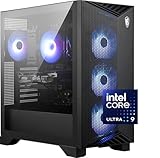
- Intel Core Ultra 9 285 Processor: Newly developed cores deliver ultra-smooth and responsive gameplay. AI accelerators prepare users for the next era of gaming on an AI PC.
- Simplistic Design: Enjoy the latest generation of Windows 11 Home for your everyday needs. *MSI recommends Windows 11 Pro for business use.
- NVIDIA GeForce RTX 5070 Ti GPU
- Cool While Gaming: In conjunction with an RGB CPU Air Cooler, the Aegis RS features four system cooling fans; three in the front and one in the rear to pull in cool air and push heat out of the PC.
- Turn on the Bright Lights: With the built-in RGB lighting, take your gaming experience to the next level by pressing the MSI LED button to cycle through lighting options. Customize lighting even further with MSI Center software.
Red Hat chief product officer and senior vice president Ashesh Badani said in the official OpenShift AI announcement: “Bringing AI into the enterprise is no longer an ‘if,’ it’s a matter of ‘when.’ Enterprises need a more reliable, consistent and flexible AI platform that can increase productivity, drive revenue and fuel market differentiation.” This states the vendor’s rationale and intended value, not evidence that the announced software delivered those outcomes. The event materials provide no independent benchmark, customer-outcome measurement, or controlled comparison with competing platforms.
Independent reader supportYour contribution helps us test, update, and keep practical guides available for everyone.What the announcements mean for IT teams
For an organization evaluating this direction, the most useful takeaway is the portfolio scope—not a promise that every capability is ready for production. A practical review should establish the status and fit of each component for the intended deployment.
- Map where model training, serving, and monitoring will occur: datacenter, public cloud, edge, or a combination.
- Check the current support and availability documentation for the exact OpenShift AI version, serving framework, accelerator, and hardware configuration you plan to use.
- Distinguish generally available features from technology previews and announced plans; preview status can carry different support and production-use expectations.
- Assess how model governance, policy controls, and existing Kubernetes and automation practices would fit into the design.
- Treat named partnerships and integrations as starting points for compatibility checks, not as proof of universal portability.
Data Center Knowledge identified VMware, IBM, DataRobot, Dataiku, Databricks, AWS, Azure, and Google Cloud as competitors or overlapping partners, but its report did not provide a like-for-like evaluation. A comparison should therefore be based on the organization’s own requirements—deployment locations, supported accelerators and serving frameworks, lifecycle and monitoring tools, governance controls, and operational integration—rather than inferred from the Summit announcement count.
Quick Recap
Sources and timeline
- Data Center Knowledge, “Red Hat Strengthens AI and Hybrid Cloud Push with Latest Software,” May 7, 2024
- Red Hat, “Red Hat OpenShift AI Expands Predictive and Generative AI Flexibility Across the Hybrid Cloud,” May 7, 2024
- Red Hat, “Red Hat Infuses Generative AI Across Hybrid Cloud Portfolio with Red Hat Lightspeed,” May 7, 2024
- Red Hat, “Red Hat Announces General Availability of Red Hat OpenShift Lightspeed,” May 20, 2025
- Red Hat, “Red Hat Launches Red Hat AI Enterprise to Deliver a Unified AI Platform that Spans from Metal to Agents,” February 24, 2026
Product prices and availability are accurate as of the date/time indicated and are subject to change. Any price and availability information displayed on Amazon at the time of purchase will apply.
What’s actually slowing this PC down?
Pick the symptom - the matching free tool is one click away.

