
RealSense and NVIDIA announced a collaboration on August 25, 2025, to connect RealSense depth cameras with NVIDIA tools for robot computing, simulation and sensor streaming. The effort targets humanoid robots and autonomous mobile robots (AMRs). It is an integration of building blocks for robotics developers—not an announcement of a finished robot or independently verified field performance.
What is physical AI?
NVIDIA uses “physical AI” to describe systems that perceive, reason, learn and act in the physical world. Its robotics workflow spans training, simulation and real-time deployment. That is NVIDIA’s framing rather than a settled technical standard: in this collaboration, the practical idea is to connect sensing hardware with compute and development software used to build robots.
What did RealSense and NVIDIA announce?
RealSense’s August 25, 2025 announcement names four parts of the development stack: RealSense depth cameras, NVIDIA Jetson Thor for robot runtime computing, Isaac Sim for digital twins and Holoscan Sensor Bridge for low-latency sensor streaming. RealSense singled out its D555 camera, which it says supports native Holoscan Sensor Bridge streaming. The announcement describes intended integration and target applications; it does not establish that the companies have delivered a production robot.
How do depth cameras help robots?
A depth camera provides depth and image data that a robot’s perception system can use to interpret objects and distances in its surroundings. That data is one input to a larger system: the camera does not by itself give a robot general autonomy, guarantee safe motion or establish reliable operation in a particular environment.
#1 Best Overall
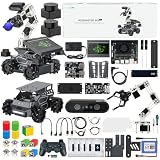
- 【Upgraded ROS2 Configuration】Rosmaster M3 PRO is a high-performance MegWave robot with a 3D vision manipulator arm, specifically developed for ROS2 educational scenarios. It's equipped with a Raspberry Pi 5-16GB, a Jetson Nano, a Jetson Orin Nano 8GB SUPER, or Jetson Orin NX 8GB/16GB SUPER as the main controller. The M3 PRO integrates Python and a 3D AI deep learning framework, making it ideal for developing complex AI projects and embodied models.
- 【Empowered by Large Al Model & OpenClaw Deployment】 M3 Pro is based on OpenRouter and features an interactive system centered around 3 AI models. Supports multimodal AI large model deployment, including online access and local offline deployment. Deep integration enables remote voice and text commands, autonomous task breakdown, intelligent decision-making, and complex task execution.
- 【Dual Lidars for 360° Perception】Dual Lidars are arranged in a diagonally staggered configuration, providing 360° environmental awareness. The right front radar precisely scans the driving path, while the left rear radar simultaneously complements dynamic environmental information, making it suitable for frequent turning scenarios. Point cloud registration and IMU fusion reduce high-speed motion distortion, improving mapping and navigation accuracy, and enabling one-step path planning.
- 【High-Performance AI Robot】M3 PRO is equipped with six intelligent serial bus servos, a 3D binocular depth camera, a built-in AI large-model voice module, and a large multimodal AI model, enabling a variety of applications including 3D spatial grasping, target tracking, object classification, scene understanding, and voice control.
- 【Advanced Technologies Comprehensive Tutorials】Integrates YOLO26, OpenCV, MediaPipe, Gmapping, inverse kinematics, Gazebo simulation and other algorithms, providing a highly configurable and extensible development environment. Comes with extensive tutorials and development manuals, ensuring that you can fully experience AI embodied intelligence!
RealSense sells multiple camera families, and their interfaces, ranges and features are not interchangeable. The D455, for example, is listed as a USB depth camera with an ideal range of 0.6 m to 6 m and global-shutter sensors. The D555 is listed for industrial, inspection and mobile-robotics use and connects over Ethernet with PoE. These are manufacturer specifications, not independent head-to-head test results. See the RealSense product catalog and verify the latest model datasheet and configuration before selecting hardware.
What does the RealSense D555 do?
The D555 is the camera highlighted in the collaboration. RealSense says it introduces the Vision Processor V5 and on-chip Power over Ethernet (PoE), supports native Holoscan Sensor Bridge streaming and includes an on-camera neural network for image post-processing. These are manufacturer claims about a component in a larger sensing and compute system, not proof of a particular robot’s accuracy or performance.
Rank #2
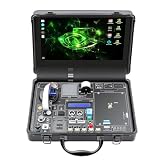
- 30-in-1 No-Solder Sensor Board, Plug and Play: Integrates 30 functional sensors including temperature & humidity, ultrasonic ranging, gas and motion sensors. Innovative common board design requires no soldering or complex wiring, and comes with a full set of accessories like 128G SD card, adapter board and acrylic mounting plates for zero-threshold experiments
- 8MP Gimbal Camera & Dual Servos for Professional Visual AI: The Starter Kit is equipped with an IMX219 8MP monocular camera and a dual-servo gimbal, supporting face and target tracking, and is ideal for AI edge computing scenarios such as intelligent monitoring, robot navigation, and automated recognition
- 38 Step-by-Step Python Tutorials, From Beginner to Practical Application: The Jetson Orin Nano Starter Kit comes with 38 well-designed Python tutorials progressing from basic programming to vision practice, covering all key knowledge of sensor control, embedded development and AI visual recognition for both beginners and advanced learners
- 11.6-inch IPS HD Screen & AI Voice Interaction System: Built-in 1366*768 resolution IPS screen eliminates the need for an external monitor, enabling one-device experimentation and visual feedback. The exclusive AI voice interaction system supports intelligent Q&A and voice command control for natural human-computer dialogue
- Rich Expansion Interfaces & Portable All-in-One Design: Features 2x I2C, 1x UART and 2 IO expansion interfaces to meet personalized experiment expansion needs; a custom carrying case integrates all components (11.81×7.87×3.94 inch), allowing AI experiments and demonstrations anytime and anywhere
The D555 also has deployment requirements beyond choosing a camera. Its v1.1 datasheet specifies a host with Ethernet and a PoE source that meets the stated requirements, along with Cat 6 or better Ethernet cable. Consult the D555 datasheet for the requirements applicable to the intended configuration.
How does Jetson Thor fit into a robot?
Jetson Thor is the onboard-computing element in the announcement: NVIDIA positions it for real-time robotics and sensor processing, so developers can run workloads on the robot rather than relying only on a remote computer. NVIDIA’s August 25, 2025 blog said Thor was generally available and described RealSense among the sensor companies using Holoscan Sensor Bridge to connect camera and other sensor data to Thor.
Rank #3

- Optimized AI Arm Kit for LeRobot & Hugging Face Projects – The SO-ARM101 is an upgraded low-cost robotic arm servo motor kit designed for AI robotics enthusiasts and developers. Fully compatible with LeRobot and Hugging Face frameworks, it supports imitation learning and reinforcement learning, making it ideal for real-world robotics applications. (3D-printed parts not included.)
- Enhanced Wiring & Performance – Compared to the SO-ARM100, the SO-ARM101 features improved wiring to prevent disconnection at joint 3 and eliminates range-of-motion limitations. The leader arm uses optimized gear ratio motors for smoother performance—no external gearboxes required.
- Real-Time Leader-Follower Functionality – New real-time tracking allows the leader arm to follow the follower arm, enabling human intervention and correction during reinforcement learning (RL) training. Perfect for hands-on AI robotics development and research.
- Open-Source, DIY-Friendly & Nvidia-Compatible – Developed by TheRobotStudio, this open-source AI Arm kit integrates seamlessly with the LeRobot platform, offering PyTorch-based datasets, simulation, training, and deployment tools. Fully compatible with Nvidia Jetson edge devices, including reComputer Mini J4012 Orin NX 16 GB.
- Comprehensive Learning Resources – Includes detailed open-source assembly and calibration guides, testing tutorials, and deployment instructions. From wiring to AI training, get everything you need to start building, teaching, and optimizing your robotic arm for grasping and placing tasks.
NVIDIA’s launch materials describe Jetson Thor as delivering 2,070 FP4 teraflops and claim 7.5× more AI compute, 3.1× more CPU performance and 2× more memory than Jetson Orin. Those are NVIDIA’s platform figures and comparisons, not measurements of this RealSense collaboration. The same August 25, 2025 blog quoted Agility Robotics CEO Peggy Johnson saying Jetson Thor would enhance Digit’s real-time responsiveness and expand its skills; that company-published statement concerns Digit and is not evidence of performance attributable to the RealSense integration.
Independent reader supportYour contribution helps us test, update, and keep practical guides available for everyone.What are Isaac Sim and Holoscan Sensor Bridge for?
Isaac Sim: develop and evaluate in simulation
RealSense names Isaac Sim as the digital-twin and simulation part of the collaboration. Simulation can help developers work on robot behavior and evaluate designs before deployment. It does not, by itself, show that a physical robot will operate reliably in a real workplace or outdoor setting.
Rank #4
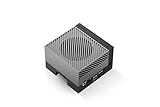
- The NVIDIA Jetson AGX Orin 64GB Developer Kit makes it easy to get started with Jetson Orin. Compact size, lots of connectors, and up to 275 TOPS of AI performance make this developer kit perfect for prototyping advanced AI-powered robots and other autonomous machines.
- The developer kit includes a Jetson AGX Orin 64GB module, and can emulate all the Jetson Orin modules. It supports multiple concurrent AI application pipelines with the NVIDIA Ampere GPU architecture, next-generation deep learning and vision accelerators, high-speed IO and fast memory bandwidth. Now you can develop solutions using your largest and most complex AI models to solve problems such as natural language understanding, 3D perception, and multi-sensor fusion.
- Jetson runs the NVIDIA AI software stack, and use-case specific application frameworks are available, including Isaac for robotics, DeepStream for vision AI, and Riva for conversational AI. You can save significant time with NVIDIA Omniverse Replicator for synthetic data generation (SDG), and by using NVIDIA TAO toolkit to fine-tune pretrained AI models from the NGC catalog.
- Jetson ecosystem partners offer additional AI and system software, developer tools, and custom software development. They can also help with cameras and other sensors, as well as carrier boards and design services for your product.
- With the computing capability of more than 8 Jetson AGX Xavier systems in a developer kit that integrates the latest NVIDIA GPU technology with the world’s most advanced deep learning software stack, you’ll have the flexibility to create tomorrow’s AI solution as well as today’s.
Holoscan Sensor Bridge: connect sensor data
Holoscan Sensor Bridge is the sensor-streaming link named by RealSense. NVIDIA describes it as a way to connect camera and other sensor data to Jetson Thor. Its presence in the announced workflow is relevant to system integration, but the materials do not provide independent testing of end-to-end latency or performance for the collaboration.
What should developers compare when choosing a camera?
Choose for the robot’s actual operating conditions rather than assuming all RealSense cameras offer the same capabilities. Compare:
- Working distance and field of view: match the camera’s stated range and view to the distances and scene the robot must perceive.
- Shutter and motion: account for fast-moving robots, moving objects and outdoor conditions when evaluating sensor behavior.
- Connection and power: USB and Ethernet/PoE have different host, cable, network and power requirements.
- Environment and mounting: check the selected model’s environmental rating and mounting options against the installation site.
- Software and integration: confirm support and requirements for the chosen camera, host computer and sensor pipeline.
For the D555, check the datasheet’s Ethernet and PoE requirements; for other models, consult their own current documentation. The D455’s USB interface and stated ideal range, for instance, do not describe the D555.
What does the announcement establish—and what does it not?
The companies have publicly described an intended connection between RealSense depth sensing and NVIDIA’s compute, simulation and sensor-streaming platforms, aimed at humanoids and AMRs. Their announcements and product materials establish what the companies say the products and integration are for. They do not independently verify collaboration-wide performance, safety, autonomous capability in a specific setting or production readiness. NVIDIA’s broader overview of robotics and physical AI explains its own platform framing and development workflow, not independent validation of this partnership.
Quick Recap
Product prices and availability are accurate as of the date/time indicated and are subject to change. Any price and availability information displayed on Amazon at the time of purchase will apply.

