
A compatibility review for a smart-contract upgrade must compare the proposed implementation with the exact implementation it replaces, then verify storage layout, initialization, migration behavior, and upgrade authority. For “Gate,” the specific protocol, network deployments, and upgrade scope are not established by independently verified primary materials here, so no Gate-specific compatibility verdict can be made.
What can be concluded about the Gate upgrade?
A DEV Community article matches the title and describes a Gate v2.3-to-v2.4 review, but its claims about total value locked, contract changes, governance, and vulnerabilities are not corroborated by primary Gate documentation. They should not be treated as verified findings. The matching article and its claims do not establish the contract addresses, networks, implementations, or proposed upgrade artifacts needed to reproduce an assessment.
A defensible Gate-specific review requires the exact deployed contracts and proposed changes. Until those are identified and checked, the appropriate conclusion is that the upgrade’s compatibility is unverified—not that it is compatible or incompatible.
What information is needed for a protocol-specific review?
First establish the scope. Collect the following for each relevant deployment:
#1 Best Overall
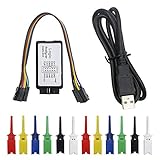
- This kit contains 12pcs SMD IC 6 Colors Test Hook Clips which are ideal for using this 24MHz 8CH logic analyzer.
- If you are doing microcontroller, ARM system, FPGA development, we highly recommend you purchase this product! This item will help you solve your problem when you do MCU related products, especially for UART, SPI, IIC and other communication debugging.
- Compatible with the Logic analysis software and open source programs such. B. sigrok (protocol analysis of RS232, SPI, IIC, 1-Wire, etc.)
- Reliable Technical Support: We have prepared detailed tutorial, includes: guidance manual, demo code, burning tools, necessary class libraries. Please visit our website (github: Keeyees/KY-57) to get tutorial or can contact us on Amazon, we will send PDF Document to you.
- The precise Gate entity or protocol meant by the title.
- The network and chain-specific addresses of the proxy, current implementation, and proposed implementation.
- The proxy pattern and the contract or account authorized to upgrade it.
- Verified source code or other reproducible implementation artifacts for both versions, including compiler settings and storage-layout build information.
- The proposed upgrade transaction, initialization calldata, and any separate migration calls.
Without these inputs, a reviewer cannot reliably select the prior implementation as the comparison reference or establish that the source being examined corresponds to the deployed contracts.
How to check storage compatibility
Compare against the correct prior implementation
Upgrade validation is meaningful only when the proposed implementation is checked against the implementation it will replace. OpenZeppelin’s upgrade validation tooling requires a reference contract for storage-layout comparisons; its documentation warns that omitting the reference can mean incompatibilities are not reported. See OpenZeppelin’s upgrade validation documentation.
Rank #2

- HIGH-SPEED 8-CHANNEL SAMPLING: Capture and analyze up to 8 digital signals simultaneously with a maximum sampling rate of 24MHz. Ideal for general applications around 10MHz, with selectable rates including 24, 16, 12, 8, 4, 2, 1 MHz, and down to 25KHz to match your project's specific needs.
- WIDE SOFTWARE & PROTOCOL COMPATIBILITY: An essential tool for digital debugging, this analyzer works seamlessly with popular open-source software like Sigrok PulseView. Excel at decoding common protocols such as UART, I2C (IIC), and SPI, turning complex signal data into human-readable values for rapid troubleshooting.
- BROAD LOGIC LEVEL SUPPORT: Designed for versatility, this device is compatible with a wide range of logic levels including 5V, 3.3V, 2.5V, and 2.0V systems. The wide input voltage range of -0.5V to 5.25V makes it suitable for most modern microcontroller, FPGA, and digital electronics projects. Please note: operation with 1.8V systems is not recommended.
- PRECISION TIMING & SIGNAL INTEGRITY: Engineered with a high-stability +/-20ppm 24MHz crystal for reliable timing. Achieves a pulse-width measurement accuracy of +/- 42ns at 24MHz. The included USB cable features an EMI ferrite ring to minimize noise and ensure clean data capture during analysis.
- ROBUST INPUT CHARACTERISTICS: Features an input impedance of 1Mohm || 10pF (typical) to minimize loading on your circuit. Input thresholds are defined for clarity, with a low voltage recognized from -0.5V to 0.8V and a high voltage from 2.0V to 5.25V. We provide comprehensive after-sales support: complete digital documentation including user guides and technical references is available through our store customer service, and our support team is ready to assist with installation, programming, and troubleshooting to help you get started quickly.
Compile both versions with build information that includes storage layout, then run the validation command or programmatic API against the exact prior implementation. Treat a successful check as one part of the review, not as proof that business logic, authorization, or migration behavior is correct.
Inspect the storage diff
For conventional proxy storage, preserve the order and types of existing state variables and append new variables after them. Changing types or order, inserting variables among existing ones, or altering inherited storage can shift how values are read. OpenZeppelin warns that violating storage-layout restrictions can mix stored values and lead to critical application errors. The project’s upgrade-writing guide explains these constraints.
What’s actually slowing this PC down?
Pick the symptom - the matching free tool is one click away.
Rank #3
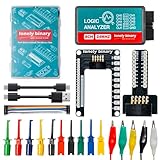
- 【High-Speed 8-Channel Analysis】Captures digital signals at up to 24MHz across 8 channels, enabling precise debugging of complex protocols like I2C, SPI, and UART—ideal for advanced STEM projects without the limitations of basic 4-channel models.
- 【User-Friendly Design】Base module and breakout board simplify connections to breadboards, microcontrollers, and other setups.
- 【Logic Level Expansion Board】Breaks out all 8 channels to 2.54mm male pins and pads for alligator clips, enabling flexible and secure connections in diverse projects.
- 【Logic Level Breadboard Adapter】 Easily connects the logic analyzer to breadboards, providing direct and convenient access to all 8 channels for prototyping and testing.
- 【Dual USB Connectivity】Comes with both USB-A and Type-C cables for universal compatibility with older PCs, modern laptops, and devices, ensuring hassle-free plug-and-play across Windows, Mac, Linux, and Ubuntu.
Review the generated layout diff alongside the code, including inherited contracts and any assumptions made by migration logic. A tool’s pass does not remove the need to understand why each reported change is safe.
Review initialization and migration behavior
Proxy-based contracts need implementation-aware initialization. In this context, initializer functions perform setup that constructors ordinarily perform for a directly deployed contract. Check that initialization runs in the intended context, cannot be improperly repeated, and sets every newly introduced variable and role required by the new implementation.
Rank #4

- Advanced communication technology: Equipped with a 2.4GHz antenna, it has a transmission power and reception sensitivity comparable to that of Class I Bluetooth devices, ensuring reliable communication and meeting various development requirements.
- Comprehensive development support: It offers standard Cortex debugging connectors (10-pin 50-mille JTAG) and in-system programming (ISP) serial connectors, supporting communication with Ubertooth and future project expansion, enhancing development flexibility.
- Hardware platform: Based on the powerful LPC175X ARM Cortex-M3 microcontroller, with full-speed USB 2.0 connection.
- Enhanced status monitoring: It can monitor Bluetooth traffic in real time in monitoring mode. The six LED indicator lights combined with the 2.4GHz antenna make the device status and activity clear at a glance, simplify the debugging process, and accelerate development and optimization.
- Open source design: As an open source device, users can access schematic diagrams and PCB design files, allowing for extensive customization and modification to meet different needs.
Trace the actual upgrade transaction and every migration call against representative pre-upgrade state. Confirm that existing balances, permissions, and protocol accounting remain valid after the calls, and that failure or partial execution cannot leave the proxy in an unsafe state. OpenZeppelin’s upgradeable-contract FAQ also cautions against using selfdestruct and delegatecall in upgradeable implementations.
Verify upgrade authority and deployment behavior
Check the deployed proxy’s actual upgrade mechanism and authority rather than relying on a description of governance. Establish which account, multisig, timelock, or other contract can authorize an implementation change, and compare that authority with current governance records. The relevant records and deployed contracts must match the network being assessed.
Do these 3 things before closing this tab:
1Repair Windows errors before they cause bigger problems2Scan for outdated or missing drivers - takes under a minute3Clear out junk files and repair common Windows errorsBest Value

- 1.【Lag-Free USB 2.0 High-Speed Capture】Supports USB 2.0 high-speed data transfer, delivers quick & accurate traffic capture for PC/Linux protocol analysis and device troubleshooting—cuts down debug time significantly.
- 2.【Precise USB Packet Decoding & Analysis】Efficiently grabs and decodes USB packets, providing critical insights to verify device performance and diagnose functional faults at a glance.
- 3.【Plug-and-Play Portable USB-Powered Tool】Compact & lightweight for fieldwork/remote debugging; no external power needed—ideal for on-site USB testing scenarios anytime, anywhere.
- 4.【Customizable Open-Source Analyzer】Fully open-source for flexible modification and project integration, perfect for developers seeking tailored USB analysis capabilities.
- 5.【Real-Time USB Device Power Monitoring】Tracks connected device power consumption dynamically, helps optimize power usage and boost long-term device stability.
Then test the intended upgrade path on a representative fork or equivalent environment using the target network’s deployment state. Include the exact implementation, authorization path, initialization data, and migration calls. This can expose network-specific assumptions that a source-only storage check does not address.
A practical review sequence
- Define scope: identify the Gate entity, network, proxy pattern, current implementation, proposed implementation, upgrade authority, and all migration or initialization calls.
- Obtain reproducible artifacts: confirm that source code or verified implementation artifacts correspond to the deployed addresses, and compile both versions with storage-layout information.
- Run upgrade validation: use the exact prior implementation as the reference for OpenZeppelin validation, then examine any incompatibility warnings or reported changes.
- Review code and layout: inspect variable types and order, inheritance changes, newly added state, initializer logic, and assumptions in migration code.
- Exercise the upgrade path: test the full transaction sequence against representative existing state and verify state, permissions, and expected behavior afterward.
- Confirm authorization: verify the upgrade controls against deployed contracts and current governance records for that network.
A protocol-specific compatibility conclusion should identify the deployments and artifacts examined, the validation reference used, and the migration path tested. For Gate, those primary materials are not established by the available title-matching article, so its reported findings cannot substitute for this review.
Quick Recap
Product prices and availability are accurate as of the date/time indicated and are subject to change. Any price and availability information displayed on Amazon at the time of purchase will apply.

