zero-release
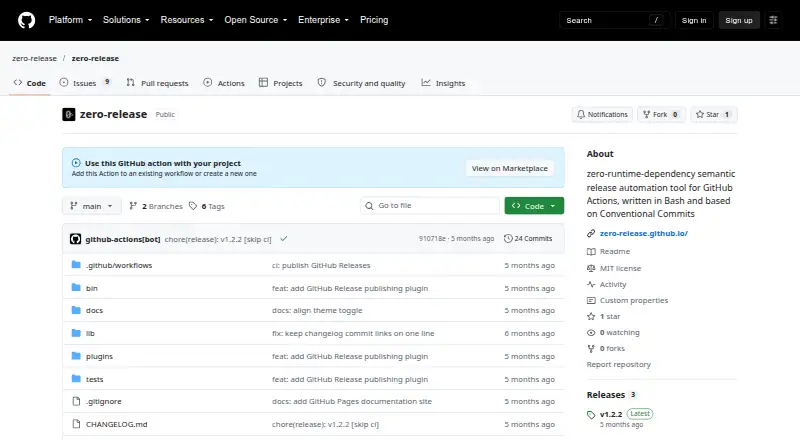
zero-release: A free Bash release tool that calculates SemVer from Conventional Commits and runs in GitHub Actions. Ranked #24 of 29 in Release Automation Tools by our editors (6.3/10); pricing: Free plan; best for gitHub Actions users wanting modular release steps.
At a glance
- Editor score6.3 / 10
- PricingFree plan
- Best forGitHub Actions users wanting modular release steps
- Free planYes
- Paid fromFree
- Semantic versioningYes
- Facts checked5 Oct 2026
Where it wins
- Calculates SemVer and creates Git tags from Conventional Commits
- Dry-run previews help check releases before publishing
- Optional plugins cover changelogs, publishing, and notifications
Where it doesn't
- Verified platform scope is Linux
- Publishing and notification steps require optional plugins
- Configuration uses flags, action inputs, and environment variables
Our verdict on zero-release
For repositories that use Conventional Commits, zero-release automates version decisions and release steps through a Bash CLI or composite GitHub Action. It analyzes commits to determine whether the next release is major, minor, patch, or no release, then calculates the SemVer version, creates Git tags, and generates release notes. Its free, open-source model and Linux platform scope make it a fit for solo developers and small or mid-market teams already working with GitHub Actions. It is less suited to teams that need a verified non-Linux platform or a release workflow centered on another source platform.
The core release process can be extended with optional plugins rather than requiring every repository to use the same steps. Plugins can update a changelog or package.json, publish to npm or GitHub Releases, and send notifications through Slack, Google Chat, or generic webhooks. This modularity is useful when a team wants to add only the parts its repository needs; those publishing and notification functions depend on their respective plugins. Dry-run previews, including default dry-run behavior on pull requests, provide a way to inspect a release before it proceeds.
The tool can run locally or as a GitHub Action, and its core requires no Node, jq, Python, or gh runtime dependencies. Configuration is supplied through CLI flags, action inputs, and environment variables instead of a releaserc file, so teams expecting that configuration-file approach may prefer another tool. Documentation and community support are the listed support channels. Choose zero-release if a Linux-based GitHub workflow needs a Bash-centered, modular path from Conventional Commits to tagged releases; look elsewhere if the workflow must run on another verified platform or requires all release steps built into the core.
Your product? Our editors can test zero-release in depth and publish a review, labelled as paid · from $149/mo →
zero-release pricing
zero-release fact sheet
| Free plan | Yes |
|---|---|
| Paid from | Free |
| Semantic versioning | Yes |
| Changelog generation | Yes |
| Release note automation | Yes |
| Release artifacts | Not verified |
| Source platforms | GitHub |
| Package registries | npm |
| Deployment | Self-hosted |
| Platforms | Linux |
| Support | Community, Docs |
| Built for | Solo, Small business, Mid-market (editorial estimate) |
| Integrations | 6 integrations: GitHub Actions, GitHub Releases, npm, Slack, Google Chat, webhooks |
| Pricing | Free plan |
| Website | github.com |
| Facts checked | 5 Oct 2026 |
zero-release integrations
zero-release lists 6 integrations on its own site.
- GitHub Actions
- GitHub Releases
- npm
- Slack
- Google Chat
- webhooks
Alternatives to zero-release
- semantic-releaseAn open-source CI release tool that turns commit history into versions, notes, and published releases.9.1
- LernaLerna combines monorepo task orchestration with npm package versioning and publishing.8.1
- release-itA flexible release CLI that handles Git workflows, release notes and npm publishing.7.9


See all zero-release alternatives →
Used zero-release? Be the first to review it
The editor score above is our own research. What this page doesn't have yet is a reader's view — what you used zero-release for, what worked and what didn't. No stars are seeded and no review is paid for; an editor reads every one before it appears.
Write a reviewTwo minutes · verified accounts only · read by an editor before it appears
Featured on iTechGuides

zero-release is listed in our Release Automation Tools directory. Add the badge to your site — it links back to this page.
<a href="https://www.itechguides.com/products/zero-release/"><img src="https://www.itechguides.com/best/badge/zero-release.svg" alt="Featured on iTechGuides" width="230" height="46"></a>
Reviewed by iTechGuides Editors · Editorial team · Updated Oct 2026
Advertiser disclosure: iTechGuides is reader-supported. Vendors can pay for top positions in our rankings and for a place on other products' pages, and we may earn a commission when you click some links. Bought places stand at the number bought; this page and our disclosure say so. Paying vendors may get a fuller, more detailed review from our editors, and that review can change their score. How we rank.
Last updated · How we research and update