sysbench
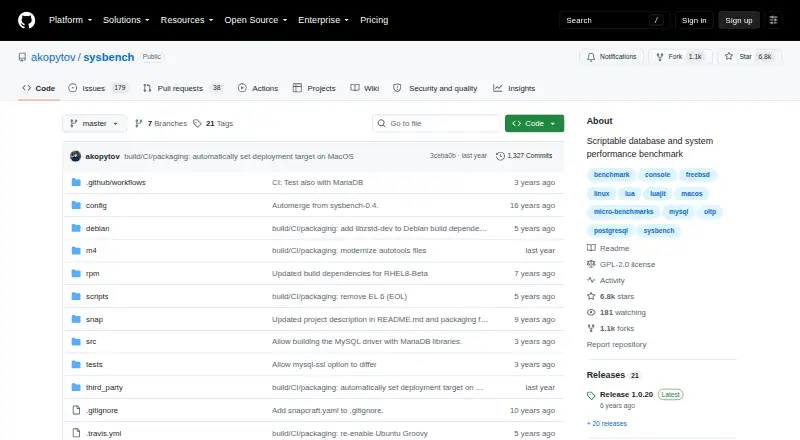
sysbench: A free, open-source CLI for bundled benchmarks and custom Lua workloads. Ranked #24 of 72 in PC Benchmark Software by our editors (6.9/10); pricing: Free plan; best for scriptable database and system tests.
At a glance
- Editor score6.9 / 10
- PricingFree plan
- Best forScriptable database and system tests
- Free planYes
- Paid fromFree
- Workload areasdatabase/OLTP, file I/O, CPU, memory, threads, mutex
- Facts checked24 Sep 2026
Where it wins
- Bundles OLTP-like database, file I/O, CPU, memory, thread, and mutex tests
- Supports custom workloads through user-provided Lua scripts
- Provides latency percentiles and histogram statistics
Where it doesn't
- Windows use requires Windows Subsystem for Linux
- Command-line workflows may not suit users seeking a graphical interface
- Documentation is the listed support channel
Our verdict on sysbench
sysbench is a free, open-source command-line benchmark tool for people who want to measure database and system workloads with repeatable scripts. Its bundled tests cover OLTP-like database activity, filesystem file I/O, CPU performance, memory access, thread scheduling, and POSIX mutexes. The project describes the tool as based on LuaJIT, and users can run bundled Lua scripts or provide their own. That breadth makes it relevant to developers, administrators, and performance-focused teams who are comfortable working in a terminal rather than looking for a graphical benchmarking suite.
The standout fit is scriptability across several workload areas in one tool. The documented workflow uses prepare, run, cleanup, and help commands, giving users a structured way to manage benchmark runs. Latency percentiles and histogram statistics add ways to inspect performance beyond a single result, while custom Lua workloads can adapt testing to specific needs. MySQL and PostgreSQL are listed integrations, which aligns with the database focus; sysbench is self-hosted and supports Linux and macOS. Windows users are directed to Windows Subsystem for Linux, as native Windows builds are no longer supported from sysbench 1.0.
This is a practical choice when a team wants a free, open-source CLI that combines database and lower-level system tests with automation-friendly custom profiles. Its fit spans solo users through enterprise teams, but that does not make it a universal choice: the command-line approach asks users to work with scripts and commands, and documentation is the listed support channel. Choose another option if you need a desktop interface or native Windows support. For teams comfortable with self-hosting and terminal-based workflows, sysbench offers a focused way to run and customize benchmarks across multiple workload types.
Your product? Our editors can test sysbench in depth and publish a review, labelled as paid · from $149/mo →
sysbench pricing
sysbench fact sheet
| Free plan | Yes |
|---|---|
| Paid from | Free |
| Workload areas | database/OLTP, file I/O, CPU, memory, threads, mutex |
| Operating systems | Linux, macOS, Windows via Windows Subsystem for Linux |
| Comparison database | Not verified |
| Result export formats | Not verified |
| Custom test profiles | Yes |
| CLI or automation | Yes |
| Deployment | Self-hosted |
| Platforms | Linux, macOS, Windows |
| Support | Docs |
| Built for | Solo, Small business, Mid-market, Enterprise (editorial estimate) |
| Integrations | 2 integrations: MySQL, PostgreSQL |
| Pricing | Free plan |
| Website | github.com |
| Facts checked | 24 Sep 2026 |
sysbench integrations
sysbench lists 2 integrations on its own site.
- MySQL
- PostgreSQL
Alternatives to sysbench
- GeekbenchA broad benchmark suite for comparing CPU and GPU performance across five platforms.9.3
- PassMark PerformanceTestA broad benchmark suite with free standard tests and a $39 one-time advanced tier.9.1
- 3DMarkA broad benchmark suite for comparing GPU, CPU, storage, and gaming performance.9.1


See all sysbench alternatives →
Used sysbench? Be the first to review it
The editor score above is our own research. What this page doesn't have yet is a reader's view — what you used sysbench for, what worked and what didn't. No stars are seeded and no review is paid for; an editor reads every one before it appears.
Write a reviewTwo minutes · verified accounts only · read by an editor before it appears
Featured on iTechGuides

sysbench is listed in our PC Benchmark Software directory. Add the badge to your site — it links back to this page.
<a href="https://www.itechguides.com/products/sysbench/"><img src="https://www.itechguides.com/best/badge/sysbench.svg" alt="Featured on iTechGuides" width="230" height="46"></a>
Reviewed by iTechGuides Editors · Editorial team · Updated Oct 2026
Advertiser disclosure: iTechGuides is reader-supported. Vendors can pay for top positions in our rankings and for a place on other products' pages, and we may earn a commission when you click some links. Bought places stand at the number bought; this page and our disclosure say so. Paying vendors may get a fuller, more detailed review from our editors, and that review can change their score. How we rank.
Last updated · How we research and update