
SPQR
SPQR: A focused self-hosted choice for PostgreSQL sharding and distributed transactions. Ranked #20 of 31 in Database Proxy Software by our editors (7.2/10); pricing: Open source; best for postgreSQL sharding and distributed transactions.
At a glance
- Editor score7.2 / 10
- PricingOpen source
- Best forPostgreSQL sharding and distributed transactions
- Paid fromFree
- Deployment modelSelf-hosted
- Facts checked20 Sep 2026
Where it wins
- Routes PostgreSQL queries using single-column or composite sharding keys
- Supports pooling, reference tables, and distributed transaction strategies
- Adds coordinator-based configuration, migration, balancing, and Prometheus metrics
Where it doesn't
- Self-hosted deployment requires PostgreSQL infrastructure management
- Designed for PostgreSQL rather than multiple database engines
- Its focus is sharding and routing, not a broad database platform
Our verdict on SPQR
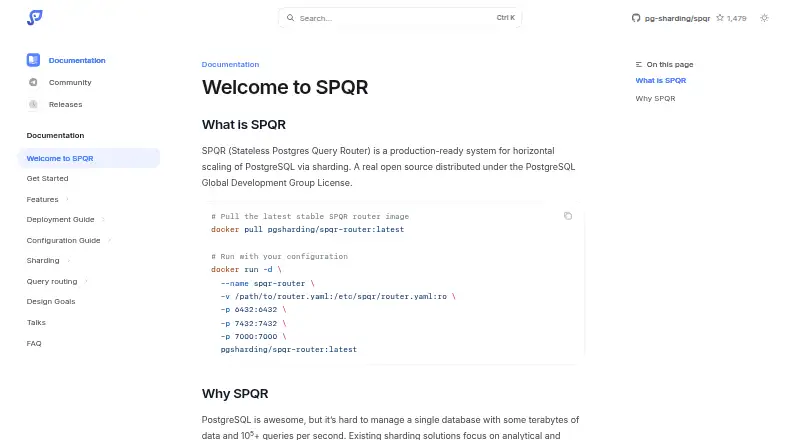
SPQR is self-hosted, open-source database proxy software for teams scaling PostgreSQL horizontally through sharding. It sits between applications and PostgreSQL shards, uses the PostgreSQL protocol, and routes queries according to configured sharding rules and key ranges. The product is aimed at developers comfortable with PostgreSQL who want to keep sharding logic out of application code, particularly when databases are well partitioned and workloads are dominated by single-shard OLTP operations.
Its strongest area is the depth of its PostgreSQL sharding workflow. SPQR supports single-column and composite sharding keys, reference tables replicated across shards, and connection pooling in session and transaction modes. Distributed transaction commit strategies include two-phase commit, while data migration and workload balancing support changes across shards. A coordinator provides dynamic configuration, and multiple router instances can share cluster metadata through etcd. Prometheus metrics export adds a path for monitoring the proxy within an existing observability setup.
SPQR fits teams that want an open-source PostgreSQL router with routing, pooling, coordination, migration, and distributed transaction capabilities in one focused system. The self-hosted model gives those teams control over deployment and operations, but it also makes infrastructure management part of the product decision. PostgreSQL is the supported database, with PostgreSQL and etcd forming the stated ecosystem fit. Choose SPQR when horizontal PostgreSQL scaling and shard-aware routing are central requirements. Consider another option if the priority is a multi-database proxy or a broader platform centered on capabilities beyond PostgreSQL sharding and distributed transactions.
Your product? Our editors can test SPQR in depth and publish a review, labelled as paid · from $149/mo →
SPQR pricing
SPQR fact sheet
| Free plan | Not verified |
|---|---|
| Paid from | Free |
| Deployment model | Self-hosted |
| Connection pooling | Yes |
| Query routing | Yes |
| Load balancing | Not verified |
| Automatic failover | Not verified |
| Supported databases | PostgreSQL |
| Maximum connections | Not verified |
| Deployment | Self-hosted |
| Support | Community, Docs |
| Built for | Small business, Mid-market, Enterprise (editorial estimate) |
| Integrations | 2 integrations: PostgreSQL, etcd |
| Pricing | Open source |
| Website | docs.pg-sharding.tech |
| Facts checked | 20 Sep 2026 |
SPQR integrations
SPQR lists 2 integrations on its own site.
- PostgreSQL
- etcd
Alternatives to SPQR
- Heimdall Database ProxyA broad database proxy with pooling, routing, analytics, security, and failover.9.4
- ProxySQLA free, open-source proxy for routing, pooling, balancing, and managing database traffic.9.2
- ShardingSphere-ProxyA self-hosted proxy for routing, scaling, and high availability across four database protocols.9.0



Used SPQR? Be the first to review it
The editor score above is our own research. What this page doesn't have yet is a reader's view — what you used SPQR for, what worked and what didn't. No stars are seeded and no review is paid for; an editor reads every one before it appears.
Write a reviewTwo minutes · verified accounts only · read by an editor before it appears
Featured on iTechGuides

SPQR is listed in our Database Proxy Software directory. Add the badge to your site — it links back to this page.
<a href="https://www.itechguides.com/products/spqr/"><img src="https://www.itechguides.com/best/badge/spqr.svg" alt="Featured on iTechGuides" width="230" height="46"></a>
Reviewed by iTechGuides Editors · Editorial team · Updated Oct 2026
Advertiser disclosure: iTechGuides is reader-supported. Vendors can pay for top positions in our rankings and for a place on other products' pages, and we may earn a commission when you click some links. Bought places stand at the number bought; this page and our disclosure say so. Paying vendors may get a fuller, more detailed review from our editors, and that review can change their score. How we rank.
Last updated · How we research and update