
SpecShield
SpecShield: A governed contract testing platform for OpenAPI teams working across multiple CI systems. Ranked #8 of 22 in Contract Testing Tools by our editors (8.5/10); pricing: Free plan; best for governed OpenAPI teams using many CI systems.
At a glance
- Editor score8.5 / 10
- PricingFree plan
- Best forGoverned OpenAPI teams using many CI systems
- Free planYes
- Paid from$900/yr
- Contract registryYes
- Facts checked20 Sep 2026
Where it wins
- OpenAPI comparison and breaking-change detection in CI
- Consumer-provider verification with a can-I-deploy release gate
- Integrations across GitHub, GitLab, Jenkins, Slack, and more
Where it doesn't
- The free plan includes only 1 GitHub App PR check
- Team features require $89 monthly or $900 annual billing
- Enterprise pricing is custom
Our verdict on SpecShield
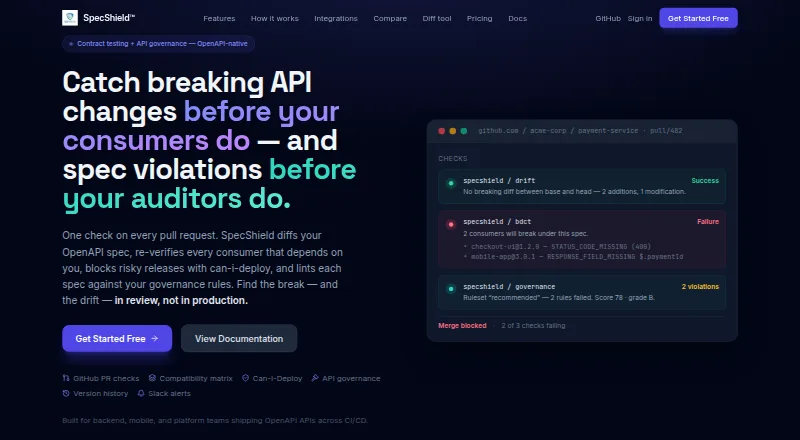
SpecShield is an OpenAPI-native API contract testing platform for backend, mobile, and platform teams. It compares API specifications, detects breaking changes, verifies compatibility between consumers and providers, and adds can-I-deploy gates to release pipelines. The product also supports GraphQL, with workflows centered on OpenAPI specifications in JSON or YAML format. Its web, API, and self-hosted options suit teams managing API contracts across development and delivery environments.
Pricing is structured around a free plan and paid Team and Enterprise tiers. SpecShield Free includes unlimited specification comparisons, breaking-change detection in CI, one GitHub App pull-request check, and community support. SpecShield Team adds a consumer registry, can-I-deploy gates, bi-directional contract testing, Slack alerts, and RBAC; it costs $89 per month when billed monthly or $900 per year when billed annually. Enterprise adds SSO, on-premise or private-cloud deployment, advanced RBAC, audit-log export, dedicated onboarding, and an SLA, with custom pricing. Prices exclude VAT/GST.
The strongest fit is for organizations that need governance around API changes rather than only point-in-time schema comparison. Version and contract verification history, linting rules, audit logs with CSV export, registry workflows, and checks for GitHub Actions, GitLab, Bitbucket, Jenkins, Drone, and CircleCI support a multi-pipeline operating model. IntelliJ IDEA, WebStorm, PyCharm, Slack, and MCP clients extend the surrounding workflow. Teams seeking consumer-provider verification, release gates, and governance should consider SpecShield. Teams that only need basic comparisons or breaking-change checks may not need its broader registry and governance scope.
Questions about SpecShield
Does SpecShield have a free plan? Yes: the SpecShield Free plan is free; paid plans start at $89/mo (SpecShield Team).
What does SpecShield run on? Web. It runs in the cloud and self-hosted.
What does SpecShield integrate with? 12 integrations, including GitHub, GitHub Actions, GitLab, Bitbucket and Jenkins.
Who is SpecShield built for? Solo users, small businesses, mid-market companies and enterprises (our editorial estimate).
Your product? Our editors can test SpecShield in depth and publish a review, labelled as paid · from $149/mo →
SpecShield pricing
All 3 SpecShield plans and prices →
SpecShield fact sheet
| Free plan | Yes |
|---|---|
| Paid from | $900/yr |
| Contract formats | OpenAPI (JSON/YAML), GraphQL |
| Consumer verification | Yes |
| Provider verification | Yes |
| Contract registry | Yes |
| AsyncAPI support | Not verified |
| GraphQL support | Yes |
| Self-hosted deployment | Yes |
| Deployment | Cloud, Self-hosted |
| Platforms | Web |
| Compliance & security | SSO/SAML |
| Support | Email, Community, Docs |
| Built for | Solo, Small business, Mid-market, Enterprise (editorial estimate) |
| Integrations | 12 integrations: GitHub, GitHub Actions, GitLab, Bitbucket, Jenkins, Drone … |
| Pricing | Free plan (source) |
| Website | specshield.io |
| Facts checked | 20 Sep 2026 |
SpecShield integrations
SpecShield lists 12 integrations on its own site.
- GitHub
- GitHub Actions
- GitLab
- Bitbucket
- Jenkins
- Drone
- CircleCI
- Slack
- IntelliJ IDEA
- WebStorm
- PyCharm
- MCP clients
Alternatives to SpecShield
- PactA broad open-source toolkit for consumer-driven contracts across HTTP and message integrations.9.4
- MicrocksA broad contract-testing choice for APIs, microservices, and event-driven systems.9.2
- PactFlowPactFlow brings Pact, OpenAPI testing, contract management, and deployment checks together.9.0



See all SpecShield alternatives →
SpecShield vs the competition
- SpecShield vs Pact
- SpecShield vs Microcks
- SpecShield vs PactFlow
- SpecShield vs ContractCase
- SpecShield vs Entente
- SpecShield vs Specmatic



Compare SpecShield with any tool side by side →
Used SpecShield? Be the first to review it
The editor score above is our own research. What this page doesn't have yet is a reader's view — what you used SpecShield for, what worked and what didn't. No stars are seeded and no review is paid for; an editor reads every one before it appears.
Write a reviewTwo minutes · verified accounts only · read by an editor before it appears
Featured on iTechGuides

SpecShield is listed in our Contract Testing Tools directory. Add the badge to your site — it links back to this page.
<a href="https://www.itechguides.com/products/specshield/"><img src="https://www.itechguides.com/best/badge/specshield.svg" alt="Featured on iTechGuides" width="230" height="46"></a>
Reviewed by iTechGuides Editors · Editorial team · Updated Nov 2026
Advertiser disclosure: iTechGuides is reader-supported. Vendors can pay for top positions in our rankings and for a place on other products' pages, and we may earn a commission when you click some links. Bought places stand at the number bought; this page and our disclosure say so. Paying vendors may get a fuller, more detailed review from our editors, and that review can change their score. How we rank.
Last updated · How we research and update