
Ray Serve
Ray Serve: A flexible choice for teams building composable, self-hosted model-serving systems. Ranked #6 of 25 in AI Model Hosting by our editors (8.8/10); pricing: Open source; best for teams building composable self-hosted serving systems.
At a glance
- Editor score8.8 / 10
- PricingOpen source
- Best forTeams building composable self-hosted serving systems
- Paid fromFree
- Deployment modeDedicated
- Facts checked22 Sep 2026
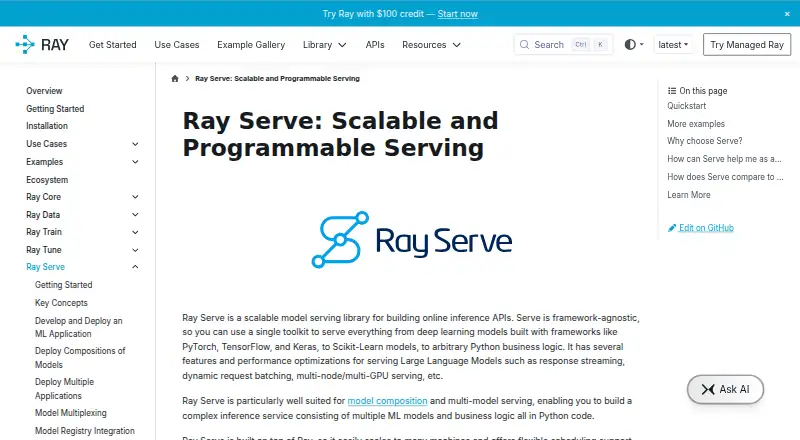
Where it wins
- Horizontal and traffic-based autoscaling with configurable replicas
- GPU, multi-node serving and dynamic request batching
- OpenAI-compatible APIs plus Kubernetes deployment through KubeRay
Where it doesn't
- Requires teams to operate their own Ray-based serving environment
- Not a vendor-hosted inference service with managed operations
- Composable deployment graphs may add architecture and maintenance work
Our verdict on Ray Serve
Ray Serve is an open-source Python framework for deploying machine-learning models and AI applications on Ray clusters. It is designed for teams that need dedicated, private model serving across local environments, virtual machines, or Kubernetes. HTTP and Python APIs expose deployments, while configurable replicas, resource scheduling, and deployment graphs support applications that combine multiple models or services. The framework covers PyTorch, TensorFlow, scikit-learn, ONNX, and TensorRT model formats.
Its strongest fit is composable infrastructure rather than a narrow, single-model endpoint. Replica-based horizontal scaling, traffic-based autoscaling, dynamic request batching, and GPU and multi-node serving give platform teams control over how inference workloads consume resources. Ray Serve LLM adds OpenAI-compatible APIs, parallelism strategies, and integrations with vLLM and SGLang. The broader ecosystem includes FastAPI, Triton Server, MLflow, Gradio, and common machine-learning frameworks, while KubeRay provides a Kubernetes deployment path. Metrics, monitoring, and Grafana dashboards support operational visibility.
The trade-off is ownership. Ray Serve is an open-source framework, so teams must run and maintain the serving environment instead of adopting a vendor-hosted inference service. That model suits organizations with platform engineering capacity, private-deployment requirements, or a need to compose several inference components. Teams seeking a managed endpoint, a simpler onboarding path, or operations handled by a hosting provider should choose a more service-oriented alternative. For teams comfortable with Ray, Kubernetes, GPU scheduling, and deployment design, Ray Serve offers broad control without a paid-tier structure shaping the architecture.
Your product? Our editors can test Ray Serve in depth and publish a review, labelled as paid · from $149/mo →
Ray Serve pricing
Ray Serve fact sheet
| Free plan | Not verified |
|---|---|
| Paid from | Free |
| Deployment mode | Dedicated |
| Autoscaling | Yes |
| GPU accelerators | Yes |
| Private deployment | Yes |
| Supported model formats | PyTorch, TensorFlow, scikit-learn, ONNX, TensorRT |
| Batch inference | Yes |
| Deployment regions | Not verified |
| Deployment | Self-hosted, Cloud |
| Support | Community, Docs |
| Built for | Small business, Mid-market, Enterprise (editorial estimate) |
| Integrations | 11 integrations: FastAPI, vLLM, SGLang, Kubernetes, KubeRay, Triton Server … |
| Pricing | Open source |
| Website | docs.ray.io |
| Facts checked | 22 Sep 2026 |
Ray Serve integrations
Ray Serve lists 11 integrations on its own site.
- FastAPI
- vLLM
- SGLang
- Kubernetes
- KubeRay
- Triton Server
- MLflow
- Gradio
- PyTorch
- TensorFlow
- scikit-learn
Alternatives to Ray Serve
- BasetenManaged model APIs with GPU deployments, autoscaling, training, and observability.9.4
- BentoMLBentoML gives open-source teams flexible paths from local serving to managed inference.9.2
- KServeOpen-source model serving for teams operating extensible inference on Kubernetes.9.1



See all Ray Serve alternatives →
Ray Serve vs the competition
- Ray Serve vs Baseten
- Ray Serve vs BentoML
- Ray Serve vs KServe
- Ray Serve vs Fireworks AI
- Ray Serve vs Hugging Face Inference Endpoints
- Ray Serve vs NVIDIA Triton Inference Server



Compare Ray Serve with any tool side by side →
Used Ray Serve? Be the first to review it
The editor score above is our own research. What this page doesn't have yet is a reader's view — what you used Ray Serve for, what worked and what didn't. No stars are seeded and no review is paid for; an editor reads every one before it appears.
Write a reviewTwo minutes · verified accounts only · read by an editor before it appears
Featured on iTechGuides

Ray Serve is listed in our AI Model Hosting directory. Add the badge to your site — it links back to this page.
<a href="https://www.itechguides.com/products/ray-serve/"><img src="https://www.itechguides.com/best/badge/ray-serve.svg" alt="Featured on iTechGuides" width="230" height="46"></a>
Reviewed by iTechGuides Editors · Editorial team · Updated Oct 2026
Advertiser disclosure: iTechGuides is reader-supported. Vendors can pay for top positions in our rankings and for a place on other products' pages, and we may earn a commission when you click some links. Bought places stand at the number bought; this page and our disclosure say so. Paying vendors may get a fuller, more detailed review from our editors, and that review can change their score. How we rank.
Last updated · How we research and update