QuickTheories
QuickTheories: A focused Java library for generating, shrinking, and reproducing property-test failures. Ranked #16 of 27 in Property-Based Testing Tools by our editors (7.8/10); pricing: Free plan; best for java teams using JUnit or TestNG.
At a glance
- Editor score7.8 / 10
- PricingFree plan
- Best forJava teams using JUnit or TestNG
- Free planYes
- Paid fromFree
- Supported languagesJava
- Facts checked20 Sep 2026
Where it wins
- Automatic shrinking turns failing inputs into smaller reproducible cases.
- Fixed seeds support deterministic reproduction of generated failures.
- Coverage-guided search targets inputs beyond uniform random generation.
Where it doesn't
- Supports Java rather than multiple programming languages.
- Stateful testing is outside its stated capability set.
- Requires Java test-suite integration for JUnit, TestNG, or another framework.
Our verdict on QuickTheories
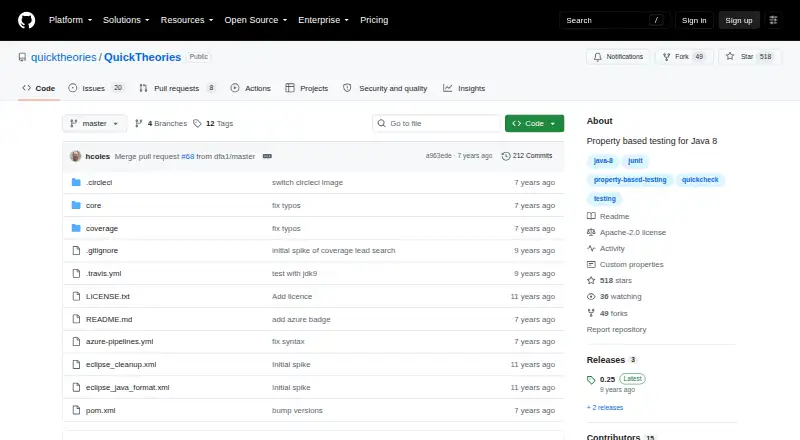
QuickTheories is an open-source property-based testing library for Java 8. It is designed for developers who want to test general properties across generated inputs rather than maintain only hand-written examples. The library can run with JUnit, TestNG, and other test frameworks, so it fits teams adding property-based checks to existing Java test suites. Its fluent DSL includes generators for common Java types, custom generators for Java types, assumptions for constraining inputs, and configurable generated-example counts.
Its strongest area is the failure workflow. QuickTheories automatically shrinks failing values, helping reduce a complicated generated case to a smaller example that is easier to inspect. Fixed-seed deterministic reproduction lets developers rerun the same generated sequence, while reported seeds provide a concrete path back to a failure. Coverage-guided targeted search adds a way to direct generation toward broader execution coverage instead of relying only on unconstrained random input. Reusable named test profiles can also standardize generation settings across a codebase.
QuickTheories is a focused choice for Java teams that want property-based generation without adopting a separate test runner. Its open-source model suits teams looking for a library rather than a paid testing platform, and its JUnit and TestNG support covers two established Java testing workflows. The trade-off is scope: the published capability set centers on generated inputs, shrinking, reproduction, assumptions, search, and profiles, with Java as the supported language. Teams seeking multi-language property testing or stateful testing should choose a tool aligned with those requirements instead. For Java developers extending conventional unit suites with repeatable property checks, QuickTheories is the more direct fit.
Your product? Our editors can test QuickTheories in depth and publish a review, labelled as paid · from $149/mo →
QuickTheories pricing
QuickTheories fact sheet
| Free plan | Yes |
|---|---|
| Paid from | Free |
| Supported languages | Java |
| Test runner support | JUnit, TestNG, and other test frameworks |
| Failing-case shrinking | Yes |
| Stateful testing | Not verified |
| Reproducible failures | Yes |
| Cases per run | Not verified |
| Support | Community, Docs |
| Built for | Solo, Small business, Mid-market, Enterprise (editorial estimate) |
| Integrations | 2 integrations: JUnit, TestNG |
| Pricing | Free plan |
| Website | github.com |
| Facts checked | 20 Sep 2026 |
QuickTheories integrations
QuickTheories lists 2 integrations on its own site.
- JUnit
- TestNG
Alternatives to QuickTheories
- fast-checkA deep, runner-agnostic testing library for JavaScript and TypeScript teams.9.4
- HypothesisA focused Python library for generated inputs, shrinking, and stateful tests.9.3
- ProptestA focused Rust framework for generated inputs, shrinking, replay, and stateful tests.9.1



See all QuickTheories alternatives →
Used QuickTheories? Be the first to review it
The editor score above is our own research. What this page doesn't have yet is a reader's view — what you used QuickTheories for, what worked and what didn't. No stars are seeded and no review is paid for; an editor reads every one before it appears.
Write a reviewTwo minutes · verified accounts only · read by an editor before it appears
Featured on iTechGuides

QuickTheories is listed in our Property-Based Testing Tools directory. Add the badge to your site — it links back to this page.
<a href="https://www.itechguides.com/products/quicktheories/"><img src="https://www.itechguides.com/best/badge/quicktheories.svg" alt="Featured on iTechGuides" width="230" height="46"></a>
Reviewed by iTechGuides Editors · Editorial team · Updated Oct 2026
Advertiser disclosure: iTechGuides is reader-supported. Vendors can pay for top positions in our rankings and for a place on other products' pages, and we may earn a commission when you click some links. Bought places stand at the number bought; this page and our disclosure say so. Paying vendors may get a fuller, more detailed review from our editors, and that review can change their score. How we rank.
Last updated · How we research and update