PySAD
PySAD: A focused, self-hosted Python library for real-time sequential anomaly detection. Ranked #18 of 21 in Anomaly Detection Software by our editors (6.7/10); pricing: Free plan; best for streaming anomaly detection researchers.
At a glance
- Editor score6.7 / 10
- PricingFree plan
- Best forStreaming anomaly detection researchers
- Free planYes
- Paid fromFree
- Real-time detectionYes
- Facts checked22 Sep 2026
Where it wins
- Supports online detection for univariate and multivariate streams
- Covers supervised, semi-supervised, and unsupervised workflows
- Includes calibration, decomposition, simulators, and evaluation metrics
Where it doesn't
- Self-hosted deployment requires a Python development environment
- Platform coverage is narrower than an end-to-end anomaly platform
- Verified integration coverage centers on PyOD
Our verdict on PySAD
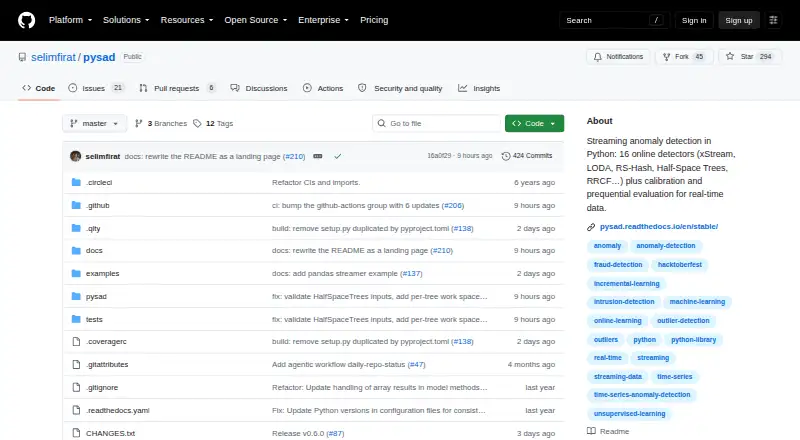
PySAD is an open-source Python framework for detecting anomalies in streaming data, including both univariate and multivariate streams. Its online and sequential models update as new instances arrive, making it suited to researchers and developers working on real-time detection workflows. The framework supports supervised, semi-supervised, and unsupervised approaches, so it can accommodate different levels of labeled data. It is distributed as a Python package and can be installed with pip or from source.
The strongest part of PySAD is its supporting toolkit around streaming detection. Stream simulators and array or dataframe streamers help represent incoming data, while preprocessors and streaming seasonal or trend decomposition address data preparation. Postprocessors and probability calibrators can refine anomaly scores, and evaluation metrics include precision, recall, AUROC, and AUPR. PySAD also provides streaming integrations for PyOD batch anomaly detectors, connecting batch-oriented models to streaming use cases. These capabilities make it more than a collection of detection models, while keeping the focus on sequential analysis rather than broader platform operations.
PySAD fits teams that want an open-source, self-hosted library they can incorporate into Python-based research or engineering workflows. Its hybrid detection approach and support for multiple learning modes give practitioners room to compare methods and evaluate results. The trade-off is a narrower ecosystem: PyOD is the listed integration, and the product does not provide broader platform coverage. Organizations seeking a complete anomaly-monitoring platform should consider a different category of tool, while researchers and developers who value control over streaming models, preprocessing, calibration, and evaluation should find PySAD a focused option.
Your product? Our editors can test PySAD in depth and publish a review, labelled as paid · from $149/mo →
PySAD pricing
PySAD fact sheet
| Free plan | Yes |
|---|---|
| Paid from | Free |
| Detection method | Hybrid |
| Real-time detection | Yes |
| Supported data | univariate data; multivariate data; streaming data |
| Deployment options | Self-hosted |
| Anomaly explanations | Not verified |
| Data retention | Not verified |
| Deployment | Self-hosted |
| Support | Community, Docs |
| Integrations | 1 integrations: PyOD |
| Pricing | Free plan |
| Website | github.com |
| Facts checked | 22 Sep 2026 |
PySAD integrations
PySAD lists 1 integrations on its own site.
- PyOD
Alternatives to PySAD
- Progress FlowmonA network-focused platform for traffic visibility, anomaly detection and capacity planning.9.0
- ManageEngine NetFlow AnalyzerAffordable on-premises flow monitoring with alerts, reporting, and security analytics.8.6
- AnodotBroad real-time anomaly detection with forecasting, correlation, and root-cause analysis.8.4



Used PySAD? Be the first to review it
The editor score above is our own research. What this page doesn't have yet is a reader's view — what you used PySAD for, what worked and what didn't. No stars are seeded and no review is paid for; an editor reads every one before it appears.
Write a reviewTwo minutes · verified accounts only · read by an editor before it appears
Featured on iTechGuides

PySAD is listed in our Anomaly Detection Software directory. Add the badge to your site — it links back to this page.
<a href="https://www.itechguides.com/products/pysad/"><img src="https://www.itechguides.com/best/badge/pysad.svg" alt="Featured on iTechGuides" width="230" height="46"></a>
Reviewed by iTechGuides Editors · Editorial team · Updated Oct 2026
Advertiser disclosure: iTechGuides is reader-supported. Vendors can pay for top positions in our rankings and for a place on other products' pages, and we may earn a commission when you click some links. Bought places stand at the number bought; this page and our disclosure say so. Paying vendors may get a fuller, more detailed review from our editors, and that review can change their score. How we rank.
Last updated · How we research and update