
pyinfra
pyinfra: A flexible open-source choice for Python teams managing infrastructure without agents. Ranked #14 of 26 in Configuration Management Tools by our editors (7.7/10); pricing: Open source; best for python teams preferring agentless deployment workflows.
At a glance
- Editor score7.7 / 10
- PricingOpen source
- Best forPython teams preferring agentless deployment workflows
- Paid fromFree
- Deployment modelBoth
- Facts checked22 Sep 2026
Where it wins
- Python deploy files combine familiar syntax with declarative operations
- Dry runs, diffs, and idempotent re-runs support controlled changes
- SSH, Docker, Terraform, and Vagrant connectors widen deployment options
Where it doesn't
- Python-based workflows may not suit teams seeking a non-code interface
- Self-hosted operation leaves infrastructure for execution and maintenance with you
- Policy-as-code and compliance reporting are not part of its stated capabilities
Our verdict on pyinfra
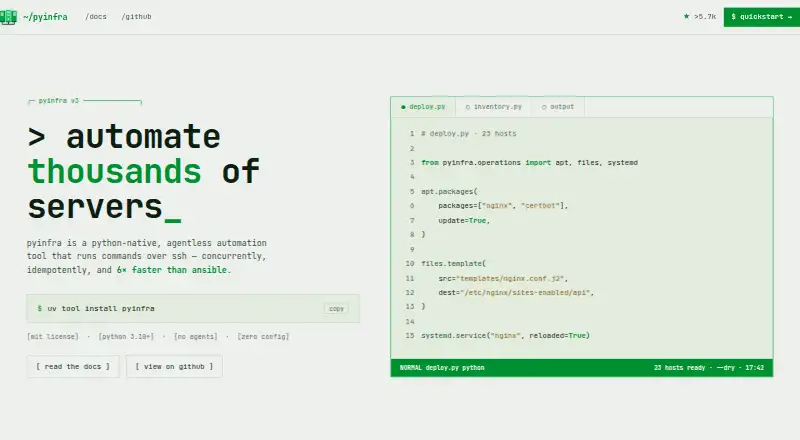
pyinfra is an open-source, Python-native configuration management and infrastructure automation tool for engineers managing servers, packages, files, services, and other system resources. It runs agentlessly over SSH and can also target local machines and supported container environments. Python deploy files, inventories, groups, host data, and facts let teams describe desired state while reading target-system conditions before applying changes. Its best fit is a Python-oriented infrastructure team that wants direct control without installing a persistent agent or operating a central control plane.
The deployment workflow is its main strength. Declarative operations calculate differences and apply only required changes, while dry-run previews and diffing provide visibility before execution. Concurrent execution supports work across multiple hosts, and package, repository, and upgrade operations cover common configuration and maintenance tasks. The Python API also supports programmatic execution. Connectors for SSH, Docker, Terraform, and Vagrant make it suitable for mixed local, virtualized, and container-based workflows, although teams preferring a visual interface or a configuration language outside Python may find the model less approachable.
pyinfra favors a focused automation workflow rather than a broad governance suite. Its self-hosted, agentless design can suit teams that want to manage Linux, macOS, Windows, and remote Unix-like systems while keeping execution close to their existing infrastructure. It is less suitable for organizations that require built-in policy-as-code controls or compliance reporting as part of configuration management. Choose pyinfra for Python-driven deployments with previews, state-aware operations, and multiple connectors; consider an alternative when centralized control or formal compliance workflows are central requirements.
Your product? Our editors can test pyinfra in depth and publish a review, labelled as paid · from $99/mo →
pyinfra pricing
pyinfra fact sheet
| Free plan | Not verified |
|---|---|
| Paid from | Free |
| Deployment model | Both |
| Agent model | Agentless |
| Drift detection | Yes |
| Patch management | Yes |
| Policy as code | Yes |
| Compliance reporting | Not verified |
| Supported platforms | Linux, macOS, Windows, Ubuntu, Debian, Fedora, Alpine, OpenBSD, FreeBSD, NetBSD, HardenedBSD, DragonFlyBSD, OpenSUSE, Docker |
| Deployment | Self-hosted |
| Platforms | Windows, macOS, Linux |
| Support | Docs, Community |
| Built for | Solo, Small business, Mid-market, Enterprise (editorial estimate) |
| Integrations | 5 integrations: SSH, Docker, Terraform, Vagrant, Podman |
| Pricing | Open source |
| Website | pyinfra.com |
| Facts checked | 22 Sep 2026 |
pyinfra integrations
pyinfra lists 5 integrations on its own site.
- SSH
- Docker
- Terraform
- Vagrant
- Podman
Alternatives to pyinfra
- PuppetA mature hybrid automation platform with strong drift, patching, and compliance controls.9.3
- AWS Systems Manager State ManagerA free AWS service for scheduled configuration, drift management, patching, and compliance reporting.9.1
- Google Cloud VM ManagerA focused Google Cloud tool for patching, policy enforcement, and VM compliance.9.0



See all pyinfra alternatives →
Used pyinfra? Be the first to review it
The editor score above is our own research. What this page doesn't have yet is a reader's view — what you used pyinfra for, what worked and what didn't. No stars are seeded and no review is paid for; an editor reads every one before it appears.
Write a reviewTwo minutes · verified accounts only · read by an editor before it appears
Featured on iTechGuides

pyinfra is listed in our Configuration Management Tools directory. Add the badge to your site — it links back to this page.
<a href="https://www.itechguides.com/products/pyinfra/"><img src="https://www.itechguides.com/best/badge/pyinfra.svg" alt="Featured on iTechGuides" width="230" height="46"></a>
Guides on configuration management tools
- Best Software Configuration Management Tools: GitHub, GitLab, Azure DevOps, Perforce, and MoreAug 2026
- 13 Best Free and Open Source Linux Configuration Management SoftwareAug 2026
- Configuration Management Tools Compared: Ansible, Puppet, Chef, and SaltOct 2026
Reviewed by iTechGuides Editors · Editorial team · Updated Oct 2026
Advertiser disclosure: iTechGuides is reader-supported. Vendors can pay for top positions in our rankings and for a place on other products' pages, and we may earn a commission when you click some links. Bought places stand at the number bought; this page and our disclosure say so. Paying vendors may get a fuller, more detailed review from our editors, and that review can change their score. How we rank.
Last updated · How we research and update